TRANSMISSION // 2609.20406v2
How much quantum measurement noise matters for NMR spectra
Source published
Simulations suggest measurement shot counts rise slowly with system size, but idealized assumptions mean quantum advantage remains unproven.
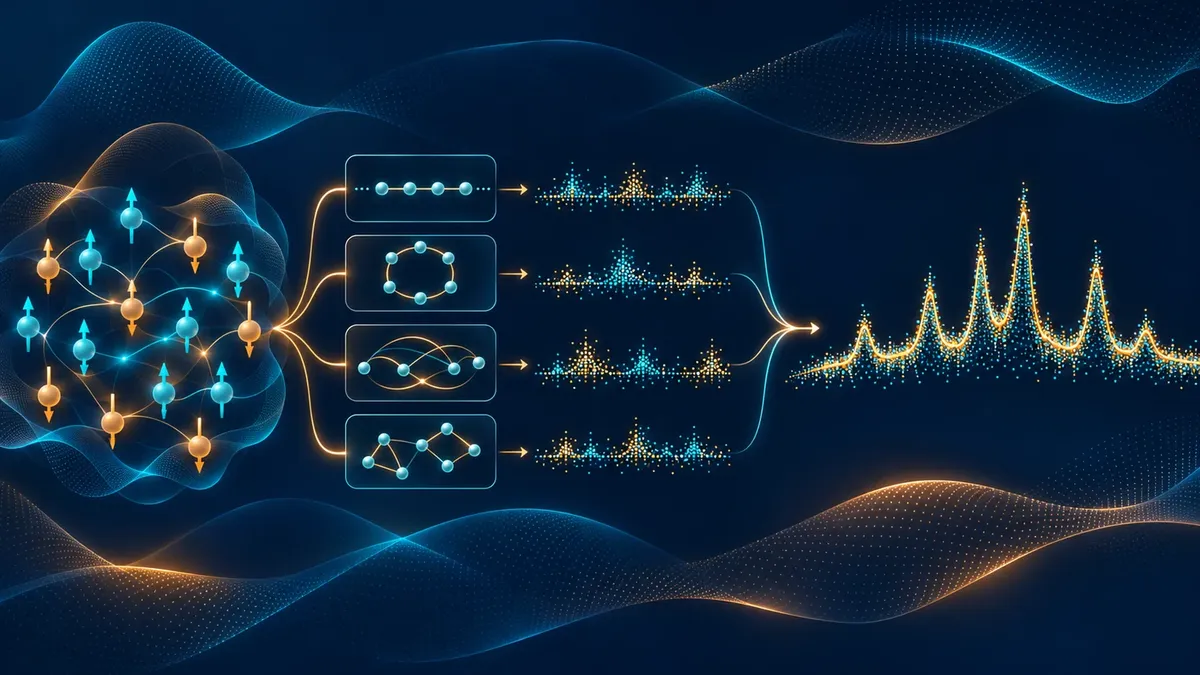
Quantum computers estimate results through repeated measurements, and those measurements are noisy. A study asks whether this shot noise alone could make quantum simulations of nuclear magnetic resonance spectra impractical as modeled systems grow.
A quantum computer can represent a many-spin system without writing out its full quantum state in memory. But it cannot simply reveal that state as a finished answer. To estimate a quantity such as magnetization, the computer must repeat a measurement many times. Each repetition, or “shot,” gives a probabilistic result, so estimates fluctuate. This statistical variation is called shot noise.
How quickly might the number of measurements grow as a simulated molecule gets larger? Sebastian Walch and colleagues explore that question using nuclear magnetic resonance (NMR) spectra as a test case. Their study finds that the required shot resources grew much more slowly than the exponentially expanding state space in the models they examined. The result addresses one possible obstacle to quantum simulation; it does not demonstrate that a quantum computer can outperform a classical one on this task.
From spin dynamics to a spectrum
In NMR, atomic nuclei behave like tiny spins. Their response to radio-frequency pulses in a magnetic field produces a signal that changes over time. Applying a Fourier transform to that signal yields a spectrum, whose peaks reflect properties of the spins and their interactions. The authors model nuclei as spin-½ particles, which can be mapped onto qubits.
The researchers simulated estimating magnetization at multiple times from repeated quantum measurements, then transforming those estimates into a spectrum. To assess the result, they compared each noisy spectrum with an exact reference using cosine similarity—a measure of how closely two spectral shapes align. They treated the deviation from a perfect match as “infidelity.” This evaluates overall spectral shape, not whether every individual peak is resolved to a specified precision.
The analysis deliberately isolates shot noise. It assumes that quantum time evolution is implemented perfectly, leaving out gate errors, decoherence and approximation errors from methods such as Trotterization. The authors describe the resulting shot counts as a lower bound on the resources a real computation would need.
Models, molecules and results
For large-scale analysis, the team used a simplified model in which spin interactions take the form of Ising couplings. Because this model allows exact calculations, it let them compare noisy estimates with reference spectra for systems of up to 50 spins. They examined one-dimensional chains, two-dimensional lattices and a case in which every spin interacts with every other spin. In the chain and lattice, coupling strength decreased with distance; in the all-to-all case, it did not.
In all three settings, larger systems required more shots to reach a given spectral accuracy. But the relationship was not exponential over the sizes studied. The increase flattened most clearly for the one- and two-dimensional geometries. It was stronger in the all-to-all model, where each spin interacts with all the others. Changing the spectral broadening parameter across the two values tested did not change this qualitative pattern.
The researchers also checked whether the pattern carried over to the more general Heisenberg interaction used to describe real NMR molecules. Exact calculations limited this part to small systems: up to 12 spins for the sampled one-dimensional models. They additionally examined four example molecules. In these checks, the authors report no steep rise in infidelity with system size. However, they explicitly describe the results as small-system checks, not a scaling analysis that establishes behavior for large Heisenberg systems.
What the result does—and does not—show
One reason shot requirements may rise slowly is that the study scores similarity of whole spectra. In the one- and two-dimensional models, distant interactions weaken, so added spins may introduce spectral features close to existing peaks. Those changes can have a limited effect on the overall similarity measure. The authors offer this as an explanation for the flattening, rather than as a universal rule about every way of using an NMR spectrum.
The scope matters. The main large-system results rely on a simplified Ising model, a low-field setting, chosen interaction geometries and an idealized, shot-noise-only quantum computer. The Heisenberg and molecule examples provide supporting checks at smaller scales, but do not settle how measurement costs behave for larger realistic systems. Nor does counting shots alone capture all the time, hardware and classical computation needed for a practical simulation or comparison with the best classical methods.
The paper therefore makes a focused claim: under its assumptions and accuracy measure, shot noise does not appear to require exponentially growing measurement resources in the systems studied. That is encouraging for researchers investigating quantum simulation of NMR, but it is not evidence that quantum advantage has been achieved—or that shot noise will be harmless in other many-body problems. The article is available as an arXiv preprint; the supplied source does not establish its peer-review status.
- quantum computing
- shot noise
- NMR spectroscopy
- quantum simulation
- many-body systems
- measurement resources
Related reading
Automatically matched by shared topic keywords. These links do not imply that the sources agree or establish a consensus.
When Do Eighth-Order Quantum Simulation Formulas Help?
Source published
Shared keywords: quantum computing, quantum simulation
A better way to split quantum time evolution
Source published
Shared keywords: quantum computing, quantum simulation
A world model reads quantum dynamics to infer hidden interactions
Source published
Shared keywords: quantum simulation
Uneven ion spacing changes how a quantum of vibration travels
Source published
Shared keywords: quantum simulation
How many electric-field levels does a quantum simulation need?
Source published
Shared keywords: quantum computing, quantum simulation