TRANSMISSION // 2609.20137v2
A thin coating boosts signals from diamond defects in near-UHV
Source published
In measurements of 17 shallow diamond defects at near-UHV pressure, a titanium-dioxide coating increased the negatively charged state’s fluorescence contribution and spin-resonance contrast. These results are consistent with improved charge-state stability, but do not directly measure it.
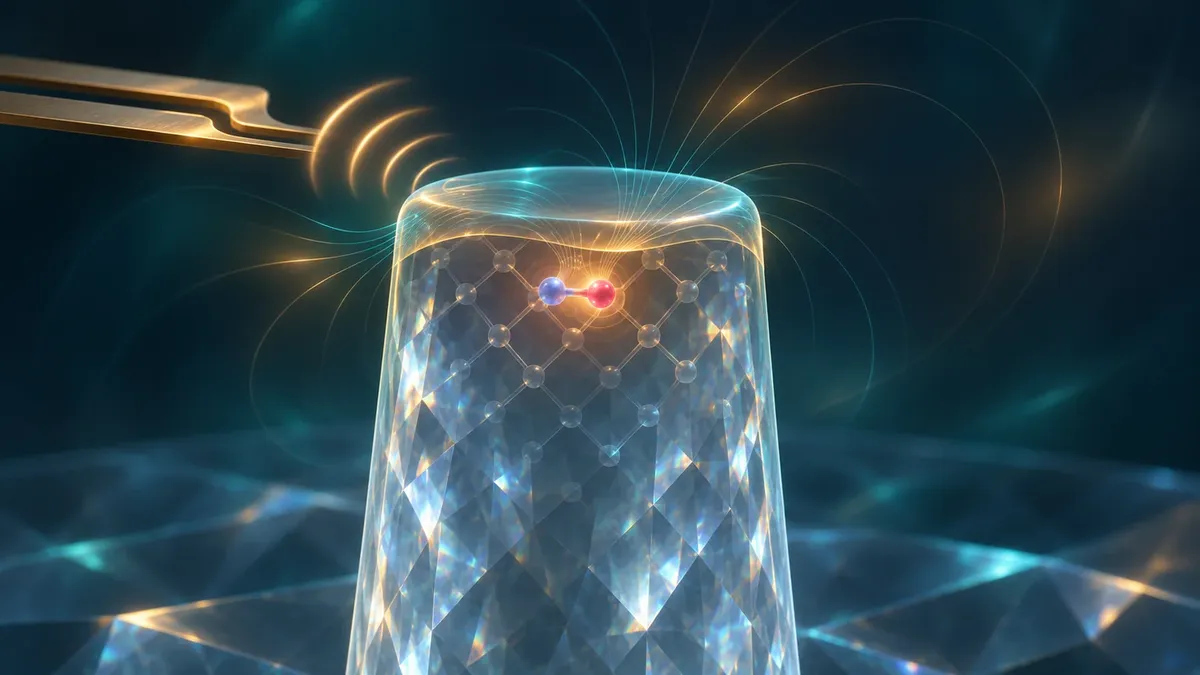
Shallow nitrogen-vacancy defects in diamond are useful quantum-sensing elements, but surface conditions can affect their charge states. A preprint reports that a thin titanium-dioxide coating changed fluorescence and spin-resonance measurements on individual defects in near-ultra-high vacuum. The results suggest a possible route to steadier sensors, though the charge-state measurement is indirect and the proposed mechanism remains to be tested.
Nitrogen-vacancy (NV) centers are defects in diamond: a nitrogen atom sits next to a vacancy in the crystal lattice. Their negatively charged form, NV⁻, is useful for optical and spin measurements. But when NV centers are close to the diamond surface, nearby defects and charges can alter their electronic environment. In near-ultra-high vacuum (near-UHV), this can make their charge-state behaviour difficult to control.
Atharva Paranjape and colleagues tested whether a titanium-dioxide (TiO₂) surface coating could change measurements of shallow NV centers under near-UHV conditions. The work is a preprint, not a settled account of how the effect works or how broadly it applies.
Comparing the same defects before and after coating
The researchers implanted nitrogen ions into diamond and made the surface into an array of small pillars. The mean depth of the implanted ions was estimated by simulation to be 8 ± 3 nanometres; this is not a direct depth measurement of each NV center. The team selected 17 individual centers and measured them before and after applying a TiO₂ coating. The coating was about 6 nanometres thick.
Measurements took place at room temperature, 300 K, and a pressure of 3 × 10⁻⁹ millibar. The researchers used fluorescence spectra to estimate the relative contributions of NV⁻ and neutral NV⁰ to the measured light. They also measured optically detected magnetic resonance (ODMR), where a spin-related feature in the light signal changes as microwaves drive the defect’s spin. In addition, microwave driving produced Rabi oscillations in the measured spin signal.
Changes in fluorescence and resonance contrast
Across the 17 centers, the estimated NV⁻ contribution to fluorescence rose on average from 0.38 before coating to 0.68 afterward. The researchers describe this as a 79% increase. It is important to interpret that figure carefully: it is a contribution to the measured fluorescence, not a direct count of defects or a direct measurement of how long each defect spent in NV⁻. The two charge states can emit different amounts of light, so fluorescence contribution may not equal their actual population or dwell time.
Average ODMR contrast—the relative size of the spin-related feature—rose from 6.9% to 10.1%, an enhancement of 46%. None of the 17 measured centers showed a decrease in contrast after coating. The researchers also estimated a 19% improvement in photon-shot-noise-limited sensitivity to static magnetic fields. This is a calculated sensitivity under a specified noise limit, not a demonstration of magnetic sensing in an application.
The measured Rabi oscillations were generally less damped after coating. Their average fitted decay rate fell from 3.2 to 1.4 microseconds⁻¹. This change is consistent with reduced noise or more persistent charge-state behaviour, but it does not establish a spin-coherence time. Dedicated pulse sequences and longer measurement windows would be needed to determine coherence times accurately. For three centers, the number of oscillations within the available measurement window was insufficient for a fully unconstrained fit.
What remains uncertain
The authors propose that TiO₂ changes the local electronic environment, potentially reducing surface-related band bending and passivating charge traps. That could help explain the fluorescence and spin-measurement changes. However, the proposed mechanism was not directly established by these measurements. The paper identifies coating thickness and surface structure as subjects for further study.
The findings apply to the tested diamond, coating, pressure, temperature and 17 selected defects. The pillar structures were intended to resemble scanning-probe geometries, but the experiment did not demonstrate a complete scanning sensor performing a sensing task. Further work is needed to test the approach in other devices and protocols.
The study is available as an arXiv preprint and may not have undergone peer review. Its measurements show a consistent change after coating, while the fluorescence proxy, limited sample and unresolved mechanism leave important questions open.
- quantum sensors
- nitrogen-vacancy centers
- diamond
- titanium dioxide
- near-ultra-high vacuum
- quantum sensing
- surface engineering
Reviewed cross-references
These connections were reviewed by a model, not independently fact-checked by a human. Similarity does not imply agreement; consult the original papers and the evidence below.
A diamond sensor probes nitrogen-15 in nitrate solution
Supporting evidence: Both studies indicate that the interface around shallow diamond NV centers can affect sensing behavior: Paranjape et al. report improved NV− contribution and ODMR contrast after TiO₂ coating in near-UHV, while Iqbal et al. attribute slow ¹⁵N spin diffusion near the diamond to an adsorbed KNO₃-containing layer and note that surface noise shortens NV coherence. These are different interface effects, environments and measurements, so the findings support only the bounded point that surface conditions matter, not a shared mechanism or direct confirmation.
Model review: · openai-codex/gpt-6-luna
Evidence and provenance
Selected excerpts, not complete papers. PDF extraction can omit figures or damage equations, tables and reading order; sources may be preprints.
2609.20137v2 — Original paper
Excerpt reference:
static/papers/2609.20137v2.md:121-256
Basis: Paper text
Source SHA-256:4a50e48d8288d611287e01315ecdc740dd8e049a0e359be607759440a191c1132609.20137v2 — Original paper
Excerpt reference:
static/papers/2609.20137v2.md:358-516
Basis: Paper text
Source SHA-256:4a50e48d8288d611287e01315ecdc740dd8e049a0e359be607759440a191c1132611.33360v1 — Original paper
Excerpt reference:
static/papers/2611.33360v1.md:61-102
Basis: Paper text
Source SHA-256:63b5e1d9c19482c3983b14a528dfc2dd57ad99de43ba90c13891fa1c3b1d88d62611.33360v1 — Original paper
Excerpt reference:
static/papers/2611.33360v1.md:157-205
Basis: Paper text
Source SHA-256:63b5e1d9c19482c3983b14a528dfc2dd57ad99de43ba90c13891fa1c3b1d88d6
Related reading
Automatically matched by shared topic keywords. These links do not imply that the sources agree or establish a consensus.
Which diamond-sensor method best detects tiny NMR signals?
Source published
Shared keywords: nitrogen vacancy centers, quantum sensing
A diamond sensor probes nitrogen-15 in nitrate solution
Source published
Shared keywords: nitrogen vacancy centers, quantum sensing
How moving nitrogen spins reshape diamond’s quantum echo
Source published
Shared keywords: nitrogen vacancy centers, quantum sensing
Silicon-carbide vacancy spins show transition-dependent coherence
Source published
Shared keywords: quantum sensing
Quantum sensing algorithms target specific spectroscopy questions
Source published
Shared keywords: nitrogen vacancy centers, quantum sensing