TRANSMISSION // 2609.19759v3
When Should an AI Agent Call for Backup?
Source published
In four benchmark evaluations, a preprint finds that subagents’ results vary with task dependencies. The evidence supports a conditional proposal, not a general rule for delegation.
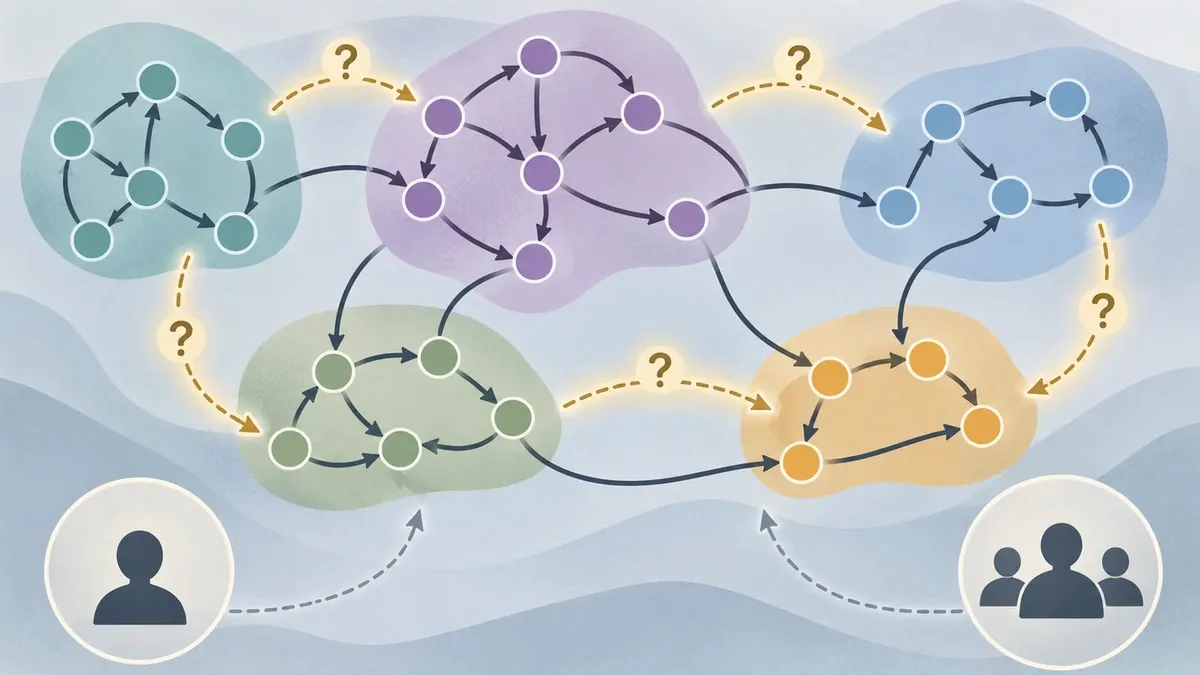
Adding AI agents does not guarantee better results. A new preprint tests a structural way to think about delegation, using four benchmarks and two language models. Its findings suggest task dependencies may matter—but do not validate a universal test for when to delegate.
A long task can seem suited to a team of AI agents: one might research, another write code, and a coordinator combine their work. But splitting a task can also add coordination overhead or leave an agent without important information. In When to Use Subagents, researchers ask whether the structure of a task’s dependencies can help explain when subagents might be useful.
The paper formalizes a task trajectory as a directed acyclic graph: interaction steps are nodes, and an earlier step is connected to a later one when removing it from the history lowers the later action’s expected value by more than a specified threshold. The authors also assume that each step contributes to a later decision, so redundant interactions can be discarded. This is a modeling choice, not a directly visible or universal map of how tasks work.
A bridge edge, in this graph, is an edge whose removal increases the number of weakly connected components. The researchers propose that this structure can help guide delegation. But a bridge edge does not, by itself, show that the resulting parts can be completed independently. The relevant boundaries must be predicted while a task is underway, and those predictions can be wrong.
SAIGE and the benchmark tests
The researchers built SAIGE, a framework that attempts to grow a team during execution. It estimates dependencies from the task’s observed history and can spawn a child agent when its structural checks indicate a possible bridge. It also retrieves information from other agents on demand, rather than automatically adding all earlier material to each agent’s context. These are intended ways to limit unnecessary context and adapt to evolving work—not guarantees of reliable boundary detection or savings in every task.
The paper tests SAIGE and other methods on four long-horizon benchmarks: command-line tasks, repository generation from written requirements, deep research, and everyday instruction-following. The systems run on the Codex CLI harness with two language models. In the main comparisons, multi-agent methods are capped at four agents and a recursion depth of one. The benchmarks use different measures, including task resolution, software tests passed, and rubric-based scores, so their scores should not be compared directly across benchmarks.
Results vary by benchmark, method, and model. In the reported tables, SAIGE has the highest score among the tested methods on Deep Research Bench II and AgentIF-OneDay for each of the two models. On Terminal Bench 2.1 and NL2Repo, its scores are close to the single-agent baseline, while several other multi-agent methods score lower than that baseline. These are observed benchmark results; the paper excerpt provides no uncertainty estimates or significance tests to establish how robust the rankings are.
The authors interpret the results as evidence that task structure may help explain when delegation works. Their post-hoc analysis characterizes the tested command-line and repository tasks as more tightly coupled, and the research and everyday tasks as more separable. That interpretation comes from analyses of trajectories and representative examples; it does not establish that all tasks in those domains share those structures.
More agents were not a reliable shortcut
In ablations on the research and everyday-task benchmarks, the authors varied team-size limits and recursion depth. More agents or deeper recursion did not consistently improve performance and often increased token use. A limit of four agents and depth one was selected as the default for a favorable trade-off; it was not the top-scoring configuration in every ablation. Disabling SAIGE’s on-demand retrieval lowered its score in the reported everyday-task configuration, suggesting that information-sharing design mattered in that test.
The paper also describes a representative command-line case in which an omitted dependency—from a virtual machine’s memory layout to build configuration—was said to lead to repeated build-and-validation cycles and a local deadlock. This is the authors’ account of an illustrative failure, not an independent estimate of how often such errors occur.
What the evidence can—and cannot—show
The paper reports bridge-edge prediction metrics on AgentIF-OneDay. Its reference boundaries are established through post-hoc semantic annotation of trajectories. This is limited evidence for prediction quality on that benchmark, not broad validation across all four. More generally, both dependency definitions and predictions affect the proposed approach, and the full trajectory is not available when a live system must make decisions.
The paper’s theoretical context-cost result assumes the complete trajectory is known and correctly decomposed. It does not establish that a system will find the right split in advance or achieve context savings in every setting. The experiments also cover only the specified benchmarks, models, harness, and main-comparison limits; results could differ under other conditions.
This is an arXiv preprint, not evidence of peer review. Its contribution is a conditional proposal: task dependencies may be useful to consider when designing agent coordination. The experiments do not establish a general-purpose test or a proven practical rule for when to delegate.
- AI agents
- subagents
- multi-agent systems
- task decomposition
- dependency graphs
- SAIGE
- language models
Reviewed cross-references
These connections were reviewed by a model, not independently fact-checked by a human. Similarity does not imply agreement; consult the original papers and the evidence below.
When AI team leaders follow the crowd
Supporting evidence: Both preprints suggest that adding agents alone does not ensure useful collaboration: Yuan et al. report that scaling agent pools or recursion depth did not reliably improve task performance, while Xie et al. find that senior agents often follow generic review majorities or omit witness limitations. This is a complementary, bounded caution, not a direct comparison: the studies examine different systems, tasks, and outcomes.
Model review: · openai-codex/gpt-6-luna
Evidence and provenance
Selected excerpts, not complete papers. PDF extraction can omit figures or damage equations, tables and reading order; sources may be preprints.
2609.19759v3 — Original paper
Excerpt reference:
static/papers/2609.19759v3.md:13-41
Basis: Paper text
Source SHA-256:e2a0ffc16512ec528804501f057c95c4a4d5bae14520976dffefe382b6232e802609.19759v3 — Original paper
Excerpt reference:
static/papers/2609.19759v3.md:1057-1071
Basis: Paper text
Source SHA-256:e2a0ffc16512ec528804501f057c95c4a4d5bae14520976dffefe382b6232e802611.27139v1 — Original paper
Excerpt reference:
static/papers/2611.27139v1.md:15-59
Basis: Paper text
Source SHA-256:96cec0710f3fb5c1192c7a8192004b00330d4cc737465cccb5af4f520a68670b2611.27139v1 — Original paper
Excerpt reference:
static/papers/2611.27139v1.md:243-335
Basis: Paper text
Source SHA-256:96cec0710f3fb5c1192c7a8192004b00330d4cc737465cccb5af4f520a68670b
Related reading
Automatically matched by shared topic keywords. These links do not imply that the sources agree or establish a consensus.
When AI team leaders follow the crowd
Source published
Shared keywords: ai agents, multi agent systems
Training a web agent's planner and actor together improves benchmark results
Source published
Shared keywords: multi agent systems, task decomposition
What GitHub Copilot’s coding traces reveal about AI agents
Source published
Shared keywords: language models
Delegent cuts AI-agent costs by handing off the legwork
Source published
Shared keywords: ai agents
Can One AI Agent Learn From a Whole Team?
Source published
Shared keywords: ai agents, multi agent systems