TRANSMISSION // 2609.18606v2
What polarized light may reveal about a MOG black hole
Source published
Model-based images explore how a non-rotating black hole’s apparent shadow and polarized light vary with gravity, viewing angle and accretion flow.
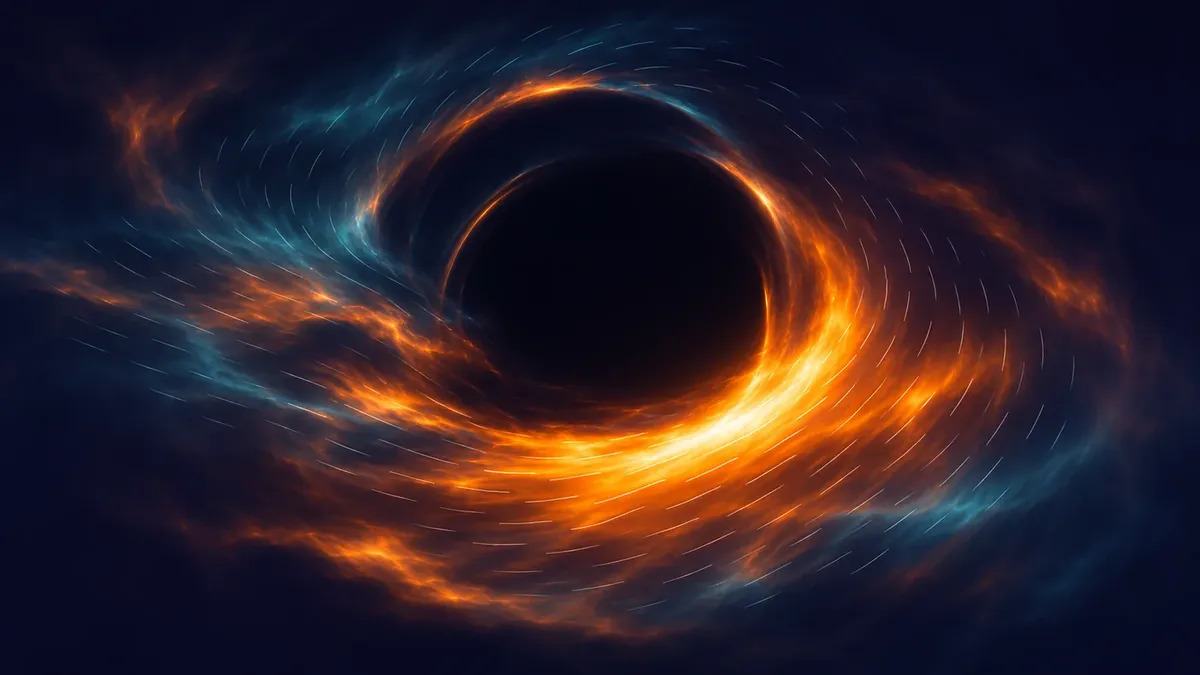
A black hole’s shadow is shaped not only by gravity but also by glowing gas and bent light. Cheng Hu and colleagues model a non-rotating black hole in MOdified Gravity (MOG) to explore how those ingredients affect its image. Their polarization results come from one specific accretion-flow model, so they are possible theoretical signatures—not evidence that MOG describes an observed black hole.
A black hole bends light so strongly that some photons travel along highly curved paths before reaching a distant observer. Together, those paths and the surrounding glowing gas shape the bright rings and darker regions in a black-hole image. The orientation of polarized light—described by the direction of its electric field—may also carry information about the emitting plasma and the spacetime through which the light travels.
Cheng Hu, Huan Ye, Hong Lei and Zi-Chao Lin investigate these effects for a static, non-rotating Schwarzschild-MOG black hole. MOG is short for MOdified Gravity. In the model studied, the parameter α is the MOG parameter associated with a change in the gravitational coupling relative to the Newtonian value. The authors ask how α, the observer’s viewing angle and assumptions about the gas affect simulated images. This is a theoretical study, not an analysis of a particular black hole observation.
Calculating light and emission
The researchers calculate photon paths, called null geodesics, and use relativistic radiative transfer to model how radiation travels through the plasma. The modeled light is synchrotron emission, produced by energetic electrons moving in magnetic fields. The surrounding accretion flow is geometrically thick and optically thin: it has substantial vertical extent, while most of its radiation can pass through without being absorbed.
For unpolarized images, the paper considers two flow descriptions. A phenomenological model specifies profiles for properties such as plasma density and temperature. The Hou model is an analytical flow model developed from general-relativistic magnetohydrodynamic work. The authors vary the MOG parameter and viewing inclination and examine both isotropic and direction-dependent emission in their image calculations.
A crucial scope limit is that the polarization calculations use only the Hou model, with an infalling flow and anisotropic synchrotron emission. Anisotropic emission depends on the direction of the light relative to the magnetic field. The polarization findings therefore describe this particular modeled setup; they are not a comparison of polarization predictions from both flow models.
What changes in the images
The simulations show that the apparent ring, central dark region and brightness distribution depend on both the MOG parameter and the accretion-flow assumptions. The paper reports that increasing α broadens the shadow in its overall summary, while its detailed image discussion describes the central dark region and higher-order lensed features changing in size. The reported ring-size behavior is not a single model-independent rule: it varies with the image configuration and flow description. In intensity profiles, the peak can shift outward and decline as α increases. These different measures should not be collapsed into a claim that every ring simply grows brighter or larger.
Viewing angle also matters. In the modeled images, nearly face-on views are more symmetric; higher inclinations produce more asymmetric brightness and alter the apparent ring structure. The paper discusses projection, lensing and, for relevant moving-flow configurations, relativistic beaming as contributors. These explanations should not be applied uniformly: the Hou flow used for the polarization analysis does not include orbital motion.
Within the Hou-model polarization simulations, higher inclination is associated with stronger polarized emission in the apparent shadow region. That does not mean radiation is escaping from inside the event horizon. In a thick flow, light from emitting gas above or below the equatorial plane can be bent into the observer’s view of the central region, partly filling or obscuring the apparent shadow.
For this same polarization setup, the electric-vector position angle is mostly oriented around the image, though it changes rapidly near higher-order lensed features. The authors report that polarization signals are localized around those features. These are predictions of the adopted model, not established patterns across all plausible flows.
What the study cannot establish
The authors present the calculations as possible diagnostics for future horizon-scale polarimetric observations, including observations with the Event Horizon Telescope or a proposed next-generation array. The simulations do not show that existing data favor MOG, nor do they establish that the predicted patterns uniquely identify modified gravity. Different assumptions about the emitting gas can also shape an image, and this study does not provide a comprehensive comparison against all competing gravity and plasma models.
The black hole is non-rotating, and the flow properties are prescribed by models rather than obtained from a full simulation of a specific observed source. The polarization analysis is narrower still: it uses only the infalling Hou model with anisotropic emission. These limitations make the results useful as theoretical predictions to test, not measurements of gravity in the sky.
This work is available as an arXiv preprint. A preprint is a publicly shared research manuscript; its availability on arXiv does not by itself establish peer review. The findings should therefore be read as model-dependent calculations whose observational relevance remains to be assessed.
- black hole shadow
- MOdified Gravity
- MOG parameter
- polarization
- photon rings
- accretion flow
Reviewed cross-references
These connections were reviewed by a model, not independently fact-checked by a human. Similarity does not imply agreement; consult the original papers and the evidence below.
Magnetic disturbances could reshape polarized light around black holes
Shared method: Both studies use polarized ray tracing to model black-hole images: Hu et al. solve null geodesics and relativistic radiative transfer for a static Schwarzschild-MOG black hole, while Huang and Liang develop time-dependent general-relativistic polarized ray tracing for reconnection bubbles. Their setups and questions differ, so this is a methodological connection, not a direct comparison of predictions.
Model review: · openai-codex/gpt-6-luna
Evidence and provenance
Selected excerpts, not complete papers. PDF extraction can omit figures or damage equations, tables and reading order; sources may be preprints.
2609.18606v2 — Original paper
Excerpt reference:
static/papers/2609.18606v2.md:13-62
Basis: Paper text
Source SHA-256:815e16d36e2726813d2adf3ba2194c96f2713699e5a797f84186d9c16f6255e32611.10525v1 — Original paper
Excerpt reference:
static/papers/2611.10525v1.md:12-70
Basis: Paper text
Source SHA-256:8529b1bba753c2120cc09736f30014cb7434a7a5f4a46f1029251e139b7ad861
Related reading
Automatically matched by shared topic keywords. These links do not imply that the sources agree or establish a consensus.
A proposed safety barrier for modified-gravity futures
Source published
Shared keywords: modified gravity
Can One Modified Gravity Rule Work Across a Star’s Different Matter Phases?
Source published
Shared keywords: modified gravity
A softly broken symmetry offers a route across the phantom divide
Source published
Shared keywords: modified gravity
Could satellites help test hidden forces behind dark energy?
Source published
Shared keywords: modified gravity
A spinning white dwarf’s tidal response depends on how the star changes shape
Source published
Shared keywords: modified gravity