TRANSMISSION // 2609.17412v2
Could dark matter’s cosmic history shape a rare LZ recoil?
Source published
A theoretical study links the present-day abundance of excited dark-matter particles to how they might scatter in the LUX-ZEPLIN detector. Its model can produce recoil spectra near a reported high-energy candidate event, but does not establish that the event was caused by dark matter.
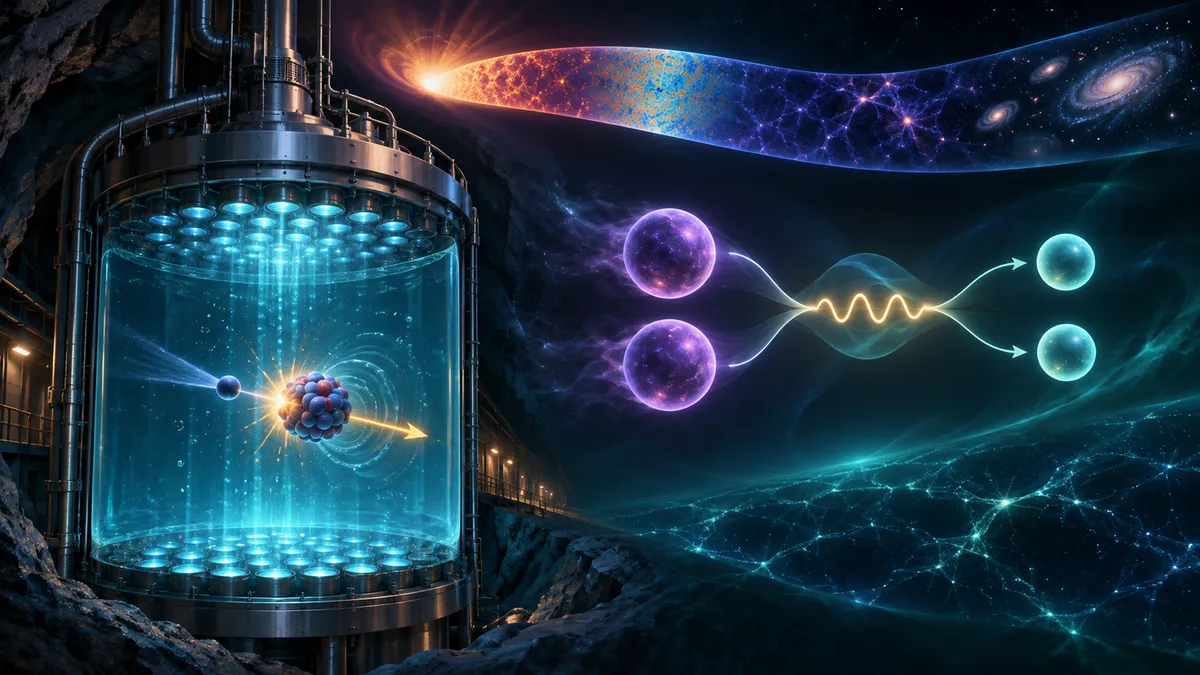
A high-energy recoil reported by LUX-ZEPLIN has prompted physicists to explore dark-matter models with unusual scattering. This preprint asks whether the early-Universe history of two dark-matter states could determine which kind of scattering dominates today—and whether that could help explain the candidate event.
A dark-matter particle passing through a detector could, in principle, bump into an atomic nucleus and make it recoil. The energy and frequency of those recoils depend on the particle’s properties and interactions. The LUX-ZEPLIN (LZ) experiment reported a nuclear-recoil candidate at about 248 keV. That event is not proof of dark matter: the paper quotes a maximum local significance of 3.4 sigma and a global significance of 2.6 sigma. Its relatively high recoil energy has nevertheless inspired new theoretical interpretations.
Haipeng An and colleagues examine one possibility: dark matter has two nearly equal-mass states, a lighter state, χ1, and an excited state, χ2. The states interact with each other through an axion-like particle (ALP), a hypothetical particle related in some respects to the axion. In the model, the ALP also interacts with gluons and photons. The gluon interaction contributes to nuclear scattering, while the photon interaction allows the excited state to decay. The authors calculate that this decay is slow enough for χ2 to survive to the present in the parameter ranges they study.
The key question is what fraction of dark matter today remains excited. That affects whether a detector is more likely to see endothermic scattering, in which a lighter particle gains energy and becomes excited, or exothermic scattering, in which an excited particle drops to the lighter state and releases energy.
Following the dark matter from the early Universe
Rather than assume that only the lighter state survives, the authors track how both populations evolve. They model their early thermal history and calculate how conversions within the dark sector—especially two excited particles turning into two lighter ones—change the excited-state fraction after other processes stop keeping the states in equilibrium.
The interaction’s mathematical structure matters. The team studies four benchmark cases, combining two kinds of dark-matter fermion (Majorana or Dirac) with scalar or pseudoscalar transition couplings to the ALP. For scalar couplings, repeated mediator exchange can make a simple first-order calculation inadequate. The authors instead solve coupled quantum-mechanical equations for the two-particle states, calculate conversion rates, and use those rates in a cosmological evolution equation. They also calculate example nuclear-recoil spectra and seasonal changes in the predicted signal.
The modeled outcome depends on the coupling
For scalar transitions, the calculated excited-state fraction varies non-monotonically with ALP mass. The authors attribute this pattern to resonant structure in the conversion rates. Across the parameter range studied, the fraction spans roughly one in ten thousand to about one half. Depending on the parameters, endothermic and exothermic scattering can both contribute, or their relative importance can shift.
For pseudoscalar transitions, the excited-state fraction remains close to one half in the studied cases, and the example recoil spectra are dominated by exothermic scattering. In all four benchmark scenarios, the authors select parameters for which the modeled spectrum peaks near the candidate’s recoil energy. This demonstrates that the model can reproduce an energy feature of interest; it does not show that the event came from dark matter or that this is the correct explanation.
The predicted seasonal behavior also differs among examples. Where endothermic scattering is important, the rate can vary appreciably over the year: producing a high-energy recoil requires particles in the fast-moving tail of the assumed dark-matter speed distribution. Other examples, dominated by exothermic scattering, show little seasonal variation. The authors suggest that sufficiently numerous future events with reliable timing could help distinguish these possibilities. One event cannot establish an annual pattern.
What remains uncertain
These are model calculations, not a detection or a direct measurement of the excited-state fraction. The spectra rely on selected benchmark parameters and assumptions about the dark-matter halo; for their modulation estimates, the authors use a truncated Maxwellian speed distribution. They also identify a region of scalar-coupling parameter space where dark-matter bound states might form and change the results. That region is left for future study and is not covered by their analysis.
The supplied source is a preprint, so its results should be read with the usual care given to research that may be revised or further assessed. The paper discusses possible complementary tests using collider searches and future detector data, but reports no new experimental confirmation. Its central result is a theoretical link: in this model, early cosmic evolution sets the present mix of dark-matter states, and that mix can influence which direction inelastic scattering takes in a detector.
- dark matter
- LUX-ZEPLIN
- inelastic scattering
- axion-like particles
- cosmology
- direct detection
Related reading
Automatically matched by shared topic keywords. These links do not imply that the sources agree or establish a consensus.
Electron signals could extend LZ’s search for lightweight dark matter
Source published
Shared keywords: dark matter, direct detection, lux zeplin
Cosmic-ray boosts sharpen model-dependent limits on lightweight dark matter
Source published
Shared keywords: dark matter, direct detection, lux zeplin
Can the Sun test dark matter behind LZ’s unusual recoil?
Source published
Shared keywords: dark matter, inelastic scattering
SPHEREx sets early limits on axion-like dark matter
Source published
Shared keywords: axion like particles, dark matter
Cosmic background light complicates a proposed escape route for gamma rays
Source published
Shared keywords: axion like particles