TRANSMISSION // 2609.16884v2
Robots Can Plan Around What They Can’t See
Source published
A simulated-robot study tests whether planning across several possible scene interpretations can help with household tasks—and where the evidence stops.
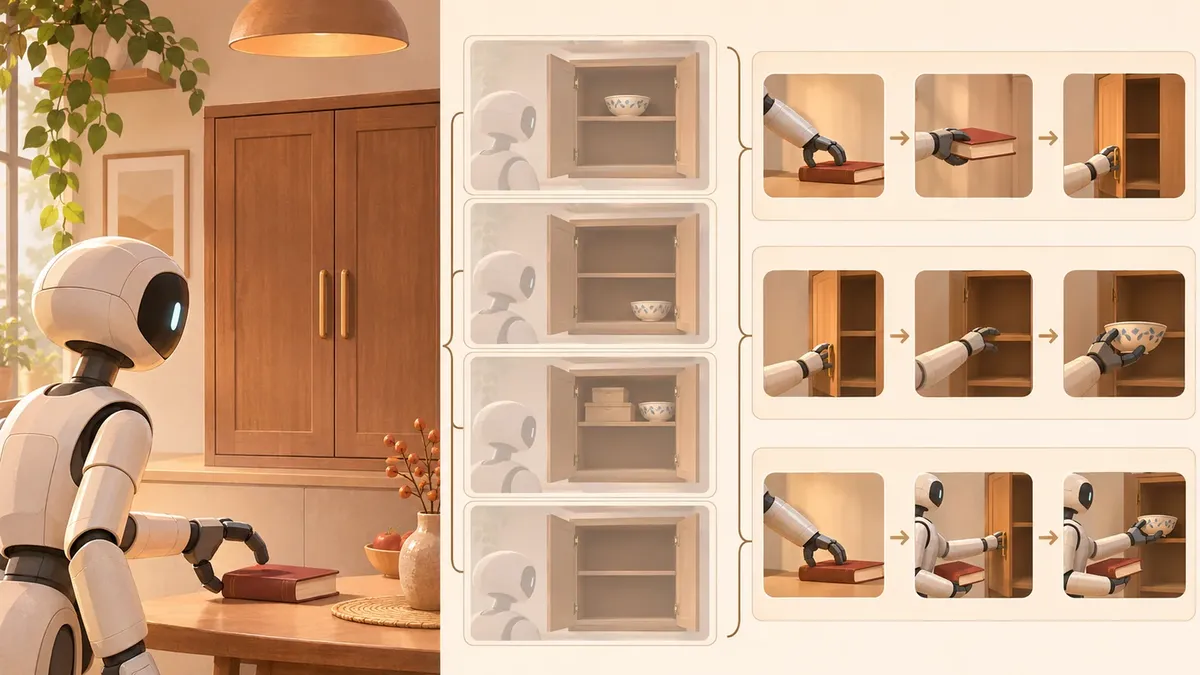
A robot may not know whether it is holding a book or whether a bowl is hidden inside a closed cabinet. RoVLaP, a proposed planning system, keeps probabilities for possible scene states and seeks a plan that works across a likely subset. In selected simulated tasks, it had the highest reported success in each difficulty group, though one result tied a comparison method.
A robot cannot always see enough to know what is happening. An object may be outside the camera’s view, hidden in a cupboard, or confused with something near the gripper. If the robot commits to a mistaken interpretation, a sensible-looking plan can fail: it might try to pick up a bowl that is still inside a closed cabinet.
Guy Azran, Michael Navat and Sarah Keren study whether a robot can plan more robustly by representing uncertainty explicitly. Their preprint introduces RoVLaP (Robust Vision-Language Planning), which uses a vision-language model (VLM) to estimate facts about a scene and combines those estimates with a symbolic planner. Rather than treating one best guess as certain, the system plans across a set of plausible states.
From visual estimates to plans
The authors compare three ways of using a VLM. One asks the model to propose actions directly from an image. Another uses it to assign yes-or-no facts about the scene, then gives that state estimate to a conventional planner. RoVLaP instead asks for probabilities about task-relevant facts—such as whether an object is being held—and passes that uncertainty into planning.
The system combines the estimates into a belief over possible symbolic states, applying known constraints to exclude impossible combinations. It selects a subset of states whose cumulative probability meets a chosen threshold. A conformant planner then seeks a plan valid for every state in that subset. During execution, the robot updates its belief from new images and may replan if the plan becomes unlikely, an action is unsafe across the considered states, or the plan runs out without completing the task.
RoVLaP also treats “unknown” as a meaningful response. When the VLM indicates that an image does not provide enough evidence about a fact, the method assigns that fact a probability of one half rather than forcing a true-or-false answer. This avoids treating missing visual evidence as certainty, but does not ensure that the model’s other probabilities are calibrated.
Tests in a simulated home
The evaluation used ViPlan-HH, a household-robot benchmark built on the iGibson simulator. The robot received first-person RGB images and performed tasks such as sorting books, opening containers and moving household objects. The authors removed privileged simulator information about objects that were not visible, making hidden objects part of the planning problem. All three approaches used GPT-4.1 through the OpenAI API.
The reported comparison covers task families that the conformant-planning software backend could run reliably. In the simple, medium and hard groups, RoVLaP’s task-success rates were 86.7%, 57.1% and 66.7%, respectively. It had the highest reported success in each group, but did not beat both alternatives in every split: on medium tasks, its 57.1% matched the VLM-as-grounder baseline, while the direct-planning baseline scored 21.4%. The reported table also shows fewer planner calls and fewer actions on average for RoVLaP, though this does not mean it led on every measure. These findings concern this experiment, not other simulators, models or physical robots.
The examples illustrate why carrying uncertainty could help. If a bowl may be hidden in a cabinet, a plan that opens the cabinet can work across more than one interpretation of the scene. If a book near the gripper may or may not already be held, a plan that accounts for both possibilities need not rely on a single visual judgment.
What remains uncertain
The evidence is limited to simulation and a subset of benchmark tasks. The authors excluded other task families because the planner backend could hang without reliably returning either a plan or a failure. This practical constraint means the results do not cover the entire benchmark. The study also uses one VLM; it does not establish how the approach would perform with other models, real-world sensors or physical robot motion.
The method makes assumptions, too. Its full-state belief approximates independence between facts, except for constraints represented in the task domain. Unmodelled relationships could affect which states appear plausible. The theoretical guarantees depend on assumptions about prediction accuracy and repeated visibility; they are not assurances that any VLM will be reliable. Parts of the planning process also have exponential worst-case complexity.
RoVLaP’s contribution is to carry visual uncertainty into symbolic planning rather than discard it at the start. The results suggest a benefit on selected household tasks, but broader performance and real-world reliability remain open questions. The source is an arXiv preprint marked as accepted at NeuS 2026. This article summarizes the supplied manuscript; it does not independently verify the results or establish the status of peer review.
- robotics
- vision-language models
- planning under uncertainty
- symbolic planning
- simulated household robots
Reviewed cross-references
These connections were reviewed by a model, not independently fact-checked by a human. Similarity does not imply agreement; consult the original papers and the evidence below.
DualWorldBench tests whether AI agents can turn delivery goals into workable plans
Supporting evidence: In separate simulated settings, both papers identify difficulty turning uncertain or grounded information into workable plans: Azran et al. report that RoVLaP improves household-task success over deterministic-grounding baselines, while Chen et al. report that agents in DualWorldBench often fail to produce feasible delivery plans from grounded observations. This supports only the bounded point that planning remains challenging across these tested settings; the tasks, methods, and evaluations differ.
Model review: · openai-codex/gpt-6-luna
Evidence and provenance
Selected excerpts, not complete papers. PDF extraction can omit figures or damage equations, tables and reading order; sources may be preprints.
2609.16884v2 — Original paper
Excerpt reference:
static/papers/2609.16884v2.md:805-863
Basis: Paper text
Source SHA-256:d2860f7cf871c72c71abd3092d4b6c270ffd4bcc77f7baf4dd0ecff0c02c9f102611.04228v1 — Original paper
Excerpt reference:
static/papers/2611.04228v1.md:620-780
Basis: Paper text
Source SHA-256:b83b30bd8727e10989e8112e495c7d07421814a201e4d8cd49cac4b9da485060
Related reading
Automatically matched by shared topic keywords. These links do not imply that the sources agree or establish a consensus.
PhysMoE gives robot vision-language models a more direct way to point
Source published
Shared keywords: vision language models
StereoVLM: Teaching AI to See in 3D with Two Cameras
Source published
Shared keywords: vision language models
A Robot Learns From Its Own Attempts
Source published
Shared keywords: vision language models
Can a large vision model use a smaller model’s visual memory?
Source published
Shared keywords: vision language models
HALO trains a humanoid in simulated rooms before testing it in unfamiliar spaces
Source published
Shared keywords: vision language models