TRANSMISSION // 2609.13373v3
A Star’s Chemical Clues to Early Supernovae
Source published
A chemically unusual, iron-poor giant may preserve the signature of a faint explosion from a first-generation star. The proposed origin is a model, not a direct observation.
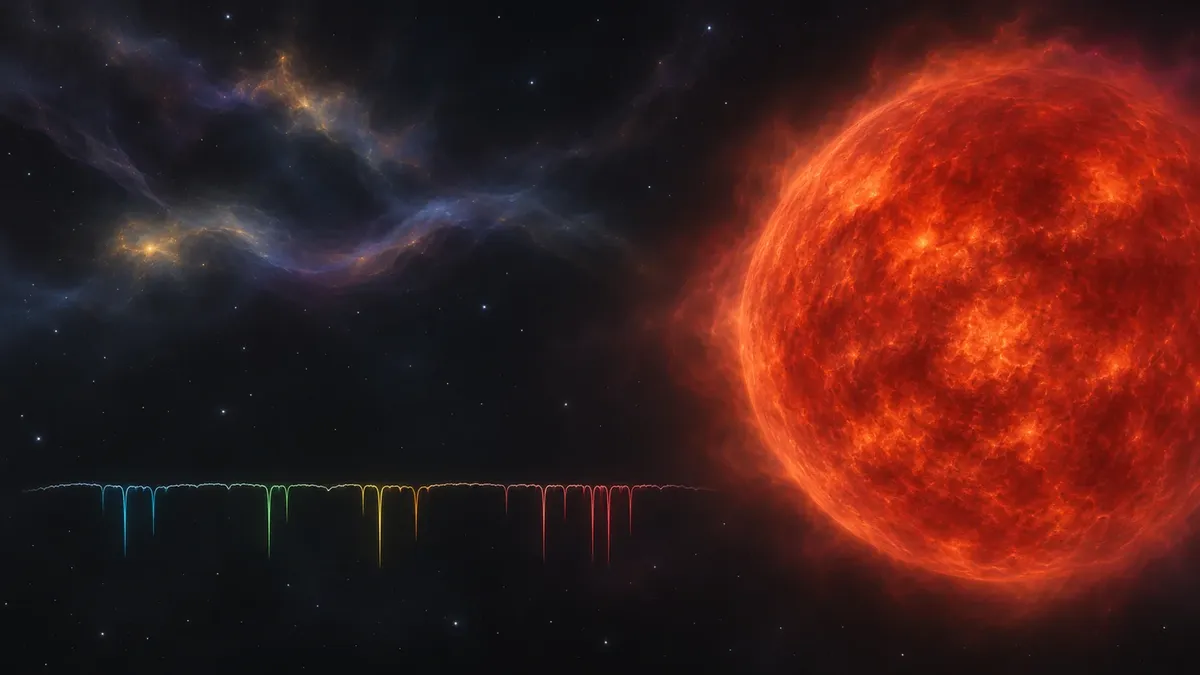
A star’s elements can act like a record of the stellar explosions that enriched its birthplace. Researchers report an unusually carbon-, nitrogen- and oxygen-rich star with very little iron, and find that a model of a faint supernova from a first-generation star can reproduce its measured chemical pattern.
Stars form from clouds enriched by earlier generations of stars. By measuring the elements in a star, astronomers can test what kinds of explosions may have seeded its birthplace. A new study examines an especially iron-poor star whose chemistry offers clues to early enrichment around the Milky Way.
Identified in data from the European Space Agency’s Gaia mission, the star has an iron abundance of [Fe/H] = −4.06. In this notation, zero means the Sun’s iron-to-hydrogen ratio; a negative value means less iron relative to hydrogen. The study classifies it as ultra metal-poor, a label for stars with [Fe/H] below −4. It is a red giant about six kiloparsecs from the Sun.
Reading the star’s chemical record
The researchers combined Gaia’s low-resolution blue and red spectro-photometric data with measurements from multiple photometric bands, astrometry and high-resolution spectroscopy. Astrometry measures a star’s position and motion; spectroscopy lets researchers infer which elements are present from the light it emits.
Their abundance analysis uses the assumption of local thermodynamic equilibrium, a simplifying framework for interpreting how atoms produce spectral features. They report strong enhancements relative to iron: carbon, corrected for depletion during the star’s evolution, at [C/Fe] = +1.54; nitrogen at +2.64; and oxygen at +2.62. The authors say this is one of only five known ultra metal-poor stars with a detected oxygen abundance. Sodium, magnesium, aluminium and silicon are also enhanced.
Different stellar explosions produce elements in different proportions. In the researchers’ models, the observed pattern can be reproduced by the yields of a single faint supernova from a Population III star—a first-generation star formed before the Universe was enriched with heavier elements. The model points to a progenitor mass of roughly 21 to 28 times the Sun’s mass and an explosion energy between 0.3 and 0.9 times 10⁵¹ ergs.
A plausible origin, not a witnessed event
The proposed supernova is an interpretation of the star’s chemical record, not an explosion observed directly. The researchers compare measured abundances with theoretical yields: predicted amounts of elements produced in an explosion. A match shows that this scenario can explain the pattern; it does not establish that it was the only possible history. The chemical measurements are evidence, while the progenitor and explosion properties are inferred from models.
The study also considers a broader question about carbon and oxygen. Using metal-poor stars reported in earlier work, the authors argue that a mild enhancement in [C/O] does not automatically imply the strong carbon enhancement, [C/Fe], often found in ultra metal-poor stars in the Milky Way and its satellite systems. This cautions against treating one abundance ratio as a direct stand-in for another. The abstract does not provide enough detail to assess the full comparison or its scope.
The star’s motion does not link it dynamically to any of the major accreted substructures in the Galactic halo considered by the researchers. They speculate that it may have formed in an ultra-faint dwarf galaxy—a very small, faint galaxy—that later merged with the Milky Way. That birthplace is possible, not confirmed.
What remains uncertain
Element abundances depend on how spectra are interpreted, and this analysis assumes local thermodynamic equilibrium. The abstract does not give enough information to assess the uncertainties in individual abundance measurements, the alternative models tested, or how uniquely the best-fitting supernova scenario is preferred. One star also cannot establish how common this enrichment pathway was.
This account is based on the paper’s abstract, not a full-text review. The work is an arXiv preprint, and the supplied source information does not establish whether it has undergone peer review. Its results are best read as a reported observation and a model-based interpretation, not a settled account of the first stars.
- Population III
- ultra metal-poor star
- stellar abundances
- faint supernova
- Gaia
- early Universe
Reviewed cross-references
These connections were reviewed by a model, not independently fact-checked by a human. Similarity does not imply agreement; consult the original papers and the evidence below.
A rare Sculptor star points to enrichment by two early stellar explosions
Supporting evidence: Both studies find abundance patterns consistent with enrichment by a Population III faint supernova: the origin study fits GDR3_479591 with a single faint-supernova model, while Cuadra et al. identify a faint supernova as the major contributor in a two-progenitor fit for Sculptor’s DR20080. This supports faint supernovae as a plausible enrichment channel in these cases, not a shared progenitor scenario; the stars, environments, and fitted models differ.
Model review: · openai-codex/gpt-6-luna
Evidence and provenance
Selected excerpts, not complete papers. PDF extraction can omit figures or damage equations, tables and reading order; sources may be preprints.
2609.13373v3 — Original paper
Excerpt reference:
static/papers/2609.13373v3.md:1882-1943
Basis: Paper text
Source SHA-256:2bb4d836cc0a726dbba137d5095896680b5e16f33e88c44412a48aead8a22e152611.13115v1 — Original paper
Excerpt reference:
static/papers/2611.13115v1.md:16-63
Basis: Paper text
Source SHA-256:82b06ee8bdbe2fbfe8f38a8e5ec35bfdf10fc80bbd4bf14047dfe5b6d839befe
Related reading
Automatically matched by shared topic keywords. These links do not imply that the sources agree or establish a consensus.
A rare Sculptor star points to enrichment by two early stellar explosions
Source published
Shared keywords: population iii, stellar abundances
Two lithium-rich dwarfs pose a puzzle in M 4
Source published
Shared keywords: stellar abundances
Rocky planets may look iron-rich because other ingredients are missing
Source published
Shared keywords: stellar abundances
What APOGEE found in young Orion stars
Source published
Shared keywords: stellar abundances
Low-resolution starlight reveals 133 candidate chemical families in the Milky Way
Source published
Shared keywords: stellar abundances