TRANSMISSION // 2609.11347v2
A shared graph vocabulary may help simple GNNs transfer
Source published
Rewriting graph facts as nodes lets standard neural networks tackle unfamiliar knowledge graphs without dataset-specific relation parameters. Results are promising, but not a general victory over specialist models.
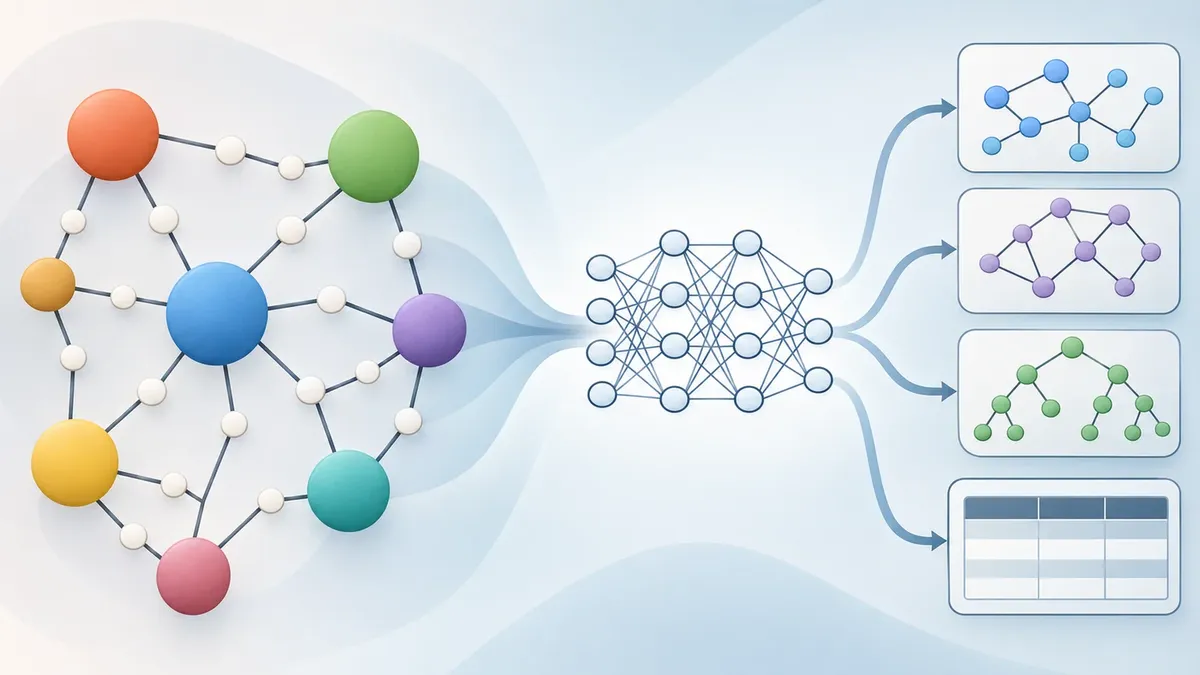
Can a change in how data is represented let ordinary graph neural networks work across unfamiliar datasets? A new preprint suggests that turning each relationship into a node may help—while also revealing important gaps and limits.
The transfer problem
A knowledge graph stores facts as triples: a subject, a relationship and an object. For example, “Paris — capital of — France.” The challenge for a model trained on one graph is that another graph may use entirely different entities and relationship types. A model with a separate learned parameter for every relation cannot simply carry those parameters over to a new vocabulary.
Camille Pradel’s preprint asks whether the transfer problem can be shifted from the model’s design into the graph’s representation. The proposed technique, called reification, turns each fact into a node. That node connects to its subject, object and relation type using a small, fixed set of six connection labels. Relation types become shared nodes in the graph rather than entries in a model-specific parameter table. The goal is to give different datasets a common structural vocabulary.
Testing ordinary graph networks
The study tested five standard graph neural network (GNN) designs: GAT, two GINE variants, GraphSAGE and R-GCN. Each was trained on one knowledge graph containing 4,245 triples, with a 30-minute training budget on one NVIDIA A100 GPU. The researchers then evaluated the trained models, without fine-tuning, on 40 inductive link-prediction benchmarks. “Inductive” here means that the evaluation includes unfamiliar entities or relation types.
The team compared results with ULTRA, a purpose-built knowledge-graph foundation model, using both its released checkpoint evaluated in the researchers’ setup and figures published by ULTRA’s authors. Performance was measured using mean reciprocal rank (MRR): roughly, a higher score means correct answers tend to appear nearer the top of a model’s rankings.
The best standard model, GAT, achieved an average MRR of 0.3564 across the 40 benchmarks, compared with 0.3732 for the locally re-evaluated ULTRA checkpoint. So the GAT did not beat ULTRA across the full suite. On 13 benchmarks whose graph families were absent from both models’ pretraining, their results were close: 0.3609 for GAT and 0.3617 for ULTRA. On the 12 benchmarks focused on new entities, GAT scored higher against that local ULTRA run; however, the comparison is less favorable when the paper’s published ULTRA figures are used. The authors therefore describe the result as a demonstration of transfer, not a new state-of-the-art model.
One benchmark exposed a pronounced weakness. It contains five entities with no connections in the test graph. The standard models gave these isolated entities scores that pushed them above other candidates, hurting their rankings. The paper traces this failure to the models’ simple scoring setup: information passed through the graph cannot reach a disconnected entity. This is a concrete reminder that a shared representation does not remove the need to examine how a model handles unusual cases.
A preliminary database probe
The paper also explores whether the same representation might apply to relational databases. In this mapping, rows become entities, foreign-key columns become relation types and foreign-key cells become facts. A model pretrained on three knowledge graphs was tested on two previously unseen databases, without cell values, schema text, fine-tuning or labeled examples in context. It ranked targets well for some foreign-key columns, but not for all: links to structurally similar events were often difficult to distinguish.
This is a limited probe, not evidence that the method is ready for general database tasks. It covers only two databases, omits most database content, and does not compare against a supervised specialist. The paper also notes that its database experiment did not test the proposed representation’s table-type nodes.
What remains uncertain
The knowledge-graph findings are substantial but bounded by the evaluation design. The standard models were trained on just one small graph, while ULTRA was pretrained on three graphs; the comparison varies both training data and model design. Benchmark families and scoring implementations also matter: the paper reports differences between published ULTRA results and its own re-evaluation. In addition, the researchers excluded one benchmark because it did not finish running within their memory and time constraints, and acknowledge that the exclusion favors their aggregate comparison slightly. This version of the paper corrects an earlier evaluation-graph error affecting eight benchmarks.
Reification also increases graph size—the paper estimates roughly 20 times as many nodes on typical knowledge graphs—and doubles graph diameter, which can raise computational costs. The authors identify training on multiple graphs and testing broader database settings as future work.
The work is an arXiv preprint, not evidence of peer-reviewed confirmation. Its central idea is narrower than “simple models solve graph transfer”: a fixed structural representation can let several standard GNNs transfer across many tested knowledge graphs, with performance that approaches a specialist under some comparisons. Independent replication and wider testing will help establish how far that approach can go.
- knowledge graphs
- graph neural networks
- link prediction
- reification
- machine learning
- relational databases
Related reading
Automatically matched by shared topic keywords. These links do not imply that the sources agree or establish a consensus.
When more data hurts: a benchmark tests how AI combines images, text and changing networks
Source published
Shared keywords: graph neural networks, link prediction
How AI’s Logic Grounding Shapes What It Can Reason About
Source published
Shared keywords: knowledge graphs, link prediction
How should AI forecast links for newly emerging entities?
Source published
Shared keywords: link prediction
Building coherence into cyber threat graphs
Source published
Shared keywords: knowledge graphs
AI Explanations May Work Better When They Match How Scientists Judge Evidence
Source published
Shared keywords: knowledge graphs