TRANSMISSION // 2609.10967v2
When quantum entanglement stretches across time
Source published
A lattice study of a free scalar field finds that time-separated quantum entropies can be real even when the regions are causally connected.
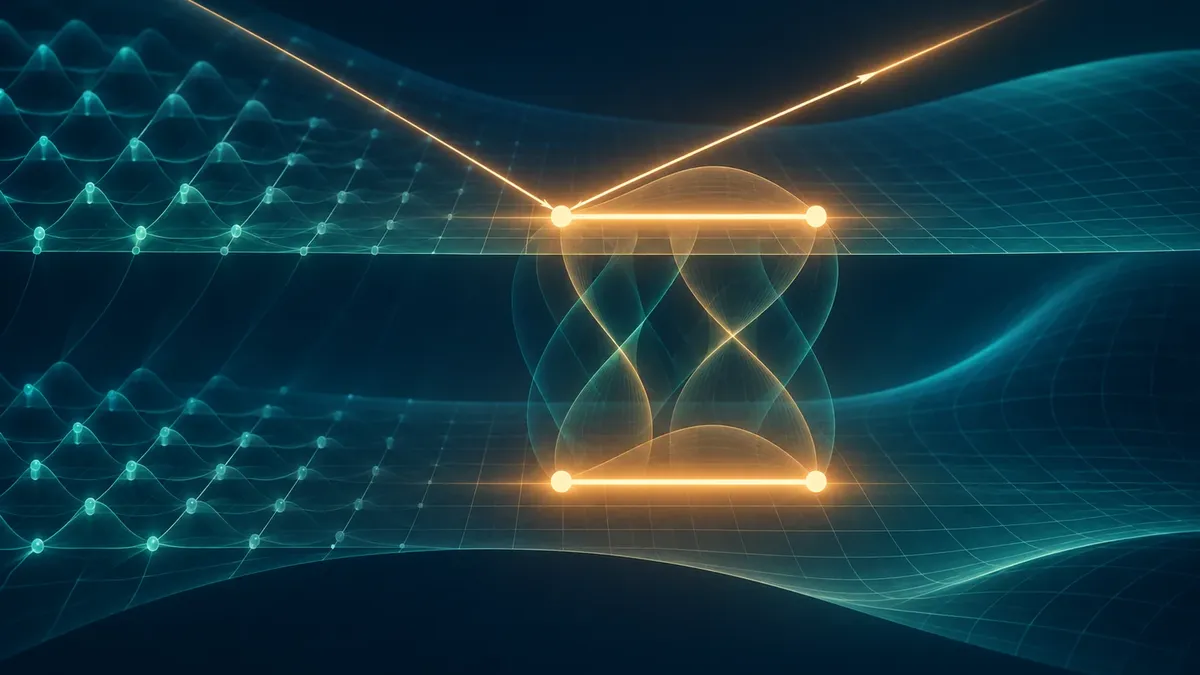
Entanglement is usually described between parts of space at one moment. Hao-yu Wang and Wu-zhong Guo study a different question: how can quantum correlations between regions at different times be calculated, and when should the resulting entropy be complex?
Entanglement is typically discussed as a relationship between parts of a system measured at the same time. In quantum field theory, though, it is possible to define a related quantity linking one spatial region at an earlier time to another at a later time. This “timelike entanglement” is mathematically unusual: the reduced spacetime density matrix used to describe it need not be Hermitian, unlike an ordinary density matrix. Its entropy-related quantities can therefore be complex.
In this preprint, Hao-yu Wang and Wu-zhong Guo ask how to calculate these quantities directly and how their complex phases relate to causality. They develop a framework for a two-dimensional free real scalar field, a relatively tractable model that lets them compare a microscopic calculation with a continuum quantum-field-theory method.
Two routes to the same quantity
The authors first put the field on a finite spatial lattice. In this description, the field becomes a chain of coupled harmonic oscillators. They select sets of oscillators on two time slices and trace out the rest, producing a reduced spacetime density matrix. Because this operator is generally non-Hermitian, familiar techniques for diagonalizing ordinary Gaussian density matrices do not directly apply. The authors extend Gaussian diagonalization to find its nonzero spectrum in the generic regular case, then use that spectrum to calculate integer Rényi moments and entropies.
Independently, they use the real-time replica method. In this approach, Rényi moments are related to correlation functions of twist operators—mathematical objects that encode how replicated copies of a field theory are joined together. Continuing these correlators to real time requires careful attention to operator ordering and complex phases.
The paper compares the lattice and continuum calculations in several settings: a circle, a finite strip with Dirichlet or Neumann boundaries, and a massive scalar field treated using form-factor predictions. The authors report quantitative agreement in both magnitude and phase for the examples studied. That agreement is an important consistency check between two different ways of describing the same timelike quantities; it is not an experimental measurement.
Causal contact does not settle the question
A central result concerns a massless scalar field with Dirichlet boundaries. For a particular arrangement of regions on a strip, the authors identify a finite time window in which all integer moments of the reduced spacetime density matrix are real, even though the regions remain causally connected. The moments are strictly positive when the initial state is Gaussian. For arbitrary initial states, the even moments are strictly positive, while odd moments may be negative or zero.
This matters because causal connection might seem to imply that a timelike entropy must acquire an imaginary part. The analysis shows that this is not generally true. In the specified Dirichlet setup and time window, the moments are real; for Gaussian initial states, the resulting integer Rényi entropies are real on the positive-real logarithmic branch chosen by the authors. Other geometries can behave differently: for example, their Neumann-boundary calculation has a nonzero constant imaginary part in a different time range. The phase depends on the setup and on how complex logarithms are continued, not simply on whether signals can connect the regions.
The authors also report that, in the massive theory, at sufficiently large time compared with the correlation-length scale, the timelike Rényi entropy approaches the sum of the corresponding spacelike entropies and becomes real. This is presented as numerical evidence for approximate factorization, rather than a universal statement about all quantum fields or states.
What remains uncertain
The conclusions are limited to a free scalar field and the geometries, boundary conditions, states and parameter regimes analyzed. The authors say that extending the framework to interacting theories and more general states is a future direction. Their continuum comparisons and lattice calculations support the method within this model, but do not establish how broadly the results apply.
There is also a technical choice to keep in mind: entropy involves a complex logarithm, whose branch must be specified. The paper describes its branch prescriptions and notes that different choices can matter for some intermediate continuum calculations. The reported reality results should therefore be read in the context of those definitions and setups.
This article summarizes an arXiv preprint, not a claim of settled consensus. Preprints may not have undergone peer review, and the source available here does not establish independent verification of the findings. The work offers a precise theoretical framework and a useful caution: in this model, causal contact alone does not determine whether timelike Rényi entropy is complex.
- timelike entanglement
- quantum field theory
- spacetime density matrix
- Rényi entropy
- scalar field
- quantum physics
Related reading
Automatically matched by shared topic keywords. These links do not imply that the sources agree or establish a consensus.
Keeping spacetime continuous in quantum path integrals
Source published
Shared keywords: quantum field theory
Quantum memory may reshape a field in an expanding universe
Source published
Shared keywords: quantum field theory
A conjecture links Wigner negativity to phase-space spread
Source published
Shared keywords: quantum physics, rényi entropy
A Rényi Route to Quantum Energy Bounds
Source published
Shared keywords: quantum field theory
How Motion Shapes Quantum Vacuum Correlations
Source published
Shared keywords: quantum field theory