TRANSMISSION // 2609.07954v2
Why sparse attention’s wiring can shape its gradients
Source published
A theoretical study shows how sparse Sinkhorn masks and marginal budgets affect gradient mixing—and why connectivity alone may not guarantee contraction.
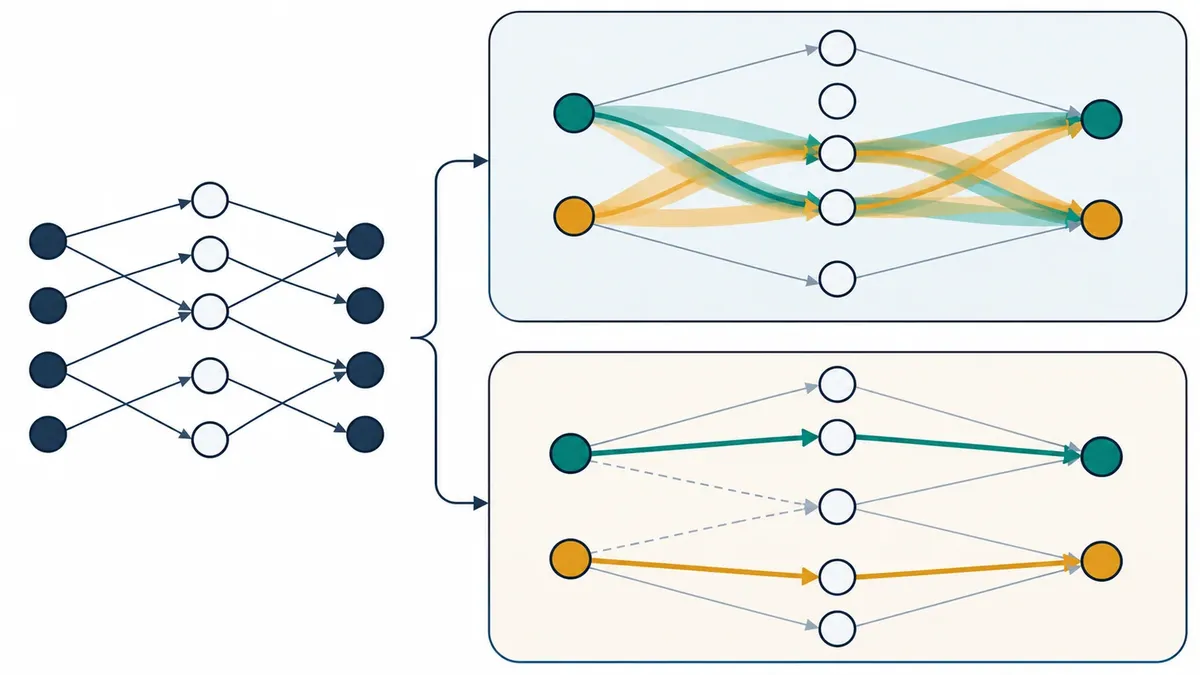
Sparse attention is often judged by how many connections it uses or how far information can travel. Dylan Forde’s preprint asks a different question: how do the connection pattern and attention budgets shape gradients as they pass backward through Sinkhorn normalization?
The hidden role of a sparse mask
Attention lets a model combine information from different tokens. In ordinary softmax attention, each query distributes its own weights across keys. Sinkhorn attention adds a balancing requirement: weights must satisfy budgets for both rows and columns. It does this by repeatedly scaling rows and columns of a matrix of weights.
For long sequences, a model may restrict that matrix to selected query–key pairs, creating a sparse mask. Such masks are commonly described by their edge count, connectivity or the number of steps needed to reach one token from another. Dylan Forde’s paper asks whether those forward-looking measures also tell us how gradients behave as they pass backward through Sinkhorn’s scaling steps.
Turning gradients into a mixing process
The work is a mathematical analysis of Sinkhorn scaling on a fixed sparse support. The support specifies which entries can be nonzero; row and column marginals specify the required totals. The author differentiates one row-then-column scaling cycle with respect to the column log-potentials—the quantities adjusted during normalization.
The calculation produces a row-stochastic matrix, meaning each row sums to one. The paper writes it as M = CᵀR, where C and R are normalized versions of the column- and row-scaling plans. Read as a two-step walk, it moves from a column to a row using Cᵀ, then from that row to a column using R. At a balanced fixed point, the two half-step plans coincide, and the resulting walk is reversible.
The paper uses the walk’s Dobrushin coefficient: the maximum total-variation distance between any pair of rows of a transition matrix. A smaller coefficient means the rows overlap more, so differences between zero-sum gradient signals contract more strongly. The analysis derives bounds connecting this contraction to backpropagation through a finite number of iterations and to error from truncating an implicit-differentiation calculation.
Connectivity is not the whole story
The central result gives a condition for one-step contraction uniformly over all finite learned scores. For a mask and its marginals, such a guarantee exists if and only if every nonempty face of the associated transportation polytope has pairwise two-hop column overlap within its active support. In practical terms, for every such limiting support and every pair of columns, the required two-step transitions must have some common destination. This is more specific than simply requiring the original graph to be connected.
Why consider limiting supports? Under the paper’s assumptions, active edges have positive transport mass for finite scores, but scores can make some masses arbitrarily small. As scores grow, a plan can approach a boundary face where some allowed edges no longer carry mass in the limit. If that face lacks the required overlap, the contraction coefficient can approach one: gradient differences need not quickly wash out. Thus, connectivity of the original mask alone does not guarantee uniform gradient mixing across scores.
The paper illustrates how budgets can matter using a small circular band with a universal hub row. In a deterministic adversarial score sweep, a light hub’s contraction coefficient approaches one as scores increase. With a sufficiently large hub marginal budget in that construction, the budget forces positive mass through the hub’s edges and keeps contraction bounded. This is an example under specified conditions, not evidence that adding hubs improves a trained language model.
The paper also analyzes sequences of sparse layers. For its coordinate-factorized construction with a product marginal, each layer can fail to contract globally on its own, while a complete sweep across coordinates gives exact mixing in one sweep. The paper proves the same exact one-sweep result for a specified hypercube butterfly schedule. These are mathematical results for the stated constructions and assumptions. It also derives bounds for particular expander, local-band and hub-based supports; they should not be read as universal rankings of these mask families.
What the evidence does—and does not—show
This is primarily a theory paper, supported by deterministic numerical checks. The author reports finite-difference checks of the derived gradients and calculations on selected masks, score patterns and spectra. These checks support the worked formulas and examples; they are not broad empirical tests of model quality or training performance.
The scope is limited. The analysis assumes fixed support, finite scores and compatible positive marginals. Dynamic pruning or top-k rewiring, which changes the support during differentiation, is outside the framework. The bounds concern the Sinkhorn scaling map itself; gradients from surrounding neural-network layers also depend on their transformations and must be handled separately. Moreover, checking every face of the transportation polytope can be computationally prohibitive for large supports, so practical analysis may need sufficient bounds or measurements at realized plans.
The supplied source is an arXiv preprint, and the record does not establish peer review. Its conclusions are mathematical claims under stated assumptions, not demonstrations that a particular sparse-attention design improves accuracy, speed or training stability. The paper offers a sharper design question: not only whether tokens can communicate in the forward pass, but whether the support and budgets also let gradients mix in the backward pass.
- Sinkhorn attention
- sparse attention
- gradient flow
- optimal transport
- Markov chains
- machine learning theory
Reviewed cross-references
These connections were reviewed by a model, not independently fact-checked by a human. Similarity does not imply agreement; consult the original papers and the evidence below.
A graph-based approach to robot world-model drift
Shared method: Both papers use Sinkhorn-based transport: Forde studies scaling over a fixed sparse support and its effect on gradient contraction, while Lyu et al. use Sinkhorn optimal transport to align spatial-token changes with graph-node changes in JointGV. This is a shared computational method, not evidence that Forde’s gradient-mixing results apply to JointGV; the excerpts describe different objectives and do not establish whether JointGV’s transport setup meets Forde’s assumptions.
Model review: · openai-codex/gpt-6-luna
Evidence and provenance
Selected excerpts, not complete papers. PDF extraction can omit figures or damage equations, tables and reading order; sources may be preprints.
2609.07954v2 — Original paper
Excerpt reference:
static/papers/2609.07954v2.md:15-44
Basis: Paper text
Source SHA-256:14264ee7b6b4431add2c08425ed293306fe937133bba318766cbe519d44f534d2611.22543v2 — Original paper
Excerpt reference:
static/papers/2611.22543v2.md:235-317
Basis: Paper text
Source SHA-256:d99c8e922a2b110268bbccfaecb71f1bb874a95b0fa0917ffb197d1cb816b669
Related reading
Automatically matched by shared topic keywords. These links do not imply that the sources agree or establish a consensus.
A Mathematical Case for Neural Flow Matching
Source published
Shared keywords: machine learning theory
How quantum algorithms can transport samples through nonreversible chains
Source published
Shared keywords: markov chains
A small memory makes quantum measurement records predictable
Source published
Shared keywords: markov chains
A Head-by-Head Approach to Faster AI Attention
Source published
Shared keywords: sparse attention
How Mosaic coordinates CPUs and GPUs for long-context AI
Source published
Shared keywords: sparse attention