TRANSMISSION // 2609.06960v2
iBrain brings two kinds of invasive brain recordings into one model
Source published
A foundation model trained on intracranial EEG and neural spikes performs well across eight decoding benchmarks, though the evidence remains task- and dataset-specific.
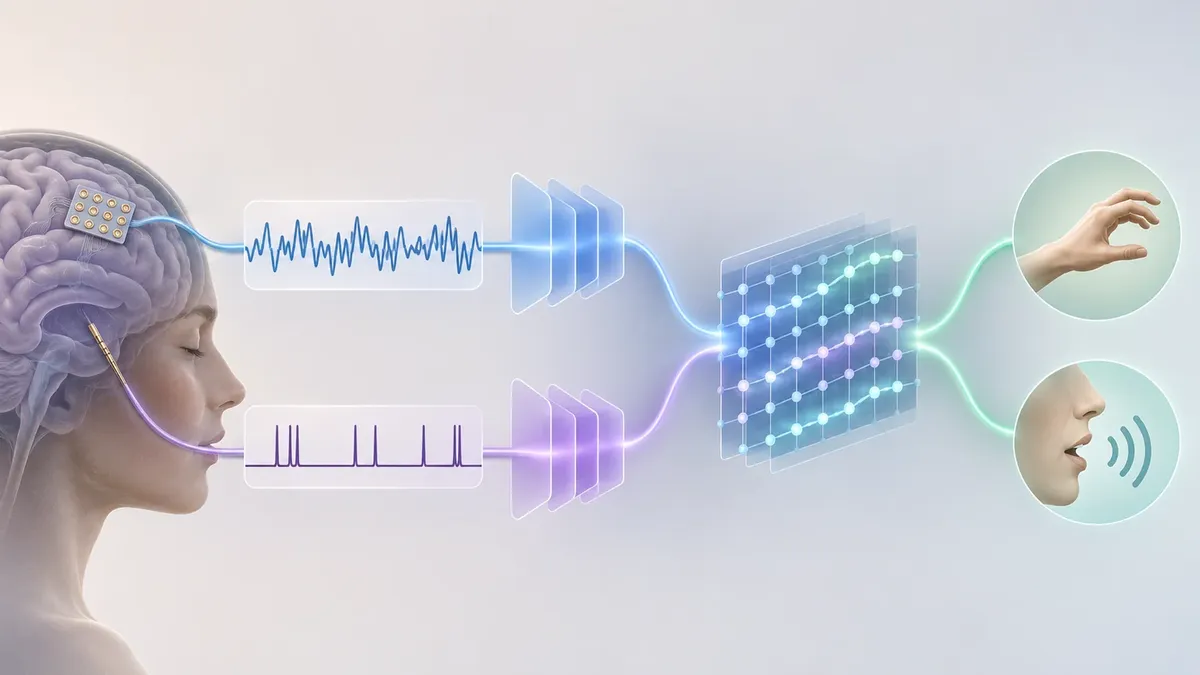
Intracranial EEG and recordings of individual neurons reveal different aspects of brain activity. The iBrain preprint tests whether a model trained on both can learn representations useful across tasks—and reports encouraging results, with important limits.
Brain recordings come in different forms. Intracranial electroencephalography (iEEG) measures electrical activity through electrodes placed inside the skull, while intracortical recordings can capture the firing of individual neurons. These signals differ in scale and structure, but both reflect brain activity. Could a model learn from both rather than treating each recording type separately—and would that help when adapting the model to specific tasks?
The authors introduce iBrain, a foundation model designed to test that idea. The work is described in a preprint, a research paper that has not necessarily been peer reviewed.
One shared model, with signal-specific parts
The challenge is that iEEG waveforms and spike counts are not interchangeable inputs. iBrain therefore uses a separate encoder for each signal type to turn short segments into tokens, a format the model can process. A shared Transformer backbone then models relationships across recording channels or neuron units and across time.
During pretraining, the model learns from recordings without task labels using two objectives. In masked reconstruction, it must infer portions of a signal that have been hidden. In channel-view alignment, it learns to produce similar representations from different subsets of channels or recorded units. The authors intend this second objective to help the model handle variation in which channels are available.
The pretraining collection contains 3,950 hours of iEEG and 3,209 hours of spiking activity. The recordings come from multiple sources and include varied species, brain regions and behavioral contexts, according to the paper. The model is then adapted to eight benchmarks: four involving spike-based movement decoding and four involving iEEG responses to language-related features, such as speech or sentence onset.
Strong results, with one exception
The authors report that iBrain achieved the best result among the compared models on seven of the eight benchmarks. In the four iEEG classification tasks, it outperformed the listed baselines. In the four spike-based tasks, it led on three; another model performed better on Perich T-RT, a random-target reaching task.
The paper also compares pretraining on each signal type alone with joint pretraining. On the reported benchmarks, the joint model matched or exceeded the corresponding single-signal results, and performed better on several tasks. In experiments on two movement-decoding benchmarks, performance improved as the amount of labeled training data increased. The authors describe the model as retaining competitive performance with fewer labeled trials, though the results do not mean that little or no task-specific data is needed.
A further analysis tested pretraining with different quantities of data. Scores rose as the training corpus grew from 500 to 7,160 hours, but the gains became smaller beyond 2,000 hours. The authors suggest that adding more varied subjects, tasks and recording conditions may matter alongside adding hours. That is a plausible interpretation, not something these experiments establish as the cause of the pattern.
What the results do—and do not—show
These findings support the narrower claim that joint pretraining can be useful on the tested tasks. They do not show that iBrain can read thoughts generally, work reliably in clinical settings, or transfer to every kind of invasive recording. The evaluation covers eight benchmarks, and the reported task setups include particular dataset splits and fine-tuning procedures. Other data or evaluation choices could produce different results. The paper also reports one benchmark where iBrain did not lead, a reminder that performance is not uniform across tasks.
The study’s own scaling analysis points to a remaining question: how much of the apparent benefit comes from having more recordings, and how much from their diversity? More tests across subjects, institutions, recording devices and tasks would help clarify how broadly the model transfers. The paper does not establish clinical benefit or show that the model can replace task-specific testing.
Finally, the available source is an arXiv preprint, not evidence of peer-reviewed validation. Its reported comparisons and conclusions should be read as the authors’ current findings, open to scrutiny and replication. iBrain offers a promising approach to combining two distinct kinds of invasive neural data; whether that approach generalizes broadly remains to be tested.
- iBrain
- neural recordings
- intracranial EEG
- spiking activity
- foundation models
- brain-computer interfaces
Reviewed cross-references
These connections were reviewed by a model, not independently fact-checked by a human. Similarity does not imply agreement; consult the original papers and the evidence below.
Separating Movement-Related Patterns in Mixed Brain Recordings
Supporting evidence: In separate settings, both studies report benefits from combining neural modalities: iBrain’s joint iEEG–spike pretraining improved results over signal-specific pretraining on its evaluated benchmarks, while BREM-NET reported improved behavior decoding when adding a second neural modality in a non-human-primate reaching dataset. These findings are compatible with multimodal information helping model performance in the tested settings, but the models, modalities, populations and outcomes differ, so they do not establish a shared mechanism or general benefit across tasks.
Model review: · openai-codex/gpt-6-luna
Evidence and provenance
Selected excerpts, not complete papers. PDF extraction can omit figures or damage equations, tables and reading order; sources may be preprints.
2609.06960v2 — Original paper
Excerpt reference:
static/papers/2609.06960v2.md:80-143
Basis: Paper text
Source SHA-256:25b7404aa59ed3ce7c50aa26abaf39a148337a7a2ce571607c6ef6106a8746b22609.06960v2 — Original paper
Excerpt reference:
static/papers/2609.06960v2.md:625-707
Basis: Paper text
Source SHA-256:25b7404aa59ed3ce7c50aa26abaf39a148337a7a2ce571607c6ef6106a8746b22611.05167v1 — Original paper
Excerpt reference:
static/papers/2611.05167v1.md:598-722
Basis: Paper text
Source SHA-256:cd7093e20e3515e447f5467d4d500661875d3ac2cc5ac94237bf68ea2d36c734
Related reading
Automatically matched by shared topic keywords. These links do not imply that the sources agree or establish a consensus.
Separating Movement-Related Patterns in Mixed Brain Recordings
Source published
Shared keywords: brain computer interfaces, spiking activity
EEG Models May Separate People Better Than the Tasks They Perform
Source published
Shared keywords: brain computer interfaces, foundation models
What Relevance Maps Reveal About EEG AI
Source published
Shared keywords: brain computer interfaces
Seizure-detection AI learns to handle different electrode layouts
Source published
Shared keywords: intracranial eeg
One EEG Model, Three Kinds of Decisions
Source published
Shared keywords: brain computer interfaces