TRANSMISSION // 2609.06295v3
Organic Molecules and Outflows Around Two Young Stars
Source published
NOEMA observations map organic molecules and gas outflows around IRAS 4B and IRAS 4B′, revealing different emission patterns around the two young objects.
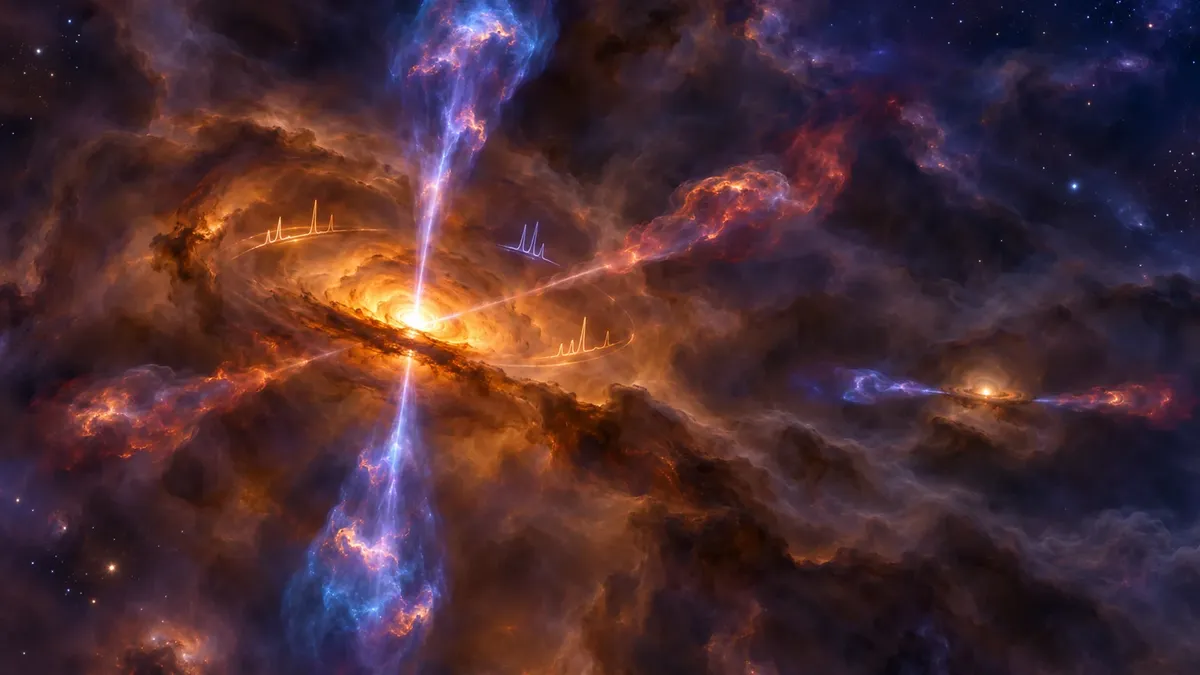
Molecular signals can reveal what is happening in the gas around forming stars. NOEMA observations of IRAS 4B and its nearby companion show a molecule-rich warm inner region and multiple outflows around 4B, while 4B′ has an outflow but no detected complex-organic-molecule emission coincident with its continuum source in the observed frequencies.
How are complex organic molecules arranged around forming stars, and how do they relate to the gas those stars send streaming outward? A study using the Northern Extended Millimeter Array (NOEMA) examines these questions in NGC 1333, a star-forming region in the Perseus molecular cloud. The targets, IRAS 4B and IRAS 4B′, are young stellar objects that appear close together on the sky.
Interstellar complex organic molecules, or iCOMs, are carbon-containing molecules with at least six atoms. They interest researchers as possible ingredients for later prebiotic chemistry; finding them does not mean life is present. In the warm inner envelope around a young protostar, molecules frozen onto dust grains can enter the gas and produce detectable signals at radio and millimetre wavelengths.
Reading the molecular signals
The team observed the pair with NOEMA in a frequency band near 145 gigahertz. By combining signals from multiple antennas, this interferometer can map where emission comes from, rather than providing only a blended spectrum. The observations covered broad frequency ranges and narrower, higher-resolution windows selected to include transitions from molecules of interest.
Researchers matched the observed spectral lines to molecular catalogues and fitted multiple lines with GOBASIC, a spectral-analysis tool. The fits assume local thermodynamic equilibrium and optically thin transitions. These assumptions simplify the connection between line brightness and estimates of gas temperature and molecular column density—the amount of a molecule along a line of sight. The team also mapped molecular emission and estimated temperatures, column densities, and gas velocities.
A rich inner envelope and several outflows
IRAS 4B’s spectrum contains hundreds of molecular transitions. The paper reports identifying 46 molecules, with 21 meeting the authors’ criterion for a firm detection through multiple lines. They derived physical parameters for 11 molecules, including methanol and several iCOMs: methyl formate, dimethyl ether, acetaldehyde, ethanol, glycolaldehyde and acetone. Most mapped iCOM emission is concentrated around the warm inner envelope and overlaps the continuum emission, which traces the compact source and surrounding material.
Many organic molecules also show similar spatial patterns. That resemblance suggests they occupy similar environments; it does not show that one molecule chemically produces another. Establishing reaction pathways would require additional chemical modelling, which the authors say is beyond this study’s scope.
The maps distinguish compact emission around IRAS 4B from more extended emission associated with gas flows. The authors identify a north–south flow and another oriented northwest–southeast. They interpret the first as a likely faster jet and the second as a lower-velocity outflow. Because flows in two directions appear associated with 4B, they argue that it is probably a binary protostar, with each young star driving a different flow. This is an interpretation of the mapped structures, not a direct observation of each star launching its own flow.
IRAS 4B′ has an east–west outflow traced by molecular emission. However, the observations found no iCOM emission coincident with its continuum source at the frequencies studied. This non-detection does not establish that the companion contains no complex molecules. The authors suggest it may be cold, heavily obscured by dust, or have a low molecular column density. Its developmental stage remains uncertain.
What remains uncertain
The derived values depend on modelling assumptions and on which lines can be measured clearly. The authors report that many methanol lines toward IRAS 4B appear optically thick, making the fitted parameters for that molecule physically unreliable. Some other molecules lacked enough unblended lines for a full parameter analysis. Limited angular resolution may also conceal smaller structures. The paper calls for broader, higher-resolution observations to better address line blending and optical-depth corrections.
The source identifies this work as a November 2026 draft preprint on arXiv. That label describes how the manuscript is shared; the source information provided here does not establish its review status. The findings offer a detailed look at one young stellar system, but cannot alone show how common these chemical and outflow patterns are among protostars.
- astrochemistry
- complex organic molecules
- protostars
- NOEMA
- molecular outflows
- star formation
- NGC 1333
Related reading
Automatically matched by shared topic keywords. These links do not imply that the sources agree or establish a consensus.
A Protostar’s Brief Flare May Leave a Long Chemical Echo
Source published
Shared keywords: complex organic molecules, star formation
Molecular outflows offer clues to how massive young stars gather gas
Source published
Shared keywords: molecular outflows
Webb traces molecular gas pushed from NGC 3884
Source published
Shared keywords: molecular outflows
Jets trace young stars in Auriga–California
Source published
Shared keywords: star formation
A newborn star’s disc moves gas inward and outward in stacked layers
Source published
Shared keywords: star formation