TRANSMISSION // 2609.05230v2
WISPIT 2’s gas shows clues near known planets
Source published
ALMA data show gas gaps and pressure-related rotation features near two known WISPIT 2 protoplanets, plus a localized velocity disturbance near only the outer planet. Several interpretations remain uncertain.
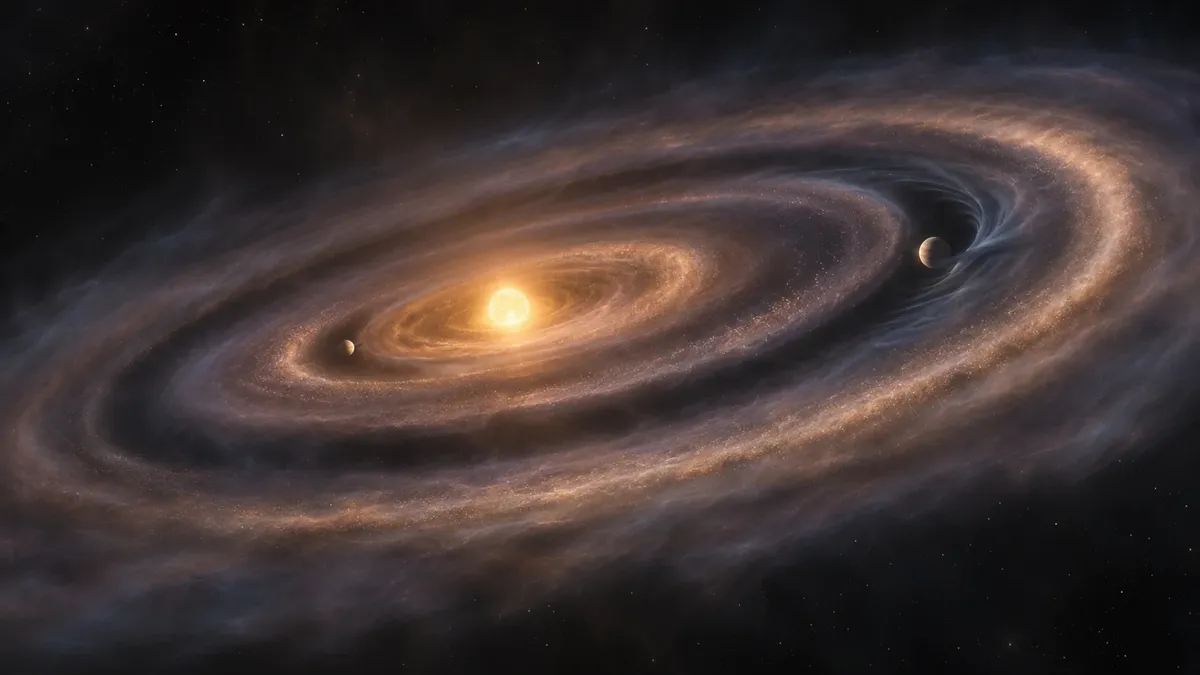
Gaps in young stars’ disks can hint at planets, but other processes can make similar patterns. In WISPIT 2, astronomers compared ALMA maps of gas and dust with two previously detected protoplanets to see how the disk’s structure and motion relate to them.
A disk with planets in view
Planets form in disks of gas and dust, but observing them while they are still embedded is difficult. Gaps in a disk or departures from the gas’s expected orbital motion can be clues to planets, though other disk processes can also produce such features. Comparing these clues with planets detected independently offers a way to test the connection.
WISPIT 2 is a young, roughly Sun-like star about 133 parsecs away. Earlier observations identified two giant protoplanets: WISPIT 2c, at about 14 astronomical units (au) from the star, and WISPIT 2b, farther out, at roughly 57–65 au. One au is the average Earth–Sun distance. The new study asks whether gas structures and motion show features near these known planets.
Reading gas and dust with ALMA
The team used new observations from the Atacama Large Millimeter/submillimeter Array (ALMA), including emission from carbon monoxide (CO) gas and millimeter-wavelength light from dust. They mapped the gas emission and motion, then compared the results with a model of a smoothly rotating, Keplerian disk. They also analyzed the dust emission and revisited earlier scattered-light images and measurements of the planets’ orbits.
In a Keplerian disk, orbital speed is largely set by the star’s gravity. Gas pressure can also affect that speed, so changes in the rotation curve can indicate pressure structures such as gaps or bumps. The researchers additionally used a statistical analysis to search for localized velocity disturbances after accounting for the smooth rotation pattern.
What the observations show
The team reports drops in CO emission near 15 and 60 au, close to the approximate locations of WISPIT 2c and WISPIT 2b. The gas rotation curve also has pressure-related features in those regions. A localized disturbance in the gas velocity field was detected near WISPIT 2b. No comparable localized signal was detected near WISPIT 2c at the observations’ spatial resolution.
The millimeter-bright dust ring peaks near 144 au. A decreasing gradient in the rotation-curve residuals there is consistent with a gas-pressure bump, but the measured feature does not line up exactly with the ring. The authors discuss possible influences on that offset, including velocity asymmetries, beam smearing and vertical differences in the disk’s pressure structure. Further observations using multiple tracers would help map that structure in three dimensions.
The gas gaps appear wider on their outer sides than on their inner sides. This asymmetry is consistent with models of gaps shaped by planets on eccentric orbits, but it is not definitive: projection or optical-depth effects could contribute, and the CO observations do not resolve the gas gaps well enough to confirm their eccentricity directly. Converting CO emission into gas density also requires assumptions about temperature, chemistry and molecular abundance. The authors say their thermal-chemical model is not unique, and different methods give substantially different indications of the disk’s mass.
The orbital evidence is also uneven. The authors’ reanalysis suggests moderate eccentricity for WISPIT 2b. WISPIT 2c’s eccentricity may be higher, but its orbit is less well constrained because the astrometric observing baseline is only about six months. The orbit measurements therefore do not establish equally strong eccentricity constraints for both planets.
An open question farther out
A shallow gap near 130 au appears in scattered-light observations but is not detected in CO emission. The authors include a possible third planet in their modeling as one explanation for the outer disk’s apparent circularity. That planet remains speculative, not a detection; the CO feature is unresolved or absent at the available sensitivity and resolution.
WISPIT 2 is a useful case for comparing disk features with planets whose locations are already known. The results show gas gaps and pressure-related rotation patterns near both known planets, and a separate localized velocity disturbance near the outer planet. Taken together, these observations are consistent with planet–disk interaction, but they do not prove that planets uniquely explain every feature or resolve the disk’s full structure.
This account is based on the supplied arXiv preprint. Its interpretation depends partly on models and assumptions, and the paper itself notes important limitations in the gas and orbital constraints. Further observations and modeling can test the proposed explanations, including the possible third planet.
- WISPIT 2
- protoplanetary disks
- ALMA
- giant planets
- planet formation
- gas kinematics
Reviewed cross-references
These connections were reviewed by a model, not independently fact-checked by a human. Similarity does not imply agreement; consult the original papers and the evidence below.
Gas persists inside the dust gaps of three planet-forming disks
Shared method: Both studies use ALMA observations of CO isotopologue emission to examine gas structure in protoplanetary disks: van der Marel et al. analyze WISPIT 2’s CO maps and isotopologue data, while Rota et al. measure isotopologue radial profiles in three transition disks. The targets and analyses differ, so this is a methodological connection, not evidence that their findings agree.
Model review: · openai-codex/gpt-6-luna
Evidence and provenance
Selected excerpts, not complete papers. PDF extraction can omit figures or damage equations, tables and reading order; sources may be preprints.
2609.05230v2 — Original paper
Excerpt reference:
static/papers/2609.05230v2.md:122-164
Basis: Paper text
Source SHA-256:290930a2bb6fe9671224d6b7b868dc5da55c13918ea103b64ee657df005cc9a12611.09449v1 — Original paper
Excerpt reference:
static/papers/2611.09449v1.md:16-71
Basis: Paper text
Source SHA-256:13f983a03f947b252fcaed5c8c92c9701712175a1200e5b1719dc72dfee8170b
Related reading
Automatically matched by shared topic keywords. These links do not imply that the sources agree or establish a consensus.
Dust clues to giant-planet formation around small stars
Source published
Shared keywords: giant planets, planet formation
A new look at the spirals around IM Lup
Source published
Shared keywords: planet formation, protoplanetary disks
Gas persists inside the dust gaps of three planet-forming disks
Source published
Shared keywords: planet formation, protoplanetary disks
How Dust Opacity Shapes a Route to Gas Giants
Source published
Shared keywords: planet formation, protoplanetary disks
Five simulated giant planets migrate inward—but their shared destination is not a universal rule
Source published
Shared keywords: protoplanetary disks