TRANSMISSION // 2609.03709v2
How Earlier Solar Eruptions May Help Shocks Accelerate Electrons
Source published
A study of nine rare interplanetary shocks links energetic electron enhancements with earlier CMEs and stream interaction regions, and uses simulations to explore how magnetic trapping may help.
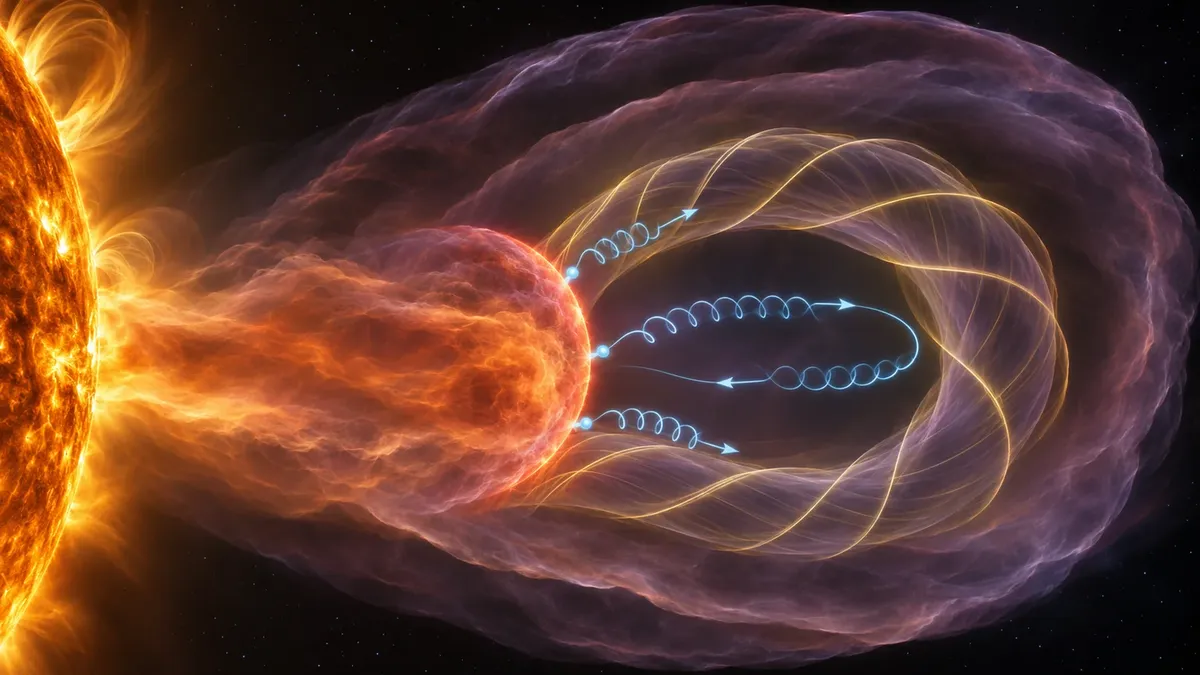
Interplanetary shocks can accelerate particles, but strong enhancements of MeV electrons near shocks are rare. A study using STEREO observations examines whether structures already in the solar wind—especially earlier eruptions and stream interaction regions—can create conditions that help electrons gain energy.
Why look beyond the shock itself?
When a coronal mass ejection (CME)—a large eruption of magnetized plasma from the Sun—moves through space, it can drive a shock. That shock can accelerate particles. Yet near Earth’s orbit, interplanetary shocks are generally not efficient at producing high-energy electrons, and strong enhancements of electrons in the mega-electronvolt (MeV) range are unusual.
The study asks whether the surroundings of a shock matter as much as its immediate properties. Earlier CMEs can leave behind magnetic structures, while a stream interaction region (SIR) forms where faster solar wind catches up with slower wind. Both may alter how particles travel, become trapped, or reach a shock.
Following nine unusual events
The authors examined nine interplanetary shocks observed by the twin Solar Terrestrial Relations Observatory (STEREO) spacecraft. These events had already been identified as having significant MeV electron enhancements. The team combined spacecraft measurements of magnetic fields, solar-wind plasma and electrons with images of solar eruptions. They also used drag-based models to estimate how CMEs and shocks might travel outward and encounter earlier structures.
Those propagation estimates are simplified: the model assumes a uniform background solar wind and does not explicitly simulate interactions between CMEs. The authors therefore treat predicted trajectory crossings as indications of possible encounters, not detailed reconstructions of what happened in space.
Eight of the nine events were associated with at least one preceding slow or intermediate-speed CME. In six, spacecraft measurements showed the shock propagating within an earlier interplanetary CME (ICME, the portion of a CME measured in space). The team identified three situations associated with electron enhancements: shocks moving into earlier ICMEs; interactions between shocks and SIRs; and flare-accelerated electrons entering an SIR and potentially being accelerated again at its shock.
These are associations in a small, selected sample—not evidence that any one structure always makes a shock an efficient accelerator. The events were chosen because they already showed unusual MeV electron increases, so they cannot establish how common these conditions are among shocks generally.
A magnetic loop as a particle trap
The researchers examined the 29 January 2012 event in greater detail. Measurements showed a nearly perpendicular shock inside an earlier CME and signs of closed magnetic field lines upstream. Such a loop could act somewhat like a track that keeps electrons near the shock, giving them repeated chances to interact with it rather than letting them stream away after one encounter.
To test that possibility, the team used a one-dimensional Monte Carlo test-particle simulation. It compared an open magnetic field with a loop-like configuration, using observed shock conditions and assumptions about how strongly particles scatter. In the simulated loop geometry, electron acceleration was more efficient, and all three tested scattering setups produced electrons above 1 MeV. The loop case also reproduced the observed spectral shape more closely, according to the authors.
This is a model result, not a direct measurement of electrons repeatedly bouncing around the real shock. The simulation simplifies the magnetic geometry and uses prescribed scattering rather than calculating all the relevant waves and particle interactions self-consistently. Its outcome supports the plausibility of magnetic trapping; it does not prove that trapping alone explains the event.
What remains uncertain
Other events suggest that different ingredients may matter in different settings. In the 2011 June case, a SIR interacted with CME structures, while a 2013 event was interpreted as flare-accelerated particles entering an SIR and later encountering its shock. The authors also note that local shock features, such as magnetic-field structure at the shock front, could affect acceleration. The nine cases do not isolate these factors experimentally, and the authors say the evolution of some interactions cannot be traced directly from available observations.
The work is presented as an Astronomy & Astrophysics manuscript and arXiv preprint. A preprint is a research report made available before or outside a journal’s final publication process. Although the manuscript mentions anonymous referee comments, the available source does not independently establish its publication status or peer-review history. Its conclusions are best read as interpretations of a limited set of observations and a simplified simulation, not as a settled general rule.
The broader message is that a shock’s magnetic environment may shape how long electrons stay nearby and how often they encounter the shock. Understanding that environment could help explain why some interplanetary shocks are associated with rare, energetic electron enhancements while many are not.
- solar physics
- coronal mass ejections
- interplanetary shocks
- energetic electrons
- stream interaction regions
- particle acceleration
Related reading
Automatically matched by shared topic keywords. These links do not imply that the sources agree or establish a consensus.
An extended gamma-ray source hints at a pulsar-powered particle accelerator
Source published
Shared keywords: particle acceleration
Could axions reshape magnetic turbulence? A theoretical study links field-line geometry to energy spectra
Source published
Shared keywords: solar physics
How Solar Flare X-rays Trace a Heating Pattern
Source published
Shared keywords: solar physics
Neural emulators speed up detailed maps of the Sun
Source published
Shared keywords: solar physics
Could traveling waves help launch solar spicules?
Source published
Shared keywords: solar physics