TRANSMISSION // 2609.03701v3
Gas disks could steer stars into growing black holes
Source published
Star-by-star simulations suggest that gas disks can deliver a sustained supply of stars to intermediate-mass black holes in dense clusters. The mechanism could accelerate early black-hole growth, but its long-term effectiveness depends on uncertain disk lifetimes and how much disrupted stellar material is actually swallowed.
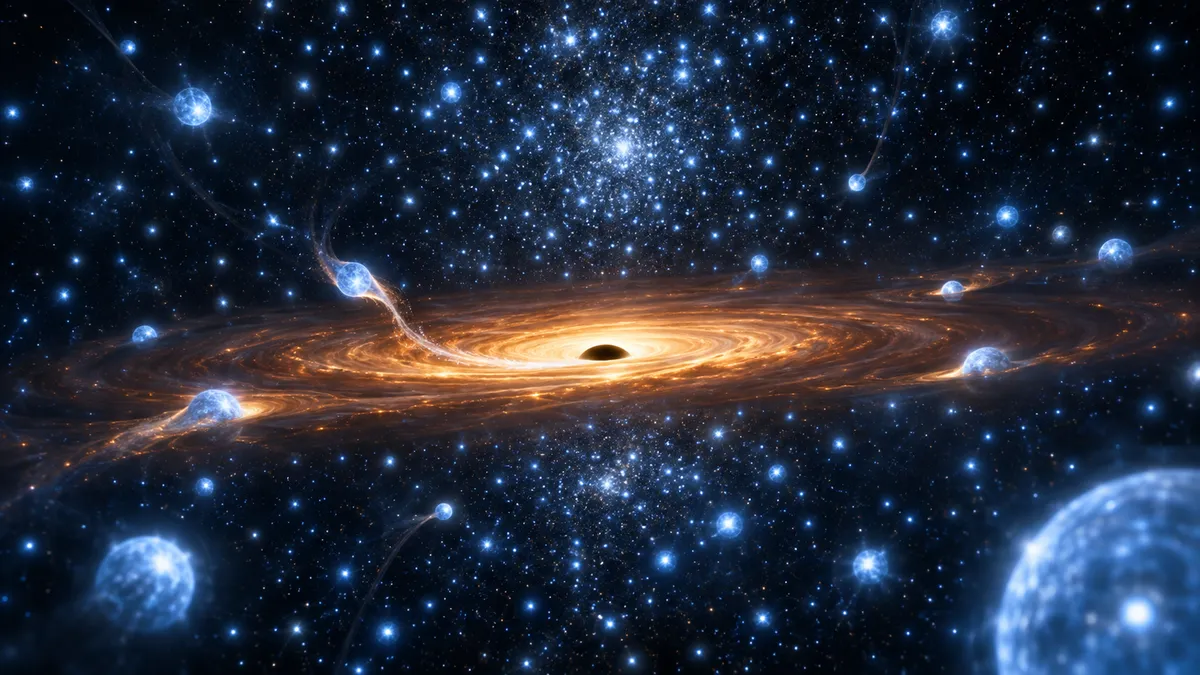
A black hole surrounded by stars does not automatically have a steady food supply: stars must reach orbits that bring them close enough. New simulations explore how a surrounding gas disk could remove orbital energy and angular momentum, capturing passing stars and guiding them inward toward destruction.
A study led by Mengye Wang investigates whether this disk-assisted feeding can keep working after the nearest stars have been consumed. Its central result is that gravitational encounters within a dense cluster can replenish the stars interacting with the disk, sustaining substantial stellar delivery over the simulated interval.
The work is available as arXiv version 2609.03701v3, revised on November 6, 2026. The landing page reports acceptance to The Astrophysical Journal; the supplied record is the arXiv manuscript, not a separately identified journal publication. These are simulation results, not observations of black holes growing through this process.
A stellar conveyor belt
In the proposed mechanism, stars repeatedly cross a black hole’s accretion disk. Interactions with gas remove orbital energy and damp motion perpendicular to the disk. Many stars gradually settle into nearly circular orbits within its plane. Interactions with density waves in the gas then drive inward migration.
Eventually, the stars should reach the region where the black hole’s tidal forces tear them apart. The authors call these disk-induced tidal disruption events, or dTDEs. Unlike the highly elongated orbits associated with classical tidal disruptions, this route can deliver stars on much rounder paths.
The crucial question is not simply whether one star can migrate inward. It is whether the surrounding cluster can keep supplying replacements. Repeated gravitational encounters between stars redistribute their orbits, potentially bringing fresh stars into contact with the disk.
Following stars individually
The team used the PETAR gravitational simulation code to follow roughly 370,000 stellar particles in a cluster containing 200,000 solar masses. Its half-mass radius—the radius enclosing half its stellar mass—was 0.6 parsecs. Three runs explored central black holes with masses of 3,000, 10,000 and 30,000 Suns.
The calculations included stellar evolution, close gravitational encounters and simplified physical mergers. Gas interactions were represented by analytical drag and migration prescriptions rather than by directly simulating the gas flow and its response to every star.
The researchers first increased the central black hole’s mass gradually over two million years, allowing the cluster to adjust and develop a central concentration of stars. They then activated the disk forces and followed the disk-assisted phase for only about 300,000–500,000 years. The standard disk’s outer edge lay at approximately 0.003 parsecs.
Substantial delivery, not guaranteed growth
The measured, time-averaged stellar mass delivery rates were about 0.00079, 0.00078 and 0.0026 solar masses per year for the three black-hole masses, respectively. These rates exceeded the Eddington-limited gas accretion rates used for comparison in all three cases. That benchmark describes gas accretion constrained by the outward pressure of radiation.
Delivery remained approximately steady during the simulated disk-active interval, rather than appearing only as an initial burst. The results support a picture in which gravitational encounters replenish the inner population while disk interactions remove stars from it.
About 80% of disruption candidates had orbital inclinations smaller than the disk’s aspect ratio when they crossed the calculation’s inner boundary. The remainder had not fully settled into the disk. Some candidates retained highly elongated, backward-moving orbits, showing that delivery did not follow one uniform migration track. Roughly 23%–45% had experienced at least one stellar merger before reaching that boundary.
An important qualification is that the simulations did not resolve actual stellar disruption. They counted stars once their orbital semi-major axes fell below 0.0001 parsecs, around 100 times the representative physical disruption radius. Halving this numerical threshold produced nearly identical rates in a control run. That supports the proxy’s usefulness, but it does not directly resolve disruption or the subsequent fate of the debris.
The longer-term possibility
Using the measured rates, the authors constructed illustrative growth histories in which a 3,000-solar-mass seed could reach roughly 100,000 solar masses in about 30 million years when stellar feeding supplements gas accretion. This is an extrapolation, not a growth history followed directly by the simulations.
It requires a compact cluster, a persistent disk and continuing supplies of gas and stars for far longer than the simulated interval. The calculations also adopt solar metallicity, so they do not directly reproduce the chemical conditions of primordial stellar systems.
Other uncertainties affect the outcome. Thicker disks could suppress stellar capture and migration. Collisions were treated as mass-conserving mergers, although real impacts can lose material or fail to merge. Feedback on the disk was not evolved self-consistently.
Most importantly, delivered stellar mass is not necessarily retained black-hole mass. The growth estimates assume full accretion of disrupted stars, which the authors explicitly describe as an optimistic upper limit. The study therefore establishes a promising local feeding mechanism under specified conditions—not a demonstrated solution to the origin of the early Universe’s massive black holes.
- intermediate-mass black holes
- accretion disks
- tidal disruption events
- stellar clusters
- N-body simulations
- black hole seeds
Related reading
Automatically matched by shared topic keywords. These links do not imply that the sources agree or establish a consensus.
How JWST Could Trace the Seeds of the First Massive Black Holes
Source published
Shared keywords: black hole seeds
Why missing radio signals do not rule out black holes in dwarf galaxies
Source published
Shared keywords: intermediate mass black holes
A billion-star search maps the Milky Way’s nested structures
Source published
Shared keywords: stellar clusters
Ansky’s galaxy shows signs of black-hole activity before its 2019 brightening
Source published
Shared keywords: tidal disruption events
Neutron star binaries may get their chance after a cluster’s black holes leave
Source published
Shared keywords: n body simulations