TRANSMISSION // 2609.01388v2
Ultraviolet Clues in Two Quiet Novae
Source published
In a quiet phase between eruptions, two recurrent novae show ultraviolet signs consistent with ongoing accretion. The estimated rates are lower limits, and several interpretations remain uncertain.
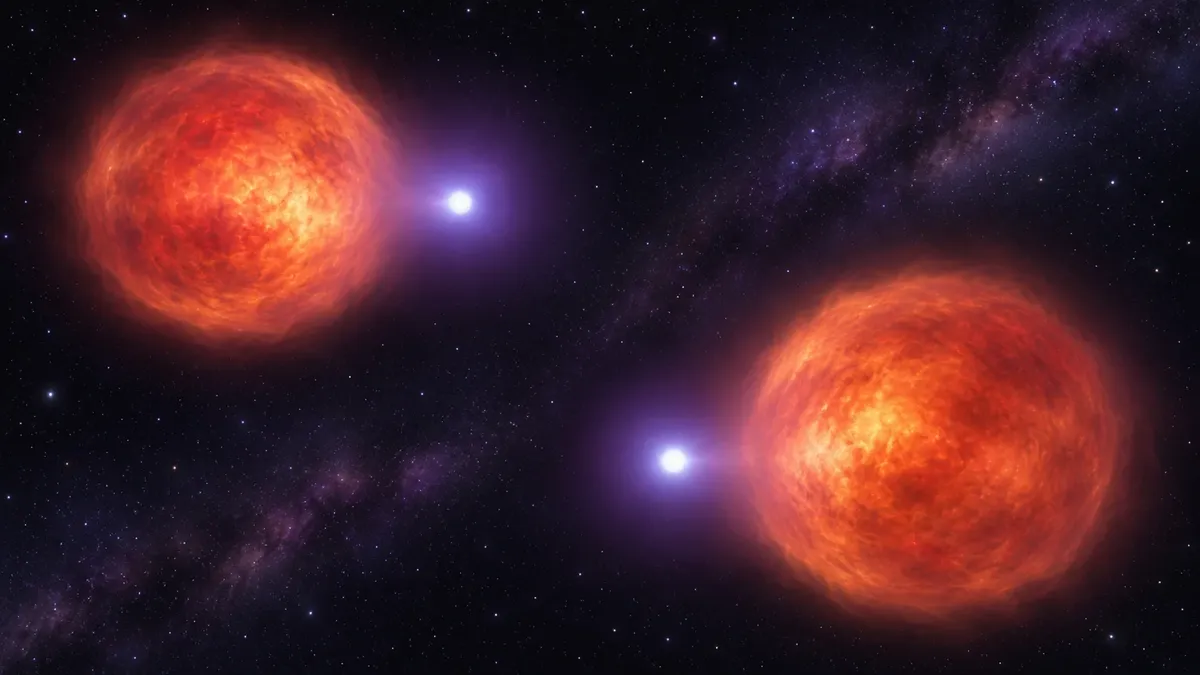
V745 Sco and V3890 Sgr are binaries in which a white dwarf and a red giant are associated with recurring nova eruptions. New observations find ultraviolet light consistent with material still reaching the white dwarfs between eruptions—but the inferred rates depend on assumptions about the stars and their light.
A nova’s “quiet” phase is not necessarily inactive. In V745 Sco and V3890 Sgr, two stellar binaries known for repeated eruptions, ultraviolet light is consistent with continued transfer of material onto a white dwarf between outbursts.
These systems belong to a rare group called symbiotic recurrent novae. Each contains a white dwarf and a red giant. Material from the giant can accumulate on the white dwarf; under the right conditions, nuclear reactions ignite and produce a nova eruption. The researchers set out to better characterise the less-studied systems while they were in quiescence—the interval between eruptions.
Reading the light from two stars
The team combined spectra from the X-shooter instrument on the Very Large Telescope with ultraviolet and X-ray observations from NASA’s Swift satellite. They supplemented these with ground-based optical measurements and archival data, including infrared observations. Spectra help identify the giant stars and reveal features of gas in each binary. Measurements across wavelengths let researchers compare each system’s energy output with that expected from a normal giant star.
That comparison is important because light beyond what the red giant alone would produce can signal emission associated with accretion: material releasing energy as it falls toward the white dwarf. The researchers classified the giants as M7III in V745 Sco and M6.5III in V3890 Sgr. To estimate how much their light is dimmed by interstellar dust and how far away they are, the team compared their colours and brightnesses with those of typical late-type giants in the Galactic bulge.
Both binaries showed a pronounced ultraviolet excess relative to the comparison stars. The authors interpret this as evidence of ongoing accretion during quiescence. From the excess light, they estimated lower limits on the mass-transfer rates: at least about 2.4 × 10⁻⁸ solar masses per year for V745 Sco and 2.5 × 10⁻⁸ for V3890 Sgr. These are not complete measurements. The observations do not cover every wavelength, and the systems’ energy output may peak at wavelengths shorter than Swift’s ultraviolet coverage.
A clue, not a full account
The rate estimates help frame how the systems might prepare for their next eruptions. If material continues accumulating at roughly the inferred minimum rate, the time to build up enough fuel could be comparable to the systems’ past intervals between outbursts. In that scenario, a prolonged period of unusually high accretion would not necessarily be required.
That conclusion is conditional, not a prediction. The calculation depends on how much material must accumulate before ignition and on whether the observed rate persists over time. The researchers stress that their observations capture the systems at particular moments, not their behaviour throughout quiescence. They also report that Swift detected neither system in X-rays during its short observations. The resulting upper limits depend on the assumed X-ray spectrum; the non-detections constrain what can be said about X-ray emission at that time, but do not negate the ultraviolet evidence.
The study also finds an infrared excess in V745 Sco, but not in V3890 Sgr. The extra infrared light could come from circumstellar dust or from cool outer regions of an extended accretion disk. Both remain plausible: the authors’ simplified disk model does not reproduce the observations well enough to rule that explanation out.
Other uncertainties affect the interpretation. Distance and reddening estimates rely partly on comparisons with typical bulge giants. The authors note possible systematic errors if the stars differ from those comparison samples. Their mass-transfer estimates also depend on assumptions about the white dwarfs and on converting observed light into an accretion rate. The paper’s discussion of how the giants transfer material considers different possibilities; the observations do not establish one specific flow geometry.
The researchers examine hydrogen-line features as well. The emission and absorption profiles differ between the systems, but observations at different points in their orbits are needed to interpret the gas confidently.
This work is an arXiv preprint presented as an Astronomy & Astrophysics manuscript; the supplied manuscript has placeholder receipt and acceptance dates. Its conclusions should be treated as provisional research findings, not a settled account. Longer-term monitoring and broader wavelength coverage could test whether the inferred accretion rates persist and help distinguish dust from a disk as the source of V745 Sco’s infrared excess.
- symbiotic recurrent novae
- V745 Sco
- V3890 Sgr
- white dwarfs
- accretion
- ultraviolet astronomy
Related reading
Automatically matched by shared topic keywords. These links do not imply that the sources agree or establish a consensus.
Quasar jets leave a mark on ultraviolet emission lines
Source published
Shared keywords: ultraviolet astronomy
Planetary debris leaves hydrogen behind in white dwarf atmospheres
Source published
Shared keywords: white dwarfs
How a star’s magnetic field reshapes its accretion disc
Source published
Shared keywords: white dwarfs
White dwarf brightness offers clues to AM CVn evolution
Source published
Shared keywords: white dwarfs
Changing accretion, similar X-ray temperatures
Source published
Shared keywords: white dwarfs