TRANSMISSION // 2609.00795v2
A New Blueprint for AI-Assisted Materials Software
Source published
A materials-science Perspective proposes combining fixed algorithms with bounded AI judgment. Its DeMARS case study builds models of disordered crystals, while highlighting the need for verification and clear limits.
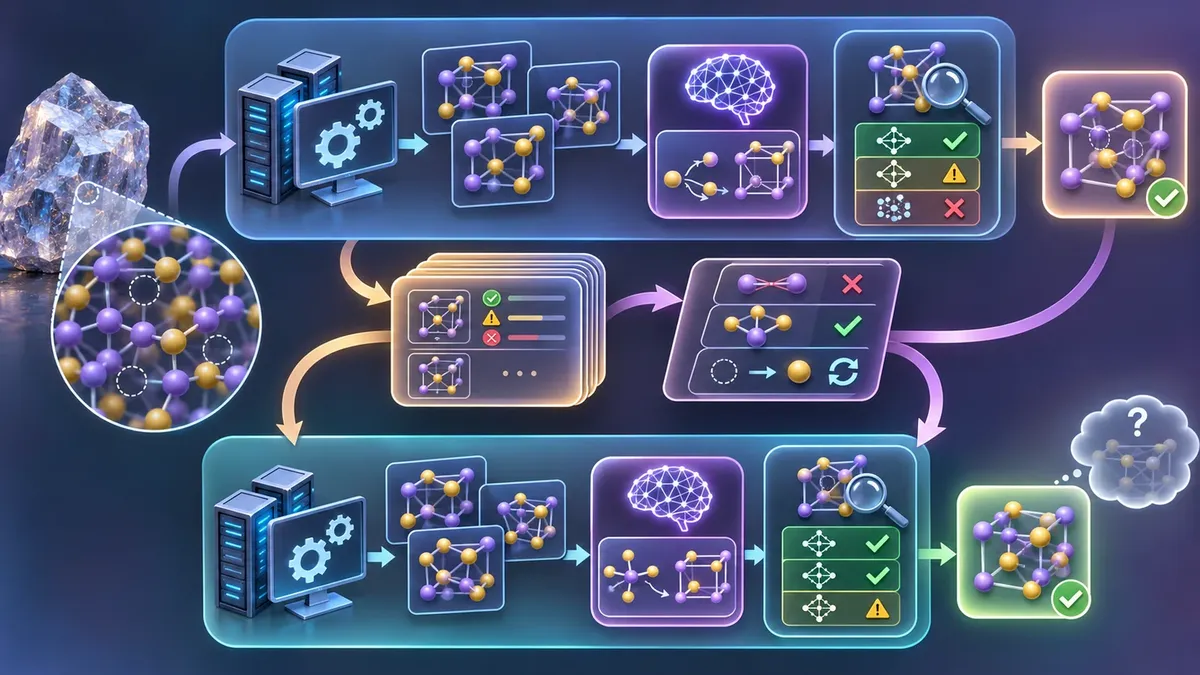
Can scientific software handle not just calculations, but some of the judgment researchers use to guide them? A Perspective on computational materials science proposes combining conventional algorithms with bounded decisions from large language models, then testing the decisions’ computable consequences. Its example, DeMARS, constructs atomistic models from crystallographic information files describing experimentally reported disordered crystals.
When software needs scientific judgment
Computational materials science has long relied on a division of labor: people make scientific decisions, while computers carry out calculations. But some tasks do not follow a fully specified recipe. A disordered crystal structure, for example, may leave researchers to decide how atoms should be arranged in a model before calculations can proceed.
In this Perspective, Yunsung Lim and colleagues argue that large language models (LLMs) could help with such decisions when placed inside what they call an agentic program. This is not simply a chatbot offering suggestions. It is software designed to take responsibility for a clearly bounded scientific task, using conventional algorithms for defined operations and model-based judgment where a rule cannot be fully specified in advance.
The authors argue that the language model should not replace algorithms. Instead, its decision-making should be limited, the consequences tested where possible, and the reasoning and results made inspectable. This is a software-design proposal, illustrated through a materials-science system—not evidence that AI can independently conduct open-ended research.
A test case in disordered crystals
The example is DeMARS, short for De-averaged Minimal Atomistic Representation System. It takes a crystallographic information file (CIF) describing an experimentally reported disordered crystal and produces an atomistic model: a representation of the material in terms of individual atoms and their positions.
For substitutional disorder, a model can often be made by expanding the unit cell and distributing partially occupied species over sites. More complex disorder may involve coupled site occupancies or chemical constraints, so independently assigning sites can produce implausible structures. DeMARS uses an LLM-based analyst to interpret evidence and specify construction rules. It can also redirect the workflow when model repair or a custom construction is needed, and assess the resulting energy distribution to decide whether to accept it or rerun enumeration with a revised specification. Conventional code generates and relaxes candidate structures. A separate reviewer agent examines the finished record in a fresh context.
The system checks outputs against criteria including charge neutrality, occupancy fidelity and connectivity. These checks test computable consequences of an interpretation, but, the authors stress, do not prove that the interpretation is uniquely correct.
One example is RbCrO₃F (ICSD 31704). Unconstrained enumeration produced CrO₄ or CrO₂F₂ units in 18 of 48 chromium-centered tetrahedra. Using chemical reasoning, the analyst proposed a construction rule requiring one fluorine atom per tetrahedron. The constrained construction lowered the final structure’s energy by 34 meV per atom. This illustrates how a judgment can guide which structures are generated and how computation can test its consequences; the energy result alone does not establish that the chemical interpretation is correct.
Learning from failures—and a measured result
The authors describe “maturation” as turning lessons from failures into reusable program components: revised instructions, diagnostics, verification checks or deterministic code. In one episode, a connectivity check incorrectly flagged chemically correct structures because it treated different chemical roles as if they had the same coordination expectations. The check was revised to account for chemical role.
For a test, the researchers randomly selected 100 disordered CIFs from the Inorganic Crystal Structure Database. The files had two to five elements, nontrivial site disorder and no more than 40 listed sites. DeMARS processed them end-to-end without human intervention. Subsequent manual inspection found that 93 produced chemically reasonable models consistent with the reported disorder; seven did not meet the authors’ success criteria.
In a comparison with the custom construction engine and analyst-side model repair disabled, successful constructions fell from 93 to 86. All seven losses occurred among the 12 cases involving custom construction. The paper also reports that six of the seven unsuccessful cases showed qualitative agreement with the original structures in calculated X-ray diffraction patterns. That agreement did not mean those cases met the stated construction criteria.
What the proposal does—and does not—establish
“Complete delegation” means that, within a defined task, the program handles routine execution and either provides a result that passes its checks or recognizes that it cannot certify one. It does not mean every input succeeds, or that people are no longer needed to set goals, investigate new failures or improve the software.
Important uncertainties remain. The authors note that LLM judgments can vary with model and context, and that checks may miss scientific considerations or hallucinated reasoning. They call for versioning and ongoing auditing. The 100-case test concerns a particular system, model setup and bounded sample; it cannot establish performance across other materials or scientific tasks.
The authors make the DeMARS code and outputs available, including outputs for the 100 test cases and the custom-engine comparison. The input CIFs are not included because ICSD is licensed, so the complete test inputs are not freely provided. This Perspective advances a design argument supported by a case study, not proof that agentic programs are generally reliable or that model-based judgment can be automated safely without domain-specific safeguards.
- computational materials science
- agentic programs
- large language models
- DeMARS
- crystal structures
- scientific software
Reviewed cross-references
These connections were reviewed by a model, not independently fact-checked by a human. Similarity does not imply agreement; consult the original papers and the evidence below.
Targeted AI repairs improve scientific code translation—but simple tests miss errors
Shared method: Both papers describe hybrid agent systems that reserve some work for LLM-based decisions while using structured workflows and checks to assess outputs: Lim et al. frame this as bounded scientific judgment verified where possible by deterministic gates, while Shen et al. route code-translation failures to targeted repairs and check execution outputs. The tasks and verification criteria differ, so this is a design-level methodological connection, not evidence that either system validates the other’s results.
Model review: · openai-codex/gpt-6-luna
Evidence and provenance
Selected excerpts, not complete papers. PDF extraction can omit figures or damage equations, tables and reading order; sources may be preprints.
2609.00795v2 — Original paper
Excerpt reference:
static/papers/2609.00795v2.md:121-177
Basis: Paper text
Source SHA-256:b221e0de3f3f94e963bf879929f86c4d41a5ead7e319ca8d6718b45979a5f3082611.08947v1 — Original paper
Excerpt reference:
static/papers/2611.08947v1.md:132-203
Basis: Paper text
Source SHA-256:de224fcf2c0a62b65d7dbfea1b6fe755c2583bb2bfc1afd7d402fdb2ab2c5d23
ChatAtom aims to simplify molecular-dynamics workflows
Shared method: Both systems combine agent-based decision-making with specialized computational tools and review steps: Lim et al. describe bounded LLM judgment alongside algorithms and task-specific verification, while Mohanty et al. describe generator–reviewer pairs for scripts within a coordinated molecular-dynamics workflow. ChatAtom also retains user approval for plans and execution, unlike the production delegation envisaged for mature agentic programs; the comparison is architectural, not evidence of equivalent autonomy or validation.
Model review: · openai-codex/gpt-6-luna
Evidence and provenance
Selected excerpts, not complete papers. PDF extraction can omit figures or damage equations, tables and reading order; sources may be preprints.
2609.00795v2 — Original paper
Excerpt reference:
static/papers/2609.00795v2.md:121-177
Basis: Paper text
Source SHA-256:b221e0de3f3f94e963bf879929f86c4d41a5ead7e319ca8d6718b45979a5f3082611.26782v1 — Original paper
Excerpt reference:
static/papers/2611.26782v1.md:163-215
Basis: Paper text
Source SHA-256:f8d00dc0f87b05cdbed755cb394b2bd374afa5e8f18f48fc647942228c483863
Related reading
Automatically matched by shared topic keywords. These links do not imply that the sources agree or establish a consensus.
AI agents search for faster atom-simulation algorithms
Source published
Shared keywords: scientific software
A Python toolkit for simulating clouds on other worlds
Source published
Shared keywords: scientific software
PLATON 7 aims to accelerate exoplanet atmosphere analysis
Source published
Shared keywords: scientific software
Phentax adapts black hole waveform calculations for LISA’s crowded signals
Source published
Shared keywords: scientific software
Fulqrum speeds up the classical step in quantum-assisted energy calculations
Source published
Shared keywords: scientific software