TRANSMISSION // 2609.00475v3
Can fractal dimension help choose quantum-kernel width?
Source published
A preprint tests whether correlation fractal dimension can guide angle-encoded quantum-kernel width. Results vary with data, circuit and angle scale, and the method has important exceptions.
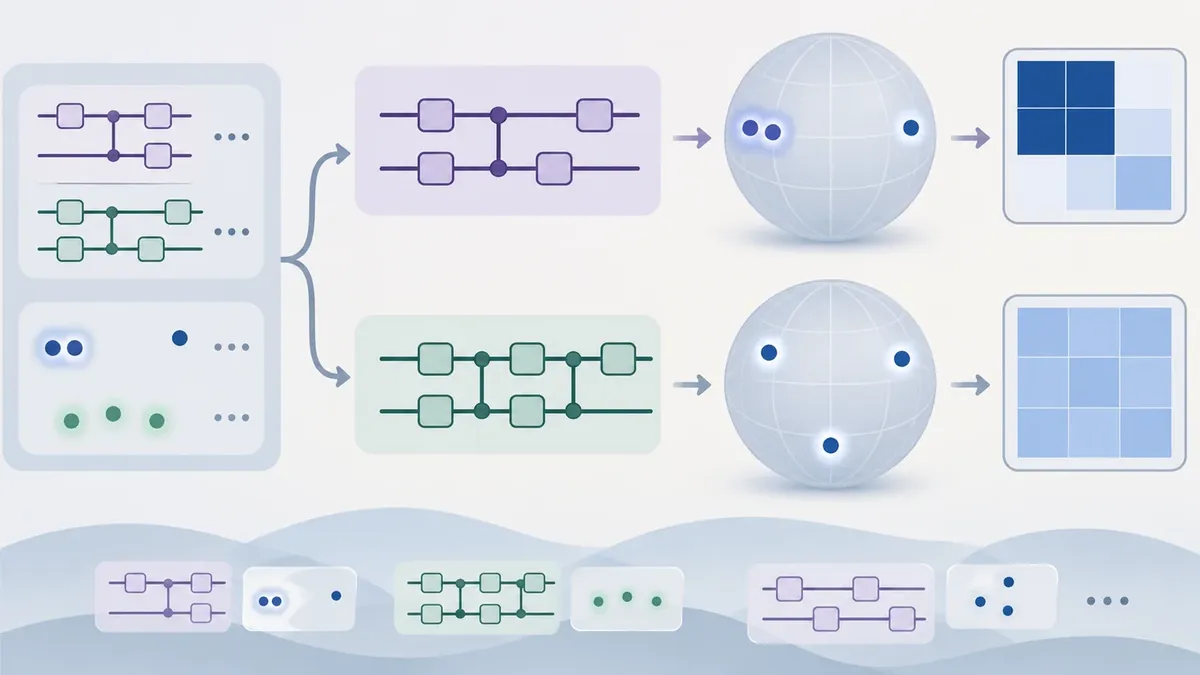
Quantum kernels compare data points through similarities between quantum states. In some circuits, increasing the number of encoded features makes those similarities fade until the kernel approaches an identity matrix. Ana Paula Appel’s preprint tests whether an estimate of data geometry can help choose a circuit width before that happens—and where the approach falls short.
A quantum kernel is a matrix of similarities between pairs of data points. In angle encoding, selected features control rotations on qubits. As the circuit widens, states for different records can become nearly orthogonal, pushing the kernel toward an identity matrix. The kernel then loses its ability to distinguish the tested pattern of nearby and distant points. That geometric collapse does not necessarily mean every downstream model performs worse.
Ana Paula Appel’s preprint asks whether an estimate of data geometry can help choose how many features to encode. Its proposed qubit budget is the rounded-up correlation fractal dimension, or D₂. The study estimates D₂ from how counts of nearby point pairs scale with distance, using a box-count procedure. A separate method, FD-ASE, selects original data columns. If that method selects fewer than two attributes, the procedure falls back to the first q principal components, where q is the proposed budget. FD-ASE does not always find a suitable subset: it can return too many columns or none.
The study covers nine data sets, including medical, wine and handwritten-digit data, along with synthetic examples. D₂ is estimated from a classical sample of up to 4,000 records; most quantum-kernel tests use 32 records. Most simulator experiments use exact statevector calculations and a one-layer ZZ feature map, which entangles qubits. The study assesses kernel geometry directly rather than defining collapse by classifier accuracy.
Its operational “alive” test requires three conditions: average fidelity for the nearest pairs must be at least 0.25; the ratio of near-pair to far-pair fidelity must be at least 2; and mean fidelity between distinct points must be at least 0.03. These are chosen thresholds, not a statistical test or a universal definition of a useful kernel.
For the one-layer ZZ map at the standard angle scale, the rounded-up D₂ was close to the last width passing these criteria in several tested cases. For the breast-cancer data, the estimate was three qubits: the kernel passed at three and failed at four. PCA retaining 95% of the variance would use ten features for that data set. The moons and synthetic intrinsic2 data similarly had PCA-95% widths of 19, while their reported knees were three. When FD-ASE selected fewer than two columns in these cases, the procedure’s fallback to principal components is relevant: the budget and coordinate-selection steps are not interchangeable. These comparisons apply to the tested samples, map, angle scale and alive rule—not to PCA or quantum kernels in general. There were exceptions: on OneBig, the kernel remained alive beyond the D₂ estimate; on wine and diabetes, it collapsed before reaching that estimate.
The circuit and angle scale mattered. Product-state Z and linear IQP maps sometimes remained alive beyond the D₂ budget, while a second ZZ layer could fail even at that width. Reducing the angle range delayed collapse in some tests; increasing it brought collapse sooner. Packing multiple features onto the same qubits sometimes kept the kernel alive at the fractal width. But in the tested packed examples, stacking features toward the PCA-95% width failed the alive test. The proposed budget is therefore specific to the data and feature map, including its angle scale.
Sample size and estimation also limit the conclusions. In the reported wine and diabetes tests, increasing the kernel sample from 32 to 128 moved the knees from two to four and from three to five, respectively. Both remained below their estimated budgets of seven and six. These are finite tests at two sample sizes, not a general rule about how sample size changes collapse. The author flags the box-count estimate for digits as unreliable when recorded width is much larger than the logarithm of the available sample size. A rotated synthetic data set also exposed a limitation: when meaningful directions were mixed across columns, the box-count estimate and FD-ASE overshot the known dimension, while PCA retained it.
Hardware tests comprised nine jobs on one IBM Quantum processor, with 256 shots per job. Six used eight data points; three used 16 points to compare coordinate selectors on breast-cancer data. For the breast-cancer PCA view at three qubits, the measured kernel’s mean absolute error from exact simulation was 0.021. The FD-ASE view at four qubits had a reported error of 0.012. At seven qubits, the PCA-view mean off-diagonal fidelity was 0.004 on hardware and 0.003 in simulation. These results show agreement for particular kernels and samples on that backend, not general validation across devices or data. The device did not run a classifier, and the selector comparison was limited to breast-cancer data.
The paper is a preprint; this article does not establish whether it has undergone peer review. Its results suggest a way to investigate feature-map width before building a quantum model, but the thresholds are operational, the selector has failures, and a kernel classified as dead did not always produce lower downstream scores. The study does not show that quantum kernels outperform classical methods or that D₂ sets the right width for every circuit.
- quantum kernels
- correlation fractal dimension
- angle encoding
- quantum machine learning
- feature selection
Reviewed cross-references
These connections were reviewed by a model, not independently fact-checked by a human. Similarity does not imply agreement; consult the original papers and the evidence below.
Choosing a quantum data encoding, with help from an agent
Shared method: Both papers use correlation fractal dimension and FD-ASE to set a qubit budget and select original features. The encoding-agent paper operationalizes the approach described in the origin paper; this is a method connection, not independent validation of its kernel results.
Model review: · openai-codex/gpt-6-luna
Evidence and provenance
Selected excerpts, not complete papers. PDF extraction can omit figures or damage equations, tables and reading order; sources may be preprints.
2609.00475v3 — Original paper
Excerpt reference:
static/papers/2609.00475v3.md:524-551
Basis: Paper text
Source SHA-256:1c9cf96dea46db5ac34b2b8d978584f384126fb0caf8b71b8ef9fc6213d4af3f2609.31902v2 — Original paper
Excerpt reference:
static/papers/2609.31902v2.md:81-141
Basis: Paper text
Source SHA-256:c86124b037e2102aa1e4aad08159a228570792b6ef42911dc47a3cc857fbcd5b
Why quantum machine-learning models can lose sensitivity
Supporting evidence: Both papers report that bandwidth affects concentration: the origin reports that changing angle bandwidth shifts the one-layer ZZ kernel’s collapse point, while Mondragon-Sampedro and Alvarez-Estevez report reduced concentration from bandwidth scaling in moderate regimes. Their study covers several model types but uses ideal simulations and a single synthetic dataset, so it supports only this bounded bandwidth–concentration connection, not the fractal-dimension budget.
Model review: · openai-codex/gpt-6-luna
Evidence and provenance
Selected excerpts, not complete papers. PDF extraction can omit figures or damage equations, tables and reading order; sources may be preprints.
2609.00475v3 — Original paper
Excerpt reference:
static/papers/2609.00475v3.md:13-46
Basis: Paper text
Source SHA-256:1c9cf96dea46db5ac34b2b8d978584f384126fb0caf8b71b8ef9fc6213d4af3f2611.27486v1 — Original paper
Excerpt reference:
static/papers/2611.27486v1.md:483-554
Basis: Paper text
Source SHA-256:35a8e8c8ba0e00bfe2fededff7ee70a453425d735589b1ed7cb2e2bc91cfb34e2611.27486v1 — Original paper
Excerpt reference:
static/papers/2611.27486v1.md:766-831
Basis: Paper text
Source SHA-256:35a8e8c8ba0e00bfe2fededff7ee70a453425d735589b1ed7cb2e2bc91cfb34e
Related reading
Automatically matched by shared topic keywords. These links do not imply that the sources agree or establish a consensus.
Choosing a quantum data encoding, with help from an agent
Source published
Shared keywords: quantum kernels, quantum machine learning
Why quantum machine-learning models can lose sensitivity
Source published
Shared keywords: quantum kernels, quantum machine learning
A feature-aware search for quantum data encodings
Source published
Shared keywords: feature selection, quantum machine learning
Selecting training examples for quantum machine learning
Source published
Shared keywords: quantum machine learning
A reported quantum gap on an engineered task
Source published
Shared keywords: quantum machine learning