TRANSMISSION // 2608.29434v3
Can robot planners think in point clouds?
Source published
A study finds that latent world models can plan from simulated point clouds and use 3D target poses instead of goal images—but performance varies by task, and real-world planning remains untested.
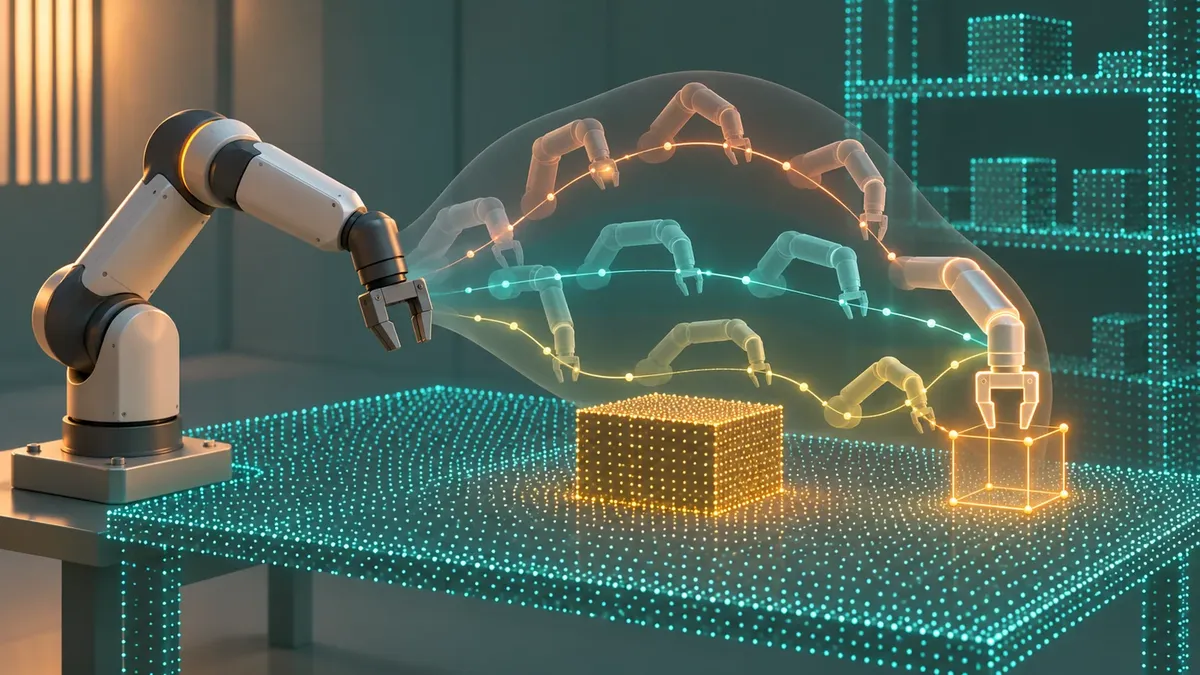
Robots often need to act on geometry: where an object is, and where it should go. Could an AI planner predict the effects of actions from 3D point clouds rather than camera images, and take a target pose as its goal? A new preprint tests that idea in simulated tasks, with a separate experiment probing representations learned from real robot data.
A robot asked to move a block does not necessarily need a picture of the block in its final position. A target position—or, for some tasks, a position and orientation—may be the more natural instruction. Yet many learned robot planners rely on camera images both to perceive the scene and to describe the goal.
In this preprint, Fabio F. Oberweger, Michael Schwingshackl and Markus Murschitz ask whether a particular kind of planner can instead use geometry directly. Their “world models” predict how actions change an environment. Joint-embedding predictive architectures, or JEPAs, make those predictions in a compressed representation of the scene rather than by generating future images.
The researchers adapted three JEPA approaches to point clouds: sets of 3D points that can represent range-sensor measurements. They also designed a way to turn a 3D target pose into a goal representation, so the planner need not receive an image or point cloud of the desired end state.
Testing geometry-based planning
The team added simulated, LiDAR-style scans to four existing benchmark environments: Two-Room, Reacher, Push-T and OGB-Cube. To make a controlled comparison, they replayed the same recorded episodes and actions used for the image benchmarks, adding point-cloud observations. The simulated sensor cast a fixed grid of rays and recorded the first surface each ray hit. It was idealized: the scans had no sensor noise, missing returns or motion distortion.
Each model learned to predict future representations from recent representations and actions. The three designs differ in how they avoid a collapsed representation—one that carries little useful information. The study tested a frozen pretrained point-cloud encoder, a distribution-regularization method, and an action-reconstruction objective. A sampling-based planner then searched for action sequences whose predicted final representation matched a goal representation.
For the pose-based goal test, a learned “target-to-latent” module mapped a 3D target, sometimes together with the current scene representation, into the goal representation. The researchers compared planning with that predicted goal against planning toward a representation encoded from a goal point cloud.
What the tests found
All three point-cloud approaches performed well above a random-action baseline in the simulated tasks, but no single design was best everywhere. The distribution-regularized Point-LeWM model was not statistically distinguishable from its image-based counterpart on the four benchmarks under the paper’s corrected tests. Point-Delta-JEPA, which uses an action-reconstruction objective, matched its image-based counterpart on Two-Room and OGB-Cube, but scored lower on Reacher and Push-T. The frozen-encoder point-cloud model also trailed its image-based comparison across the benchmarks.
The pose-based goal representation was another promising result. In every benchmark, at least one version of the target-to-latent module performed within one standard deviation of the goal-point-cloud reference. In OGB-Cube, where the target leaves the robot arm’s configuration partly unspecified, including the current scene representation mattered: omitting it reduced performance in one reported comparison. The method also reached goals at tested cube heights that had not appeared as training goals, with results similar to a simulated goal-cloud reference.
The team separately trained two models on point clouds from real robot recordings in the RH20T dataset. On held-out episodes, probes could decode information about the robot’s gripper and joints from the models’ representations—especially for Point-Delta-JEPA. This is evidence that the representations retain physical-state information, not a demonstration that the planner can successfully control a real robot. The planning benchmarks themselves remained simulated.
What remains uncertain
The results support a limited conclusion: latent planning can work with point-cloud observations in these benchmark settings, and a 3D target can sometimes replace a goal observation without reducing planning success. They do not show that the approach is ready for physical robots. The simulated scans were clean and exact, and the authors say their planning evaluation covers four scenes and an idealized sensor. Although they tested degraded scans, range noise caused severe failures in Push-T, where thin task-relevant objects were difficult to capture. The target-to-latent module also requires target annotations during training.
The paper is a preprint, so its findings have not necessarily been peer reviewed. Its comparisons use ten evaluation seeds, with one trained checkpoint per model; the reported statistical tests capture variation across evaluation episodes, not across independent training runs. The authors report releasing model weights and training and inference code, which may help others reproduce and extend the work.
For now, the study is best read as evidence that robot world models need not be tied to camera images—not as proof that point-cloud planners will work reliably on real hardware.
- robotics
- point clouds
- world models
- JEPA
- robot manipulation
- LiDAR
Related reading
Automatically matched by shared topic keywords. These links do not imply that the sources agree or establish a consensus.
A smoother way for robot AI to imagine what actions do
Source published
Shared keywords: robot manipulation, world models
Can AI-generated worlds keep up with robots and self-driving cars?
Source published
Shared keywords: world models
A robot plan that knows what remains—and when to consult a demonstration
Source published
Shared keywords: robot manipulation
A safety shield for image-based robot parking
Source published
Shared keywords: world models
Can AI World Models Help Robots Understand the Ocean?
Source published
Shared keywords: world models