TRANSMISSION // 2608.29309v2
How should AI agents be tested before they run materials experiments?
Source published
A review uses atomic layer deposition to map ways to evaluate language-model agents, from answering questions to controlling tools and optimizing processes.
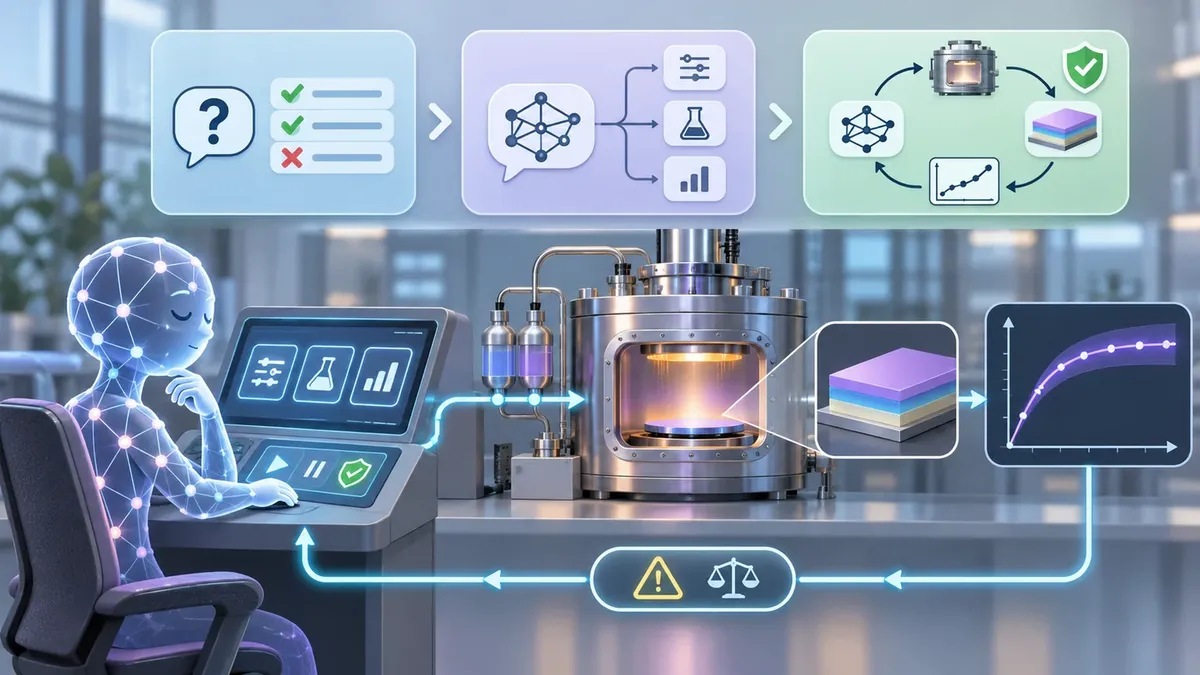
Connecting an AI agent to laboratory equipment is not the same as asking it a science question: the system must choose actions, interpret feedback and behave consistently. This review argues that evaluating those abilities requires several kinds of tests, and uses atomic layer deposition as a case study.
Large language models can do more than generate text when connected to software and laboratory equipment. An agent can receive a request, select a tool, send it structured instructions, inspect the result and decide what to do next. That opens the possibility of automating parts of materials research—but it also raises a practical question: how can researchers tell whether an agent is reliable enough for work involving real experiments?
A review by Angel Yanguas-Gil surveys evaluation approaches for language-model agents in materials synthesis. Rather than reporting one new experiment or head-to-head model trial, it draws together strategies from existing research and proposes a staged framework. Atomic layer deposition, or ALD, serves as its main example. ALD builds thin films through repeated, separated exposures to chemical precursors and co-reactants. Its relatively automated workflow makes it useful for studying how an AI system might progress from answering questions to interacting with equipment.
Testing more than scientific knowledge
A written answer can reveal whether a model knows relevant terminology, but it cannot show whether the model can operate a tool or respond sensibly to experimental feedback. The review groups evaluation into several levels: knowledge and reasoning tests; tests of whether an agent can issue correct tool calls; synthesis-specific challenges that require choosing a process; and closed-loop tests in which the agent acts repeatedly and uses feedback to guide its next move.
These levels help separate different kinds of failure. An agent might understand a direct instruction but choose the wrong chemistry when asked to work backward from a desired material. It might also identify a reasonable process but encode the request incorrectly for the instrument. Testing these skills separately can make results more informative than a single overall score.
The review describes several approaches in the literature. One ALD knowledge benchmark, ALDBench, uses open-ended questions rated by human experts for qualities including accuracy, relevance and specificity. Expert assessment can uncover plausible-sounding but flawed recommendations, though it takes time and limits how many answers can be reviewed. More structured questions, such as multiple-choice or numerical tasks, can be scored more readily, but may capture a narrower slice of capability.
Tool-use tests focus on the connection between an agent and an instrument. In one described ALD setup, models were asked to generate calls to a reactor API, including choices about precursor channels and cycle counts. The review reports that models generally handled direct instruction-following better than process-identification challenges, which require inferring which chemistry could produce a requested material. The cited work also found challenges with less familiar or counterintuitive processes. These results illustrate why a benchmark should distinguish following a recipe from figuring out which recipe to use.
For a more demanding test, an agent can interact with a virtual instrument in a closed loop. In ALD optimization, the goal may be to find short precursor and co-reactant exposure times that still achieve near-saturated film growth. A simulator can return feedback resembling measurements from an instrument, allowing repeated tests without conducting every trial on a physical reactor. The review describes prior work in which agents often reported successful optimization, but their chosen conditions and search paths varied across repeated runs.
Why repeatability and safety matter
That variability matters because language-model outputs are stochastic: the same system can respond differently on separate attempts. A single successful run therefore cannot establish dependable performance. The review recommends measuring run-to-run variation, as well as testing whether small changes in wording alter the outcome. It also emphasizes safe failure: an agent connected to equipment should be assessed on whether it can stop, ask for clarification and avoid risky actions when uncertain.
The proposed framework moves from expert-reviewed open responses, to scalable structured questions, then to low-level tool-use tests, synthesis challenges and finally multi-step interaction with virtual tools. This progression offers researchers a way to identify problems before exposing valuable equipment or materials to an agent. It is a recommendation for evaluation, not evidence that agents are already ready for autonomous laboratory work.
What the review cannot establish
The review stresses that coverage remains limited, even for ALD, one of the better-studied examples in this area. Findings from a particular benchmark depend on the model, prompts, available information, software harness and tool interface. A virtual system can probe many conditions safely, but it is still an approximation of a real experiment. And success on ALD would not automatically demonstrate competence in other synthesis methods.
This article is based on a review preprint, not a new controlled evaluation of agents. Its numerical examples and performance observations come from studies it discusses; they should not be read as a single, standardized comparison across all systems. The preprint may also change, and the evidence summarized here does not settle how reliably these agents would perform across real laboratories. Its central contribution is a case for testing distinct capabilities, variability and safety before trusting AI agents with experimental workflows.
- AI agents
- materials synthesis
- atomic layer deposition
- AI evaluation
- laboratory automation
Reviewed cross-references
These connections were reviewed by a model, not independently fact-checked by a human. Similarity does not imply agreement; consult the original papers and the evidence below.
Can AI Agents Draw Reliable Health Conclusions? A Benchmark Says Not Yet
Shared method: Both papers use benchmarks to evaluate AI agents: the origin review surveys knowledge, tool-use and closed-loop evaluations for materials synthesis, while SciConBench tests health-conclusion synthesis using expert-written references and factual precision, recall and F1. The domains, tasks and metrics differ, so their results are not directly comparable.
Model review: · openai-codex/gpt-6-luna
Evidence and provenance
Selected excerpts, not complete papers. PDF extraction can omit figures or damage equations, tables and reading order; sources may be preprints.
2608.29309v2 — Original paper
Excerpt reference:
static/papers/2608.29309v2.md:432-486
Basis: Paper text
Source SHA-256:cd94a9aba32d601e4305b7325bf0734f139c67bd3c0b3443e8bf44deff41924b2606.11337v2 — Original paper
Excerpt reference:
static/papers/2606.11337v2.md:13-77
Basis: Paper text
Source SHA-256:899a8293c9ebe9b602436d7891af64adeba12ac3de5fa7ae71b99bc98f65cb77
Related reading
Automatically matched by shared topic keywords. These links do not imply that the sources agree or establish a consensus.
Turning Lab Experiments into Code
Source published
Shared keywords: ai agents, laboratory automation
Combining explicit rules and graph learning to recover missing synthesis conditions
Source published
Shared keywords: materials synthesis
A robot reads the recipe—and finds its ingredients
Source published
Shared keywords: laboratory automation
An Enzyme-Design System That Revises Its Own Research Workflow
Source published
Shared keywords: laboratory automation
Can AI Build and Improve Business Agents?
Source published
Shared keywords: ai agents, ai evaluation