TRANSMISSION // 2608.28975v2
Could Little Red Dots Help Explain IceCube’s Neutrinos?
Source published
A model suggests shocks around some Little Red Dots could produce high-energy neutrinos, but the estimated contribution depends on uncertain assumptions about how these sources work.
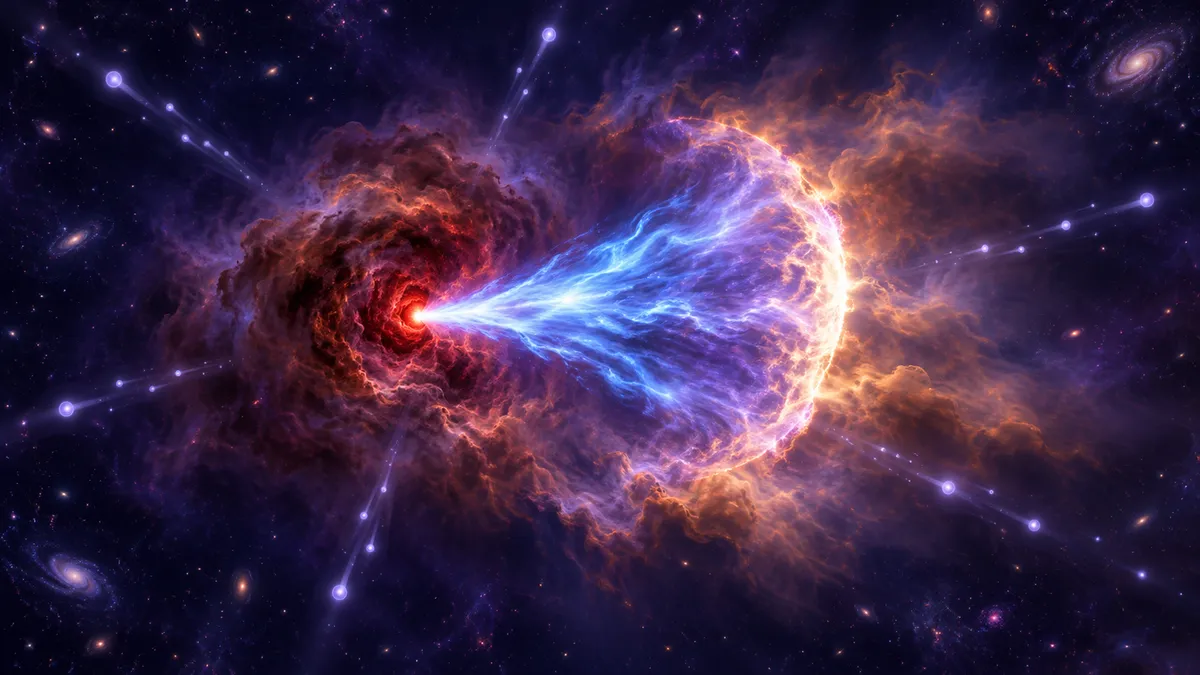
Little Red Dots are compact objects in the early universe whose nature is still debated. A new model asks whether shocks around them could accelerate particles and produce some of the high-energy neutrinos measured by IceCube.
A possible source of cosmic neutrinos
High-energy neutrinos are elusive particles that can travel across the universe from energetic astrophysical environments. IceCube has measured a diffuse background: a combined signal from sources too numerous or faint to identify individually. The origins of that background remain uncertain.
A study explores whether Little Red Dots (LRDs), compact, distant sources with unusual optical spectra, could contribute. Astronomers have not settled what powers LRDs. One possibility is that fast outflows from a central engine—perhaps a black hole embedded in dense gas—collide with slower or stationary material. The resulting shocks could accelerate cosmic rays. If those energetic particles collide with protons in the surrounding gas, the interactions can produce neutrinos.
This is a proposed possibility, not an established explanation for LRDs or IceCube’s signal.
Modeling shocks and particles
The researchers used a simplified, semi-analytic model of outflows interacting with dense surroundings. They considered both stationary gas and gas already moving outward. In each case, the model follows an initial shock traveling toward the LRD’s photosphere, the surface from which much of its visible light escapes, and then assumes a second, roughly stationary interaction near that surface.
That later interaction is prescribed rather than generated by a full hydrodynamic simulation. The team considered an illustrative shock episode lasting about 40 years, while allowing for repeated episodes over an LRD’s much longer lifetime. They explored combinations of engine mass, outflow speed and rate, and gas density, keeping setups that met adopted luminosity and mass constraints.
To estimate neutrino production, they applied an analytical framework for cosmic-ray acceleration and particle collisions in dense environments. They then combined predicted emission from individual model sources with an estimated cosmic population of LRDs. The calculation assumes every observed LRD is shock-active at a given time.
A modest contribution in the fiducial case
The viable model setups had shock luminosities of about 2.0 × 10⁴³ to 3.5 × 10⁴⁴ erg per second. With the study’s fiducial assumptions about cosmic-ray acceleration and magnetic fields, the estimated contribution varies with shock luminosity. Below 2 × 10⁵ GeV, the lowest-luminosity fifth of accepted models contributes about 0.2% of IceCube’s diffuse intensity, while the highest-luminosity fifth contributes about 2%. Averaged across the IceCube measurements considered in the paper, the estimate is about 1.4%.
The researchers also tested an illustrative higher-efficiency case, with a larger share of shock power going into cosmic rays and a stronger assumed magnetic field. For the highest-luminosity fifth, the estimated contribution rises to about 13% below 2 × 10⁵ GeV; averaged across the measurements, it is about 9.5%. These are calculated outcomes under selected assumptions, not neutrinos observed to come from LRDs.
What remains uncertain
A central model uncertainty is whether the assumed quasi-stationary shock can form and remain stable. The paper prescribes this interaction rather than modeling it hydrodynamically; multidimensional calculations are needed to test its behavior. The shock also need not power all of an LRD’s light: radiation from an accreting central engine could instead be absorbed and reprocessed by dense gas.
The predicted neutrino intensity depends on the fraction of LRDs that are shock-active, the portion of surrounding gas covered by the outflow, and the efficiency of cosmic-ray acceleration. A smaller active fraction or covering factor would lower the estimate. Survey incompleteness could mean the known LRD population is too small, potentially raising it. The authors say a population-synthesis study is needed to better constrain the total contribution.
This work is a preprint submitted to The Astrophysical Journal, not a confirmed source detection. Its calculations show that shock-active LRDs could contribute to IceCube’s diffuse neutrino background under particular assumptions. They do not establish that these shocks occur or determine how much of the observed background LRDs produce.
- Little Red Dots
- high-energy neutrinos
- IceCube
- cosmic rays
- astrophysical shocks
- early universe
Related reading
Automatically matched by shared topic keywords. These links do not imply that the sources agree or establish a consensus.
IceCube measures how the Milky Way’s neutrino emission varies across the sky
Source published
Shared keywords: cosmic rays, high energy neutrinos
Can cosmic rays gain a second boost behind a supernova shock?
Source published
Shared keywords: cosmic rays
IceCube’s muons could track Antarctic atmospheric change—if detector drift is controlled
Source published
Shared keywords: cosmic rays
Galactic Center Gamma Rays Stay Extreme, but IceCube Finds No Neutrino Counterpart
Source published
Shared keywords: cosmic rays
How JWST Could Trace the Seeds of the First Massive Black Holes
Source published
Shared keywords: early universe, little red dots