TRANSMISSION // 2608.28374v2
A radio burst’s crowded path reveals the challenge of tracing cosmic gas
Source published
A study of FRB20230907D finds that several foreground structures can account for much of its unusually large dispersion measure. The analysis allows a contribution from a nearby dwarf galaxy, but does not establish a detection of that galaxy’s ionized gas.
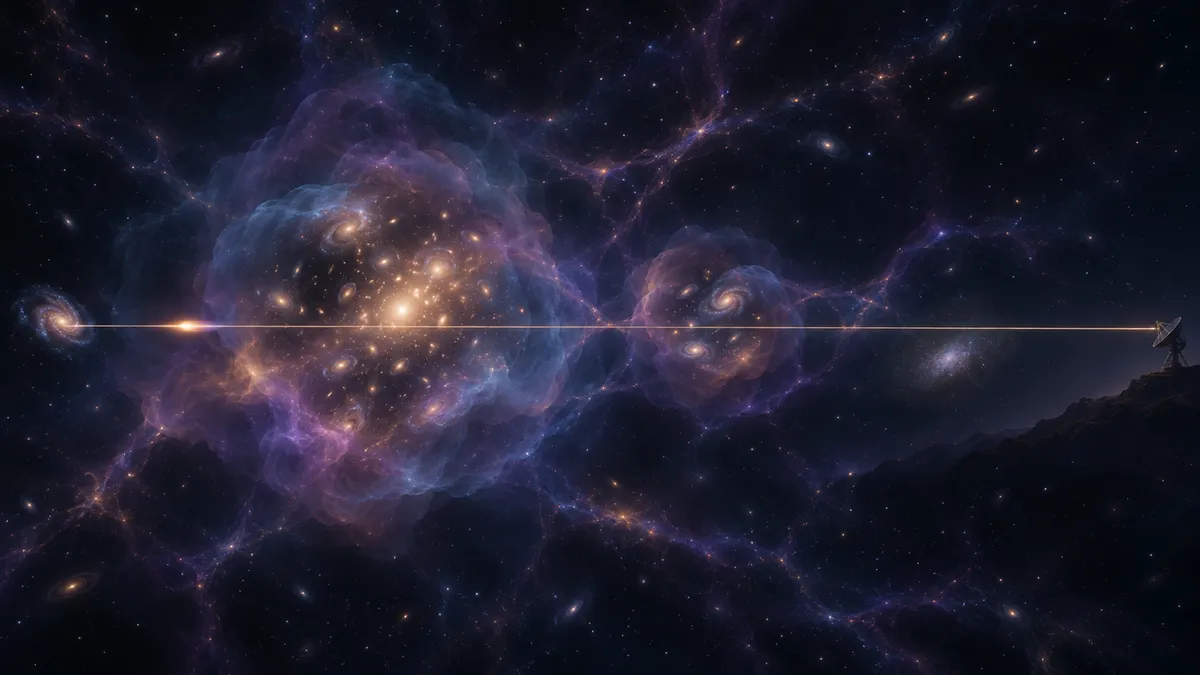
A brief radio flash carries a record of the ionized matter between its source and Earth. For FRB20230907D, disentangling that record means accounting for galaxy groups, a cluster environment and a nearby dwarf galaxy—not finding a single culprit.
FRB20230907D reached Earth with an unusually large frequency-dependent delay for a burst associated with a galaxy at redshift 0.464. A foreground survey led by Qi Guo and colleagues shows how several structures along its path could help explain that signal. It also illustrates why an apparent opportunity to measure gas around a dwarf galaxy requires caution.
The study, part of the PIFFLE program, appears in an arXiv preprint whose second version was posted on November 6, 2026. The supplied record does not establish journal publication or peer-review acceptance.
Reading the matter along a radio flash
Fast radio bursts are millisecond-scale radio flashes. As their radiation passes through ionized gas, lower-frequency waves arrive later than higher-frequency waves. The delay reveals the dispersion measure, or DM: a redshift-weighted tally of free electrons along the entire path.
This makes bursts useful probes of diffuse ordinary matter that can be difficult to see directly. But DM does not identify where each electron resides. Contributions from our Milky Way, intervening structures, diffuse intergalactic gas and the burst’s host galaxy overlap in one measurement.
FRB20230907D, discovered with MeerKAT, has an observed DM of about 1,031 parsecs per cubic centimetre, written pc cm⁻³. It lies above the mean DM expected at its host’s redshift under the Macquart relation. That excess motivates a detailed foreground inventory; it does not by itself identify an unusual gas reservoir.
Mapping a crowded foreground
The researchers combined 5,477 galaxies with secure Subaru Prime Focus Spectrograph redshifts in their selected sample with 1,007 additional SDSS galaxies. Spectroscopy supplies the distance information needed to distinguish structures that overlap on the sky. Published group catalogs, Rubin Observatory imaging and eROSITA X-ray observations supplied complementary evidence.
A “friends-of-friends” algorithm linked galaxies close in projected position and redshift. The team calibrated it against simulated catalogs with approximated observational incompleteness. Importantly, the tests recovered too many groups overall, despite reasonably good membership recovery for matched systems. The authors therefore treated its output as candidate structures requiring individual inspection, not an unbiased census.
The most important candidate was a massive system near redshift 0.09. Removing a separate projected concentration reduced its membership from 411 to 323 galaxies. A simulation-based mass inference, trained on mock observations, yielded a mean virial mass of roughly 770 trillion solar masses. Independent catalogs and X-ray emission support the presence of a massive hot-gas halo, although offsets between its different tracers suggest a complex structure.
Nearby-group catalogs also identified a separate foreground system at redshift 0.02565, below the algorithm’s search range.
Building an electron budget
The team modeled the two systems with a modified Navarro–Frenk–White gas-density profile, assuming a spherical distribution, a fixed hot-gas fraction and gas extending to twice the virial radius. Their estimated DM contributions were 205, with a 16th–84th percentile interval of 180–235 pc cm⁻³, for the more distant system, and 80, with an interval of 40–140 pc cm⁻³, for the nearer group.
Other modeled contributions included about 310 pc cm⁻³ from diffuse intergalactic gas and 226 from the Virgo environment, alongside smaller Milky Way, M49 and host-galaxy terms. These are model-dependent component estimates, not separate direct measurements.
Across 500,000 Monte Carlo realizations, the researchers varied the adopted uncertain contributions and subtracted them from the observed DM. They asked what remained available for UGC 7596, a nearby dwarf galaxy passed at a projected distance of just 2.64 kiloparsecs.
The unconditioned remainder had a median of 16 pc cm⁻³ and a 16th–84th percentile interval of −70 to 89. Only 57.9% of realizations produced a non-negative remainder. Keeping only those physically non-negative outcomes raised the median to 58, with an interval of 18–111 pc cm⁻³. That positive-only result is not evidence that a dwarf-galaxy contribution has been detected: the original distribution includes zero.
What remains uncertain
Rubin imaging found no significant optical disk emission at the burst’s projected radius. Assuming gas follows the optical light, even a fully ionized disk contribution would be below 0.27 pc cm⁻³. That limit does not constrain an extended ionized halo invisible in the optical image. An illustrative halo model predicted about 24 pc cm⁻³, but depends strongly on uncertain gas retention and structure.
The wider budget has similar limitations. Halo estimates depend on gas profiles and mass definitions, while the adopted intergalactic uncertainty excludes additional sightline-to-sightline cosmic variance. Unmodeled gas could also enter the remainder. The result is therefore a plausible accounting of a crowded sightline—not a unique allocation of its electrons or a confirmed detection of gas around UGC 7596.
- fast radio bursts
- FRB20230907D
- dispersion measure
- PIFFLE
- ionized gas
- galaxy groups
- circumgalactic medium
- UGC 7596
- Subaru Prime Focus Spectrograph
Related reading
Automatically matched by shared topic keywords. These links do not imply that the sources agree or establish a consensus.
CosmicGrain follows dust histories through a simulated galaxy
Source published
Shared keywords: circumgalactic medium
Separating faint light between galaxies from telescope-scattered glow
Source published
Shared keywords: galaxy groups
Why Bigger Telescopes Alone Cannot Perfect Pulsar Timing
Source published
Shared keywords: dispersion measure
A Census of Nearby Galaxies Finds Concentrated Stellar Mass and an Unusual Dwarf
Source published
Shared keywords: galaxy groups
Quasar winds reach across galaxies—and may contain several distinct flows
Source published
Shared keywords: ionized gas