TRANSMISSION // 2608.27596v2
When a black hole becomes the heart of a star
Source published
Models suggest some collisions can leave a black hole inside an extended stellar envelope for a time, but its long-term fate is unknown.
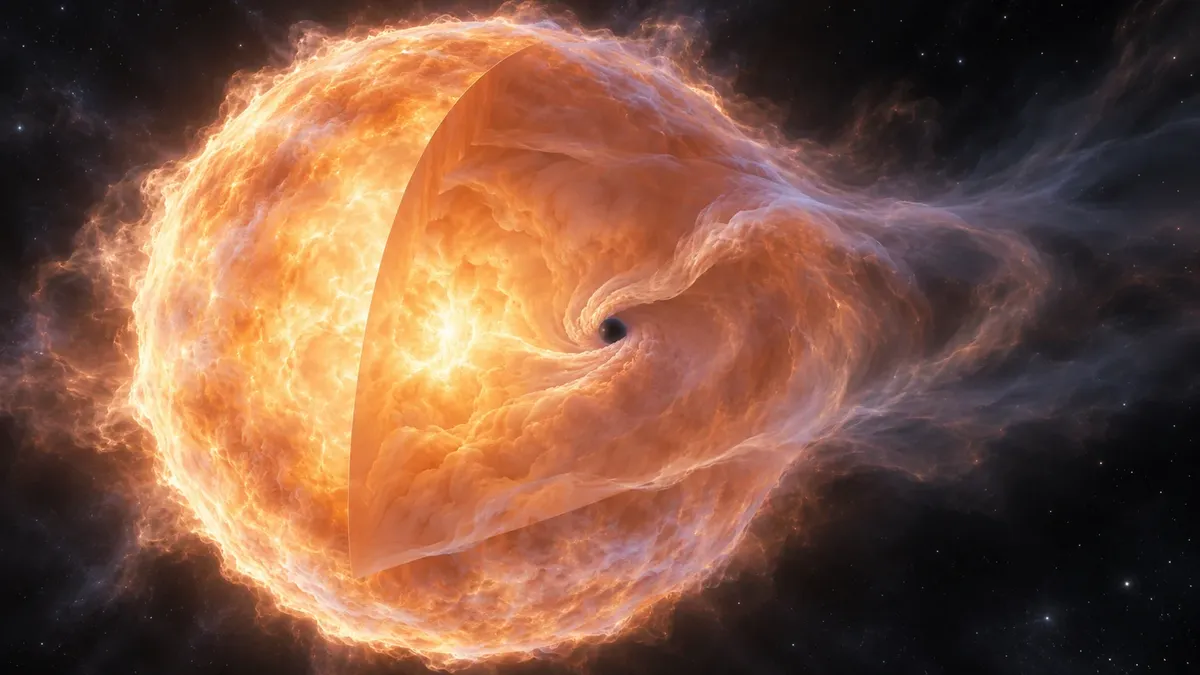
A black hole passing through a star might escape, disrupt the star—or become lodged inside it. Researchers model when that last outcome could create a “black hole star,” and what remains uncertain about its future.
A black hole buried inside a star would be surrounded by a massive envelope of gas. In this study, researchers investigate whether a collision between a stellar-mass black hole and a massive star can produce such a configuration, called a black hole star, or BH*.
The idea is relevant to crowded environments where stars and black holes may encounter one another, including dense star clusters and disks around actively feeding galactic black holes. The central question is whether the star’s gas can slow the black hole enough to keep it there—and whether the star can withstand the energy deposited in the process.
Following a collision in several ways
The team studied collisions involving a model main-sequence star with 100 times the Sun’s mass and a radius of about 16 times the Sun’s. They considered black holes of different masses and encounter conditions, including approach speed and how centrally the black hole passes through the star.
The researchers combined three methods. Semi-analytic calculations tracked the black hole’s motion under gravity and gas drag across many possible encounters. Three-dimensional hydrodynamical simulations followed the gas, shocks and changing envelope shape in selected cases. One-dimensional stellar-evolution calculations examined how the star responds to deposited heat. Each method addresses a different part of the problem; together, they still do not capture every detail of a collision and its long-term aftermath.
As a black hole moves through stellar gas, its gravity draws material into a wake. That wake pulls back on the black hole, acting like drag and removing orbital energy. In the models, gas drag can retain the black hole unless its speed at infinity—the speed it would have far from the star—is high enough. For the modelled star, the approximate retention threshold is around twice a characteristic speed set by the combined masses and the star’s radius. This is not a universal cutoff: the boundary depends on black-hole mass and collision geometry. Deeper passages encounter denser gas and can produce stronger drag.
The black hole’s mass changes the outcome
Capture does not automatically make a lasting black hole star. The ratio between the black hole’s mass and the star’s mass matters. For black holes of about 10 solar masses or less in the modelled 100-solar-mass star, some low-velocity collisions leave the black hole embedded in a dense, extended envelope. In selected simulations, the remnants became quasi-hydrostatic—roughly, they were not rapidly collapsing or flying apart during the simulated period—and retained most of the original stellar mass.
One-dimensional calculations provide a limited additional result: in the tested low-mass case, shock heating made the star expand and cool rather than trigger a nuclear runaway over the calculation. That does not establish that every remnant is stable over its full lifetime. The authors explicitly leave the subsequent evolution uncertain.
More massive black holes deposit more energy as they are slowed. In this model, black holes around 30 solar masses and above tended to leave envelopes that lost mass and remained dynamically unsettled, rather than settling into the same quasi-hydrostatic state. Some off-centre encounters produced disk-like envelopes, but these too were not shown to be long-term stable BH*s. At sufficiently high approach speeds, the black hole can escape altogether.
What the results do—and don’t—show
The authors discuss possible consequences if BH*s form. Another black hole might become bound to the embedded one, potentially leading to a gravitational-wave-producing merger inside the envelope. Repeated collisions in a dense environment might also help black holes grow. These are proposed possibilities, not observed outcomes or established routes to massive black holes. The suggested connection to JWST’s “little red dots” is speculative; the simulations do not demonstrate that those sources are black hole stars.
The modelling has important limits. It focuses on direct collisions with one idealised, very massive main-sequence star, not a broad population of stars or environments. The hydrodynamical simulations run for about 140 hours and omit black-hole accretion, its feedback and radiation transfer. Long-term evolution, observable signatures and how often BH*s form therefore remain open questions. Tests of stellar profiles and numerical resolution support aspects of the calculations, but cannot substitute for the omitted physics.
The source is an arXiv research paper; its acknowledgment of comments from an anonymous referee indicates referee input, but the supplied material does not establish publication status. Its clearest conclusion is limited to the modelled encounters: gas drag can capture a black hole, while its mass and the collision conditions help determine whether an extended envelope remains around it in the short term. Whether such objects commonly form in nature—and what happens to them later—requires further study.
- black hole stars
- stellar-mass black holes
- stellar collisions
- hydrodynamical simulations
- star clusters
- AGN disks
- gravitational waves
Reviewed cross-references
These connections were reviewed by a model, not independently fact-checked by a human. Similarity does not imply agreement; consult the original papers and the evidence below.
A black hole collision can make a massive star burn itself apart
Supporting evidence: Both studies examine direct collisions between stellar-mass black holes and massive stars. Shi et al. find that, in their drag-focused models of a 100-solar-mass star, black holes with mass ratios up to about 0.2 can be retained; Jiang and Lin likewise find that drag alone does not disrupt their modeled stars at mass ratios up to 0.2. This supports the bounded drag-only comparison, not a claim that the stars survive once nuclear burning is included: Jiang and Lin find that burning can alter the outcome, depending on composition and mass.
Model review: · openai-codex/gpt-6-luna
Evidence and provenance
Selected excerpts, not complete papers. PDF extraction can omit figures or damage equations, tables and reading order; sources may be preprints.
2608.27596v2 — Original paper
Excerpt reference:
static/papers/2608.27596v2.md:12-64
Basis: Paper text
Source SHA-256:d7928c6e2261c5e8b933e623f528a60619f5c528290681737a02c816db7dcb5f2611.10934v1 — Original paper
Excerpt reference:
static/papers/2611.10934v1.md:71-140
Basis: Paper text
Source SHA-256:e691d04b39bee9e73fa6727896349e4355641f64a7a0b380eb7637be7a1fed1a2611.10934v1 — Original paper
Excerpt reference:
static/papers/2611.10934v1.md:540-662
Basis: Paper text
Source SHA-256:e691d04b39bee9e73fa6727896349e4355641f64a7a0b380eb7637be7a1fed1a
Related reading
Automatically matched by shared topic keywords. These links do not imply that the sources agree or establish a consensus.
How a black hole inside a star could make an eccentric pair
Source published
Shared keywords: gravitational waves, hydrodynamical simulations
Merging stars could give newborn black holes a faster spin
Source published
Shared keywords: gravitational waves
How gas may speed black hole seed formation in star clusters
Source published
Shared keywords: stellar collisions
A black hole collision can make a massive star burn itself apart
Source published
Shared keywords: hydrodynamical simulations
How collapsing star clusters could help build early massive black holes
Source published
Shared keywords: star clusters