TRANSMISSION // 2608.27595v2
How a black hole inside a star could make an eccentric pair
Source published
Simulations explore how a second black hole entering a star that already contains one might form a rapidly merging, eccentric binary—and why the prediction remains uncertain.
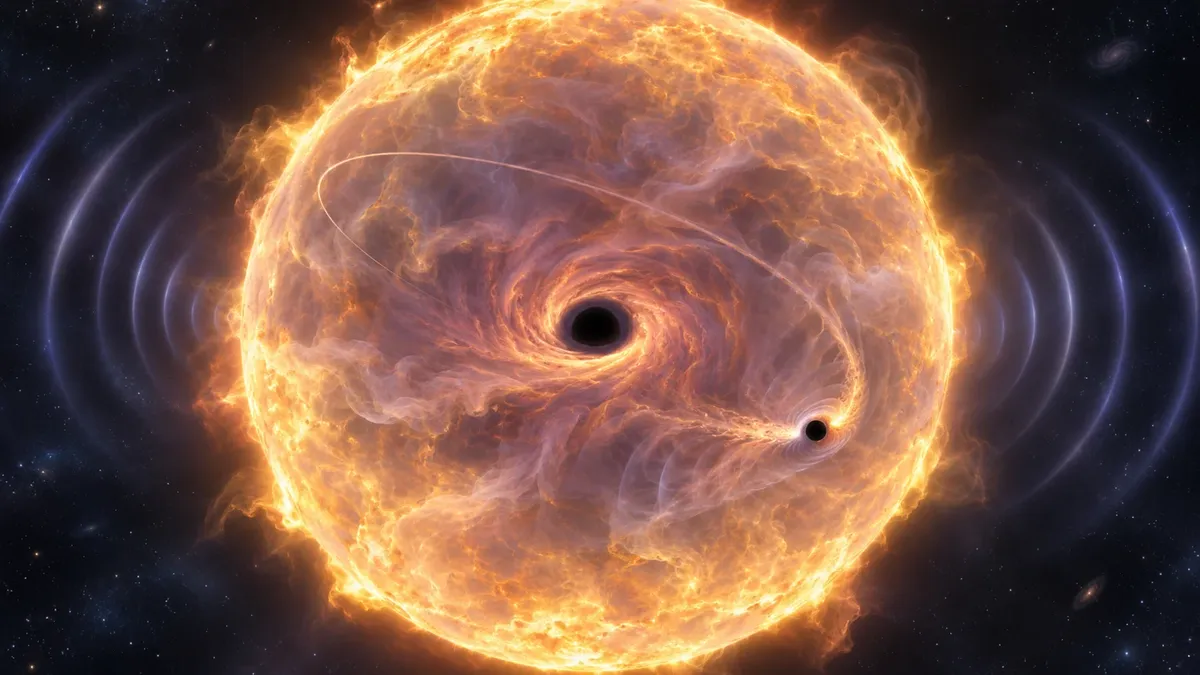
Could a star act as a temporary meeting place for two black holes? A new theoretical study models a sequence in which one black hole becomes embedded in a massive star, then a second plunges into the same envelope. The simulations suggest this route can make binaries with unusual orbital shapes, potentially leaving a detectable gravitational-wave signature.
A stellar envelope as a black-hole meeting place
When two black holes orbit each other, their path can be nearly circular or stretched into an ellipse. That shape, called orbital eccentricity, matters because gravitational waves gradually carry away orbital energy and tend to make a binary more circular. A strongly eccentric orbit close to merger could therefore offer clues about how the pair formed.
Qingru Hu and colleagues investigate a possible route to such systems. It begins with a stellar-mass black hole becoming trapped inside a massive star’s gas. The authors call this arrangement a black-hole star, or BH*: a star-like envelope surrounding an embedded black hole. If another black hole later passes through that envelope, drag from the gas can slow it down and bind it to the first black hole. The pair may then spiral together while still inside the star.
The idea is aimed at dense settings where close encounters can occur, including star clusters and disks around active galactic nuclei. It is a proposed formation channel, not a claim that astronomers have identified a merger made this way.
Simulating the encounter and its aftermath
The team combined three-dimensional hydrodynamical simulations, which follow the black holes and moving stellar gas, with semianalytic calculations of the binary’s later orbital evolution. The hydrodynamical models used a 100-solar-mass stellar envelope and black holes of 5 or 10 solar masses. The simulations varied the incoming black hole’s impact parameter—the sideways offset of its approach—and its initial speed. The hydrodynamical set included 24 combinations of these conditions.
In the second, semianalytic stage, the researchers modeled gas drag alongside gravitational-wave effects. This let them follow more of the binary’s later evolution than the hydrodynamical calculations could resolve. The two approaches are complementary, but neither recreates every detail of a real star and encounter.
What the models found
In many simulated encounters, the incoming black hole lost enough energy to remain inside the envelope and form a bound pair with the black hole already at the star’s center. In some cases, the newborn binary had an eccentric orbit, with eccentricity above 0.5. A few hydrodynamical runs reached even more extreme values, though the authors flag some of these cases as not fully resolved numerically.
The semianalytic calculations suggest that gas drag can increase eccentricity as the binary tightens. In the modeled cases, the binary could still have eccentricity above 0.9 when its gravitational-wave frequency reached 10 hertz, a frequency relevant to ground-based detectors such as LIGO. Gravitational-wave emission then drives the orbit toward circularity during the final phase before coalescence. The models also produce rapid evolution: many binaries reach 10 hertz within hours of forming, although the precise timing depends on the assumptions and setup.
The authors suggest that a high-eccentricity gravitational-wave signal could be a clue to this pathway. Their study does not show that any observed event has this origin, nor does it establish how often the channel operates in nature.
Why the prediction is still tentative
A major uncertainty is how gas drag behaves at very small separations. The semianalytic drag prescription is based on a treatment expected to become unreliable in the nonlinear regime relevant to tight binaries. If drag is much weaker than assumed, the binary may enter the gravitational-wave-dominated phase earlier. The paper finds that this could reduce its eccentricity by the time it reaches 10 hertz. Thus, the predicted high eccentricity depends on how long strong gas drag persists.
The hydrodynamical simulations also cannot resolve gas behavior below their black-hole–gas gravitational softening scale. Some of the most extreme eccentric cases approach distances smaller than the simulations can reliably track. The calculations neglect black-hole accretion and feedback, and use simplified models of the stellar envelope. These choices limit how directly the results can be applied to real stars.
The paper is an arXiv preprint, and its findings should be read as theoretical results awaiting further testing and scrutiny. The authors also discuss applying the mechanism to Thorne–Żytkow objects—hypothetical stars containing a neutron star—but that extension is not established by these black-hole simulations. More detailed modeling and observations will be needed to determine whether this striking route contributes meaningfully to the gravitational-wave population.
- black hole binaries
- orbital eccentricity
- gravitational waves
- hydrodynamical simulations
- stellar dynamics
- LISA
- LIGO
Related reading
Automatically matched by shared topic keywords. These links do not imply that the sources agree or establish a consensus.
Two cosmic signals could reveal how massive black holes grow
Source published
Shared keywords: gravitational waves
Eccentricity remains uncertain in three gravitational-wave events
Source published
Shared keywords: gravitational waves, orbital eccentricity
When a Third Body May Shift Gravitational-Wave Timing
Source published
Shared keywords: black hole binaries, gravitational waves, orbital eccentricity
LISA could find elusive black holes long before their companions fall in
Source published
Shared keywords: gravitational waves, orbital eccentricity
Can LISA spot black hole mergers before they happen?
Source published
Shared keywords: gravitational waves