TRANSMISSION // 2608.26949v2
Why AI should find tables before reading them
Source published
Compressing tables into images can save tokens, but shrinking them too far makes exact values hard to read. A two-stage approach uses small images to locate relevant tables, then restores those tables for answering.
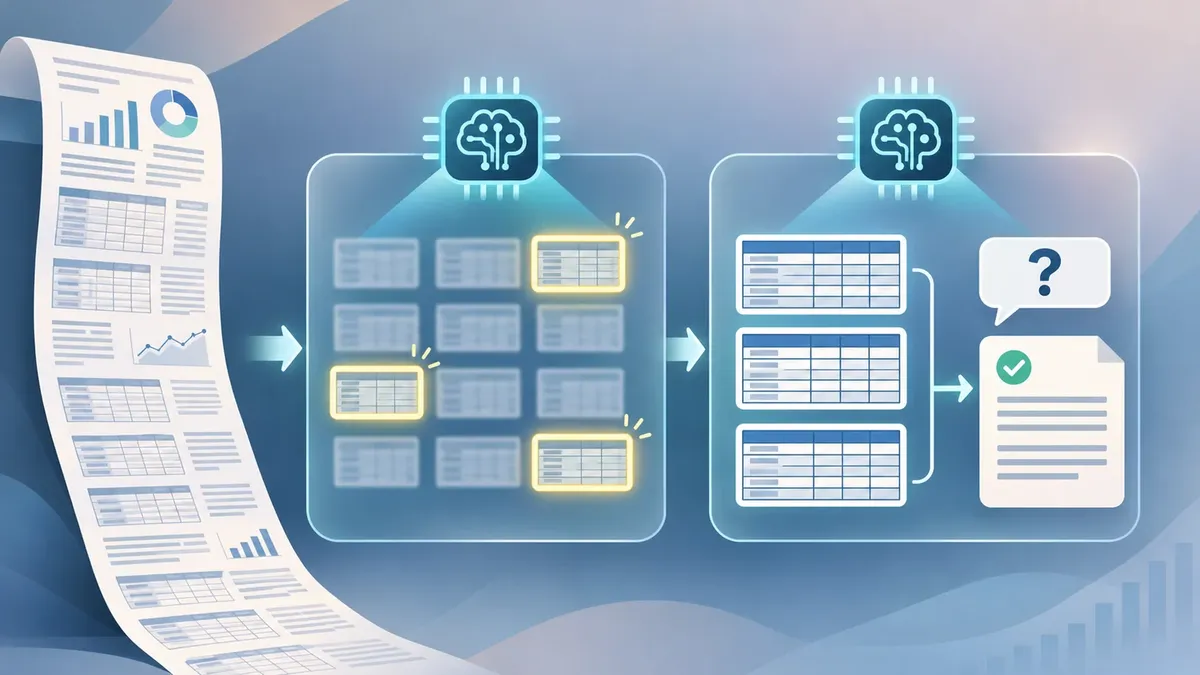
When a document contains dozens of tables, an AI model may not need to inspect every cell at full detail. A study of document question answering finds that heavily compressed table images can still help models choose which tables matter—even when they are too blurry for reliable calculations.
Long reports often mix prose with tables, and answering a question may require finding evidence across many pages. One way to reduce the amount of information an AI model processes is to turn tables into images and shrink those images, so they take fewer visual tokens. But can a model still understand a table when its image is compressed—and, if not, can that compressed view at least help it find the right table?
Iñigo Alonso and Mirella Lapata investigated those questions in a study of seven vision-language models (VLMs), which process both images and text. They tested two benchmarks involving financial documents: MultiHiertt, with typically three tables per document, and FinLongDocQA, with typically around 80. The researchers compared tables supplied as HTML with tables rendered as images at different visual-token budgets, from 64 to 1,024 tokens per table. They measured accuracy and counted decoder tokens, including both the input and the model’s generated response. This count captures an important wrinkle: a shorter input may prompt a model to generate a longer answer or reasoning trace.
The results depend on how much detail is removed. At moderate image budgets, some models answered as accurately from table images as from HTML, using fewer input tokens. But aggressive downscaling made cell values and table structure harder to read. Accuracy generally fell, while models often generated longer reasoning traces—apparently revisiting uncertain or misread values. That extra output can eat into the token savings. In other words, a compressed table may be cheap to present but costly to reason over directly.
The researchers found a useful distinction: reading a table’s exact values is harder than judging whether the table is relevant. Even at 64 visual tokens per table, models could identify relevant tables at rates similar to those at higher image resolutions or in HTML. The authors use that difference in a training-free, two-stage method. First, a model sees the document with all its tables compressed and identifies the tables needed for the question. Then those selected tables are supplied at native resolution, and the model answers using the original document and the clearer tables.
On FinLongDocQA, the two-stage approach used 41% fewer tokens than answering directly with native-resolution tables, while gaining 5.3 accuracy points on average across the three tested models. It also used 21.1% fewer tokens than the cheapest direct-answering configurations that matched its accuracy. The method also saved tokens when applied to context assembled by a separate retrieval system. These figures describe particular tested configurations and comparisons, not a guaranteed improvement for every document or model.
The study’s boundaries matter. Its experiments cover English-language financial documents and two datasets; MultiHiertt results use the development set because its test labels are private. The documents’ tables came from clean, structured representations and were rendered in a uniform style. The method assumes table boundaries are already known, so real scanned documents may need a separate table-detection step. The longest FinLongDocQA documents were excluded from the evaluation sample because of context-window and computational limits.
Token counts are also a proxy for efficiency, not a complete measure of computing cost: they do not include visual-encoder computation. The authors report wall-clock tests for one model on one GPU, but say broader measurements would be needed to establish the full computational trade-off. The study’s findings therefore suggest a practical strategy for the tested setting—not that pixel compression will work equally well across languages, document formats, or other kinds of tables. The paper is an arXiv preprint, so its claims should also be read as research that may not yet have undergone peer review.
- AI document question answering
- table understanding
- vision-language models
- token compression
- financial documents
- optical context compression
Reviewed cross-references
These connections were reviewed by a model, not independently fact-checked by a human. Similarity does not imply agreement; consult the original papers and the evidence below.
When turning text into images makes AI think longer
Supporting evidence: Both studies report that visual compression can increase a model’s reasoning-token output: Alonso and Lapata find longer reasoning for aggressively downscaled tables, while Ge reports 1.5–3.5× longer decoding for rendered-text inputs on four general-purpose VLMs. This supports the bounded point that input-token savings may be offset by extra generation; the table-QA and long-text tasks, compression methods, and model evaluations differ, so their results do not establish the same effect size or cost outcome.
Model review: · openai-codex/gpt-6-luna
Evidence and provenance
Selected excerpts, not complete papers. PDF extraction can omit figures or damage equations, tables and reading order; sources may be preprints.
2608.26949v2 — Original paper
Excerpt reference:
static/papers/2608.26949v2.md:723-810
Basis: Paper text
Source SHA-256:0586e773b0def02e47e8c16af52362f9163a3d923606a8aeb1d7465c9dff6a6d2611.30130v1 — Original paper
Excerpt reference:
static/papers/2611.30130v1.md:13-90
Basis: Paper text
Source SHA-256:cb264dd5b8ad070c3c851072689339c30ed7cce968587fd4984c2ca391a2993f
Related reading
Automatically matched by shared topic keywords. These links do not imply that the sources agree or establish a consensus.
When turning text into images makes AI think longer
Source published
Shared keywords: optical context compression, vision language models
Can AI spot fields it may have misread?
Source published
Shared keywords: financial documents, vision language models
VoluCompose compresses medical scans for AI while preserving benchmark performance
Source published
Shared keywords: vision language models
What Visual AI Routers Get Right—and Wrong
Source published
Shared keywords: token compression, vision language models
Can a video be stored in a model’s weights?
Source published
Shared keywords: vision language models