TRANSMISSION // 2608.26600v2
Can fresh encoders limit replayed faults in quantum error correction?
Source published
A mathematical and simulation study examines whether changing quantum error-correcting encoders each run can limit replayed faults under a bounded model, including when a provider may know the seed.
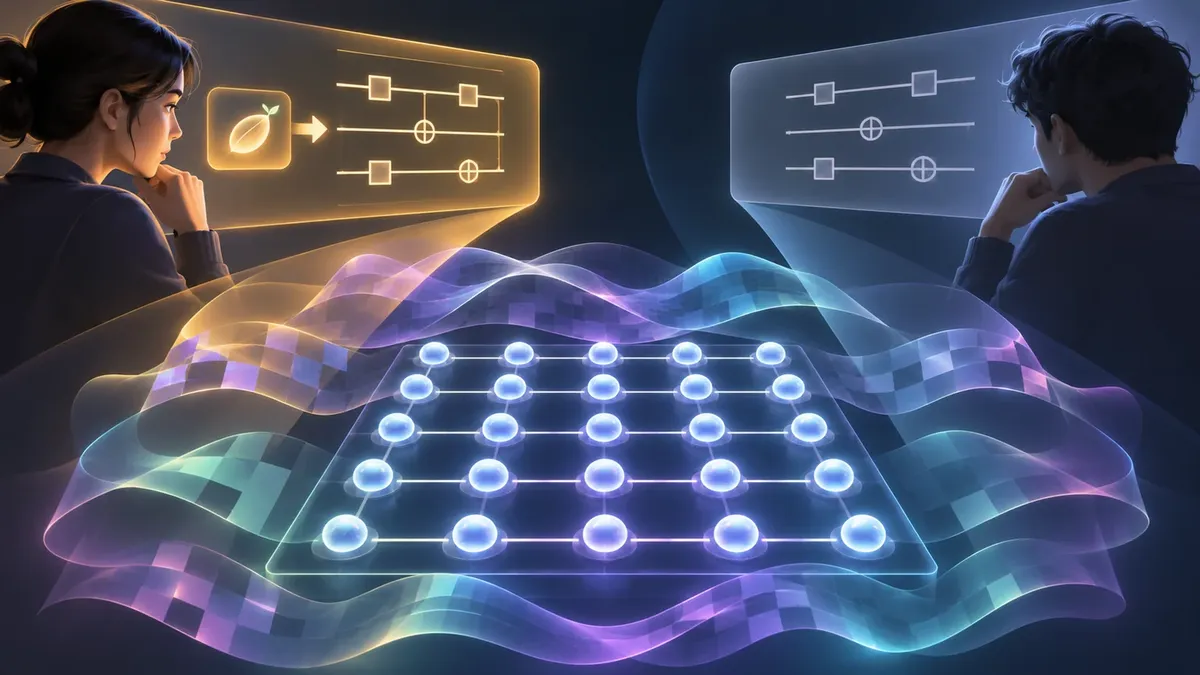
Quantum error correction checks for faults that could alter stored information. But on a shared cloud processor, could an attacker repeat a fault that gets past those checks? Researchers analyze whether changing the encoding for each run helps—and what changes if the party compiling the circuit can see the random seed.
Quantum error correction (QEC) encodes logical information across physical qubits so that checks can detect certain faults. In a shared cloud processor, some faults might be deliberately introduced rather than arising from ordinary hardware noise. If an encoding is reused, a fault that slips past the checks could potentially be replayed. This study asks whether choosing a fresh, seed-dependent encoder for each run makes replay less effective.
The authors consider two attackers. A co-tenant sharing the processor chooses a fault without knowing the victim’s random seed. A provider that compiles the circuit may know the seed and choose a fault with that information. Randomization can make it harder to reuse a fault when the attacker must commit in advance, but it does not automatically hide the encoding from the party implementing it.
The researchers define accepted corruption as a fault that passes the verifier’s check and changes the logical state. A rejected run does not count as corrupted because it produces no accepted output; the authors also track acceptance separately. Their model limits faults to Pauli operations on the encoded register, with a maximum weight—the number of affected qubits. Faults before encoding or after decoding are outside the protection model.
The study combines mathematical results with computer-based audits. The authors derive exact expected acceptance and accepted corruption for Haar-random encoders, an idealized distribution of random encodings. The same expectations hold for uniformly sampled Clifford encoders because that ensemble is a unitary 2-design: it matches Haar averages for the quantities used in the derivation. The researchers also calculate metrics directly from encoder matrices and enumerate the permitted faults. Stim circuit simulations check selected results and examine a specified depolarizing gate-noise model. These are mathematical and simulation studies, not tests on a deployed quantum cloud processor.
The analysis establishes a boundary set by code distance, D: under the idealized checks, a Pauli fault affecting fewer than D qubits cannot cause accepted corruption in a stabilizer code. Reseeding matters when the allowed fault weight reaches the distance. For faults fixed without seed knowledge, the expected accepted-corruption rate for Haar or uniform Clifford encoders decreases exponentially as physical-qubit count grows, with the number of logical qubits held fixed. This is an expectation over random encoders for a seed-independent fault—not a promise that every run detects every attack.
Plain reseeding leaves the provider’s seed knowledge intact. The authors therefore propose a “seed-blind” construction: the provider compiles a fixed pattern of controlled-Z gates, while a separate trusted control-plane boundary uses the secret seed to choose single-qubit gates. If that boundary keeps the seed from the provider as assumed, the provider is treated as seed-blind. The paper analyzes how faults spread through this template and finds that the depth and gate cost depend on the assumed hardware connectivity.
There is a trade-off. Random encoders do not necessarily correct every fault in a specified set, and adding circuit depth adds gates. In the simulated noisy-gate study, noise reduces acceptance. For deeper or wider circuits, the authors caution that accepted outputs can become scarce. A low corruption rate among accepted runs is not, on its own, evidence of a useful service if very few runs are accepted.
The conclusions are conditional on a bounded fault model and assumed system boundaries. The analysis excludes leakage, coherent rotations, measurement manipulation, and correlated multi-qubit faults; its gate-noise study uses a particular depolarizing model. Keeping the seed from the provider depends on a trusted control-plane component, while establishing the seed between client and that component is explicitly outside the paper’s scope. The authors identify hardware validation as future work. This arXiv preprint presents a theoretical and simulated audit, not a demonstration on a live cloud service or a guarantee against broader attacks.
- quantum error correction
- quantum cloud computing
- encoder reseeding
- fault injection
- quantum security
Related reading
Automatically matched by shared topic keywords. These links do not imply that the sources agree or establish a consensus.
When an AI tool call fails, did it still work?
Source published
Shared keywords: fault injection
Could the brain’s error control resemble quantum error correction?
Source published
Shared keywords: quantum error correction
A compact proof for quantum error correction across code sizes
Source published
Shared keywords: quantum error correction
GARI++ splits quantum error correction into a fast first pass and a smaller cleanup
Source published
Shared keywords: quantum error correction
A quantum decoder that learns to adapt to changing noise
Source published
Shared keywords: quantum error correction