TRANSMISSION // 2608.25534v2
Why one recycled photon can be gentler on a sample
Source published
A theory paper finds a loss-limited sweet spot for repeatedly sending one photon through a fragile sample. The result applies to a specific class of sensing schemes, not every quantum probe.
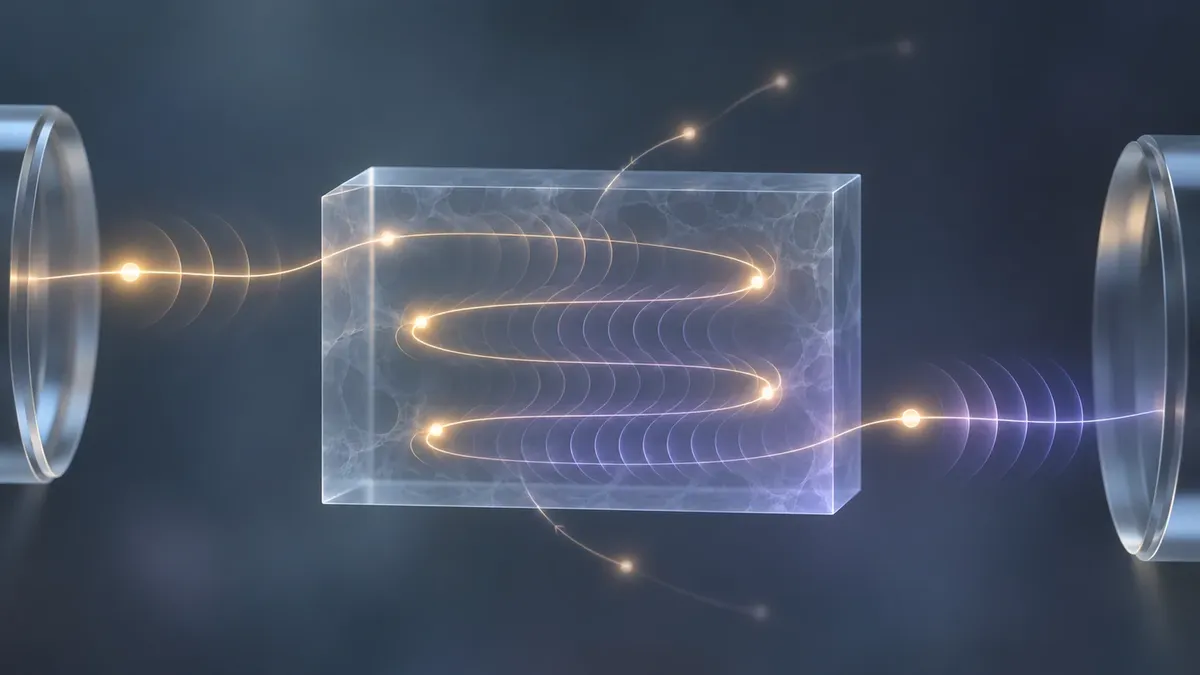
When a sample is easily damaged, sending more light is not a free way to improve a measurement. A theoretical preprint asks how much information a sensing strategy can extract for each photon the sample absorbs—and finds that, under defined conditions, repeatedly using one photon has a predictable optimum.
The trade-off behind repeated passes
A photon sent through a sample can accumulate information about it each time it passes. But every pass also brings another chance that the photon will be lost. If the sample is delicate, the useful question is not simply how many photons reach the apparatus. It is how much information is gained per photon absorbed by the sample.
Christoph F. Wildfeuer’s theoretical paper studies this trade-off for a particular family of schemes: one photon makes repeated, uniform passes through the sample, then is detected once at the end. The analysis asks when additional passes stop being worth the added risk of loss and sample damage.
A shared mathematical optimum
The paper identifies three conditions that produce a common result. The measurement payoff must grow with the square of the number of passes; the survival probability must be the same on each pass; and a photon that has already been lost must not contribute further dose to the sample. The last condition reflects a straightforward physical point: an absorbed photon cannot continue on to damage the sample again.
When those assumptions hold, the balance between accumulating information and losing the photon is captured by a function, h(x) = x²/(eˣ − 1). Here, x is approximately the number of passes multiplied by the loss per pass. The function peaks at x about 1.594, with a maximum near 0.648. In practical terms, the model predicts an optimum: keep adding passes while the growing signal outweighs the falling chance that the photon survives, but stop once loss begins to dominate.
The paper connects this mathematical pattern to earlier results on multi-pass phase sensing and interaction-free interrogation. These are not identical experiments, and the optimum for interaction-free interrogation is an asymptotic result with its own geometric factor. The author’s claim is that their shared structure can be described within the stated framework—not that every sensing problem has the same performance limit.
What the comparison says about probe choices
For phase sensing of a weakly absorbing object, the predicted best pass count is approximately 1.594 divided by the sum of the sample’s absorption and other losses per pass. Both kinds of loss reduce the chance that the photon survives, so both affect the best pass count. But only absorption by the object counts as sample dose. The paper stresses that separating these two roles matters when the optics lose photons as well as the sample.
Within the number-state probes it compares, a single photon recycled through the sample performs better per absorbed photon than path-entangled number states, including N00N states and loss-robust variants. Optimising both photon number and pass number leads to a single recycled photon in that family. This is a claim about damage per absorbed photon, not a claim that entanglement offers no benefits under other ways of counting resources.
Several approaches fall outside the main result. The paper says Gaussian probes and schemes with pass-by-pass tailored couplings can exceed the fixed, uniform scheme’s ceiling by a bounded factor. Adaptive control also changes the assumptions. The ceiling therefore belongs to the defined class, rather than to quantum sensing as a whole. The paper further argues that estimating absorption itself does not gain an advantage in information per absorbed photon; its highlighted multi-pass benefit concerns phase information.
A separate analysis considers detecting a faint companion beside a known source using a spatial-mode sorter. In the idealized case, a dark output mode can provide evidence that the companion is present. But leakage, or crosstalk, into that mode limits the benefit. Above the modeled crossover, the companion’s dose per unit of detection certainty is independent of its faintness; below it, that cost rises as the companion fades. This is a theoretical result for specified imaging models, not a general promise about real instruments.
Limits and status
The findings depend on assumptions about uniform passes, loss, detection, and how sample damage is counted. Real systems may have background noise, imperfect alignment, variable losses, or sample behavior not captured by the model. The paper discusses some practical limitations, including crosstalk, but its mathematical bounds do not by themselves demonstrate a working sensor or establish performance in a particular application.
The source is an arXiv preprint, and the supplied material does not establish that it has undergone peer review. Its conclusions should therefore be read as theoretical claims awaiting the usual scrutiny and comparison with later work. The key takeaway is narrower—and more useful—than a universal “quantum advantage”: for a specified class of fixed multi-pass strategies, accounting for photons actually absorbed reveals a clear operating sweet spot, and recycling one photon can be gentler than sending an entangled group.
- quantum sensing
- multi-pass interferometry
- photon loss
- radiation dose
- quantum metrology
Related reading
Automatically matched by shared topic keywords. These links do not imply that the sources agree or establish a consensus.
Quantum limit cycles may help spins sense more precisely
Source published
Shared keywords: quantum metrology, quantum sensing
When a quantum sensing limit depends on the model
Source published
Shared keywords: quantum metrology, quantum sensing
Why Quantum Measurement Gaps Can Persist
Source published
Shared keywords: quantum metrology, quantum sensing
How patterned quantum lattices could sharpen sensing
Source published
Shared keywords: quantum metrology, quantum sensing
What squeezing can—and cannot—do for phase sensing
Source published
Shared keywords: quantum metrology, quantum sensing