TRANSMISSION // 2608.22835v2
Twin radio bubbles offer clues to the mystery of odd radio circles
Source published
Astronomers have identified two overlapping radio shells spanning about 399 kiloparsecs around a nearby elliptical galaxy. Their geometry and radio spectrum favour an ancient episode of black-hole-powered jets, but the origin remains unconfirmed.
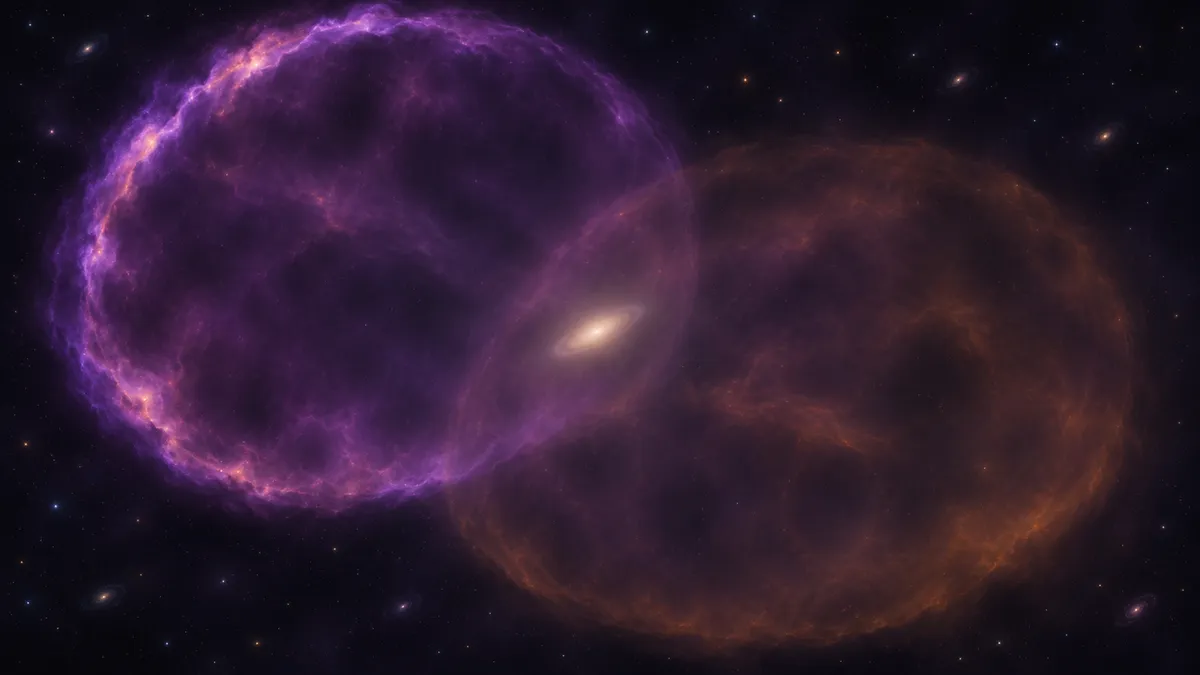
A quiet-looking galaxy sits between two enormous, faint radio bubbles. The newly reported structure could help astronomers investigate how some galaxies acquire the mysterious rings known as odd radio circles—and whether those rings preserve the aftermath of powerful nuclear outbursts.
Two shells around a quiet galaxy
Astronomers led by Renzhi Su report a pair of large radio bubbles surrounding the elliptical galaxy LEDA 217397. Together, the bubbles span about 399 kiloparsecs in projection. Their appearance resembles odd radio circles, or ORCs: faint, often edge-brightened radio structures hundreds of kiloparsecs across whose origins remain debated.
This object is not simply one ring with a galaxy at its centre. The researchers describe it as two partly overlapping, approximately circular shells, each about 114 kiloparsecs in radius. The galaxy lies near the centre of the overall structure, between the individual shell centres. That arrangement is central to their argument that an ancient, two-sided outburst may have inflated the bubbles.
The study is available as arXiv version 2, revised on November 6, 2026. Its landing page states that it has been accepted for publication in The Astrophysical Journal Letters; the supplied material is the arXiv manuscript, not an identified final journal edition.
Combining radio maps with galaxy measurements
The team first noticed the structure in data from ASKAP’s FLASH survey, then used sharper, more sensitive observations from the telescope’s Evolutionary Map of the Universe survey for its analysis. The principal image records radio emission at 944 megahertz, with an angular resolution of 15 arcseconds.
The southwestern component has a bright rim surrounding a dimmer interior. The northeastern component is fainter and appears more filled in. No optical or infrared counterpart to the diffuse shells was identified.
To establish the likely host’s distance, the researchers obtained an optical spectrum with the Australian National University’s 2.3-metre telescope. They measured a redshift of 0.040. The galaxy’s position and properties make it the natural host candidate, although the association is inferred rather than directly demonstrated.
The team also combined the ASKAP measurement with four lower-frequency measurements, from 88 to 185 megahertz, supplied by the Murchison Widefield Array’s GLEAM-X team. Fitting these measurements showed that the bubbles grow substantially fainter toward higher radio frequencies. Their spectral index is −1.04 ± 0.04, meaning the measured flux density falls roughly inversely with frequency.
Such a steep spectrum is consistent with an ageing population of energetic electrons emitting synchrotron radiation as they move through magnetic fields. It does not, by itself, uniquely identify what originally accelerated them.
Why an old jet episode looks plausible
Optical and infrared measurements across ten bands were fitted with models of the galaxy’s stellar population and dust emission. These indicate roughly 90 billion solar masses in stars and very little current star formation. The inferred star-formation rate, 0.025 ± 0.083 solar masses per year, is consistent with negligible activity. Its mid-infrared colours show no signature of a currently luminous active galactic nucleus.
The researchers compared three broad explanations: a wind powered by star formation, shocks associated with a galaxy or halo merger, and bubbles inflated by jets from an active galactic nucleus.
Their energy calculation places the bubbles’ particle-and-magnetic-field energy near 10^59 ergs under adopted assumptions about their volume and the balance between electron and magnetic energy. This is a model-based estimate, not a direct measurement; additional energetic particles could increase the requirement. Electrons emitting at 944 megahertz would lose their energy on a timescale of roughly 100 million years for the magnetic fields considered.
The galaxy’s present star formation is far too weak to supply the estimated energy within that timescale. The fitted stellar history also provides no evidence for a sufficiently recent, powerful starburst.
Merger-driven shocks could meet the energy requirement, but the authors argue that they struggle to explain two similarly sized, unusually round shells arranged around the host. Oppositely directed jets offer a more natural explanation for that geometry. A faint radio source coincides with the galaxy, although better observations are needed to determine its nature. A supermassive-black-hole merger is one possible trigger for a past jet episode—not an observed event in this system.
Important clues remain tentative
A comparison of matched-resolution radio maps suggests flatter spectra near the bubbles’ edges, potentially indicating renewed electron acceleration or compression. However, the map uses a permissive one-standard-deviation detection threshold, and uncertainties increase toward the outskirts. The apparent pattern needs confirmation.
Likewise, no substantial surrounding galaxy overdensity was found, but distance estimates based on galaxy colours could conceal a small group. No diffuse X-ray emission was detected; the available observations are not sensitive enough to exclude the merger-shock explanation.
Deeper radio imaging, measurements of radio polarization, spectroscopy of neighbouring galaxies and more sensitive X-ray observations could test the competing scenarios. For now, the twin shells favour a fossil nuclear outburst without establishing one—or settling the origin of ORCs as a whole.
- odd radio circles
- ASKAP
- EMU survey
- LEDA 217397
- radio bubbles
- active galactic nuclei
- synchrotron radiation
- galaxy evolution
Related reading
Automatically matched by shared topic keywords. These links do not imply that the sources agree or establish a consensus.
Radio surveys reveal a faint signal from IX Velorum
Source published
Shared keywords: emu survey
Galactic Gas May Preserve Traces of Fading Black Hole Activity
Source published
Shared keywords: active galactic nuclei, galaxy evolution
Quasar winds reach across galaxies—and may contain several distinct flows
Source published
Shared keywords: active galactic nuclei, galaxy evolution
Hyperion’s Densest Regions Show More X-ray-Active Black Holes
Source published
Shared keywords: active galactic nuclei
How JWST Could Trace the Seeds of the First Massive Black Holes
Source published
Shared keywords: galaxy evolution