TRANSMISSION // 2608.18950v2
A bright squeezed-light source, with limits still to solve
Source published
A KTP waveguide produces bright, nearly single-mode squeezed light for hybrid quantum photonics. Measurements and modeling also show why high-gain performance is difficult to characterize.
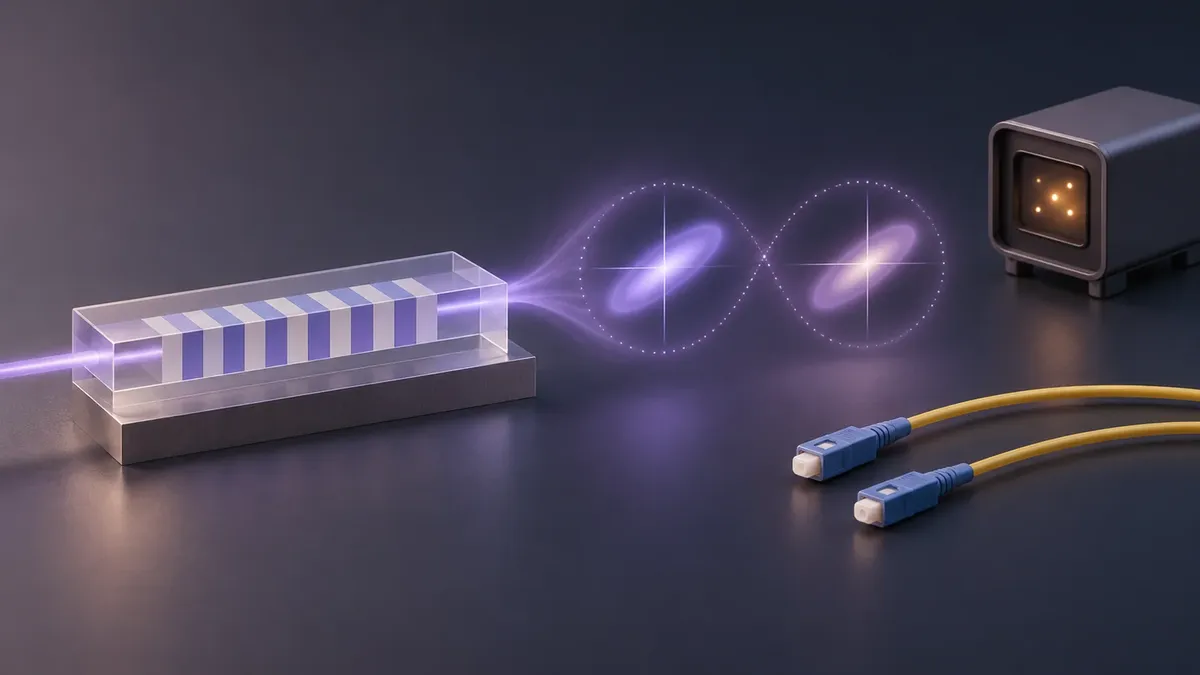
Hybrid quantum photonics combines two ways of encoding information in light. A new squeezed-light source aims to support this approach: it is bright, operates at a fiber-compatible wavelength and produces light close to a single optical mode. But its strongest squeezing is predicted rather than directly measured, while loss and high-power effects remain important constraints.
Why the optical mode matters
Quantum photonics can describe light using continuous variables, such as the strength of its electric field, or discrete variables, such as individual photons. Hybrid approaches bring the two together. One route is to make squeezed-vacuum states, interfere them in an optical network and count photons. Squeezing reduces uncertainty in one field property while increasing it in another; photon counting can provide a non-Gaussian operation useful in quantum information processing.
Ordinary photon-counting detectors generally do not distinguish the different spatial and spectro-temporal modes of light. If a source emits into several modes, a detector may combine them, making the resulting state harder to control. The research team set out to build and characterize a source that is bright, close to single-mode, compatible with fiber networks and suited to photon-number-resolving detection.
A waveguide and several cross-checks
The source is a 20-millimeter-long, periodically poled potassium titanyl phosphate (KTP) waveguide. It uses Type-II parametric down-conversion, which produces signal and idler light with different polarizations. The researchers report that the fields are spectrally indistinguishable enough to interfere on a beamsplitter, producing squeezed-vacuum states.
They tested the device across low- and high-gain operation using several measurements. Photon counts were used to estimate brightness; time-of-flight spectroscopy mapped signal–idler spectral correlations; and correlation functions helped estimate the number of modes. A Hong–Ou–Mandel-type interference measurement assessed how indistinguishable signal and idler photons were.
The team also developed a multimode theoretical model that includes loss during generation and ordering effects: the sequence of interactions as light travels through the waveguide can affect the output. They compared the model with measurements, rather than relying only on a simplified single-mode picture.
What the study reports
At the highest pump energy tested, the source produced more than 40,000 signal photons per pulse. Its operating wavelength was around 1546–1547 nanometers, in the telecommunications band. In the low-gain regime, the reported bandwidth is about 1.5 nanometers, corresponding to a Fourier-limited pulse duration of roughly two picoseconds; this duration is inferred from the bandwidth, not reported as a direct pulse-duration measurement. The authors describe compatibility with short-reach fiber networks. Differential fiber lengths of many tens of meters are suitable in their account, while longer lengths would require dispersion compensation or longer waveguides. The wavelength and short duration can also support intrinsic photon-number resolution in superconducting nanowire detectors.
The team measured an effective mode number of 1.24 ± 0.3 for the squeezed-vacuum state: close to one, but not exactly one. Signal–idler interference had a reported visibility of 92.6 ± 0.8 percent. The model describes the measurements well overall, but the paper also reports limitations and discrepancies in particular measurements, including at lower gain.
The model predicts that the source could produce squeezing approaching 20 decibels under the pump conditions considered. This is not a direct high-gain squeezing measurement. The authors say verifying that performance would require homodyne measurements, with the detector’s optical mode optimized at each pump power.
The study also highlights a measurement challenge. Estimating mode structure from joint spectral intensity can underestimate the mode number because the estimate depends on assumptions about spectral phase. Correlation measurements have their own complications: detector saturation and imperfect separation of signal and idler can affect results. The researchers modeled these imperfections. They also used higher-order correlations to estimate the squeezed state’s mode number, but say the reliability of this particular characterization technique under experimental imperfections remains to be established.
Promise, with practical constraints
Loss in the waveguide is a central limitation because it reduces squeezing and state purity. High-gain operation changes the light’s spectral structure, so a fixed measurement mode may no longer capture the strongest squeezing. The model predicts that optimizing the mode again can recover stronger squeezing. The team also identifies manufacturing reproducibility as a challenge to scaling this particular KTP waveguide approach to many sources. Possible improvements, including filtering or changing the poling pattern, involve trade-offs rather than cost-free fixes.
These results describe a carefully characterized source—not a complete quantum network or a demonstration of a particular application. The paper is an arXiv preprint; the source information provided here does not establish its peer-review status. Experimental data are available from the corresponding author on reasonable request. Direct measurement of high-gain squeezing and the robustness of the proposed squeezed-state correlation method under experimental imperfections remain open questions; the paper models several other measurement imperfections in its analysis.
- squeezed light
- quantum photonics
- KTP waveguide
- single-mode optics
- photon counting
- quantum networks
Related reading
Automatically matched by shared topic keywords. These links do not imply that the sources agree or establish a consensus.
Voltage brings silicon-carbide quantum emitters into tune
Source published
Shared keywords: quantum photonics
A design test for photon-pair sources without periodic poling
Source published
Shared keywords: quantum photonics
A common benchmark for simulating quantum computers made of light
Source published
Shared keywords: squeezed light
How a noisy photon counter can hide infinite microscopic irreversibility
Source published
Shared keywords: photon counting
When a faint cosmic signal might just be a lucky scatter of photons
Source published
Shared keywords: photon counting