TRANSMISSION // 2608.18339v2
When AI sees a changed image, relationships may help
Source published
A test-time adaptation method uses relationships among images and text to help vision-language models classify corrupted images. Reported gains are limited to specific benchmark settings.
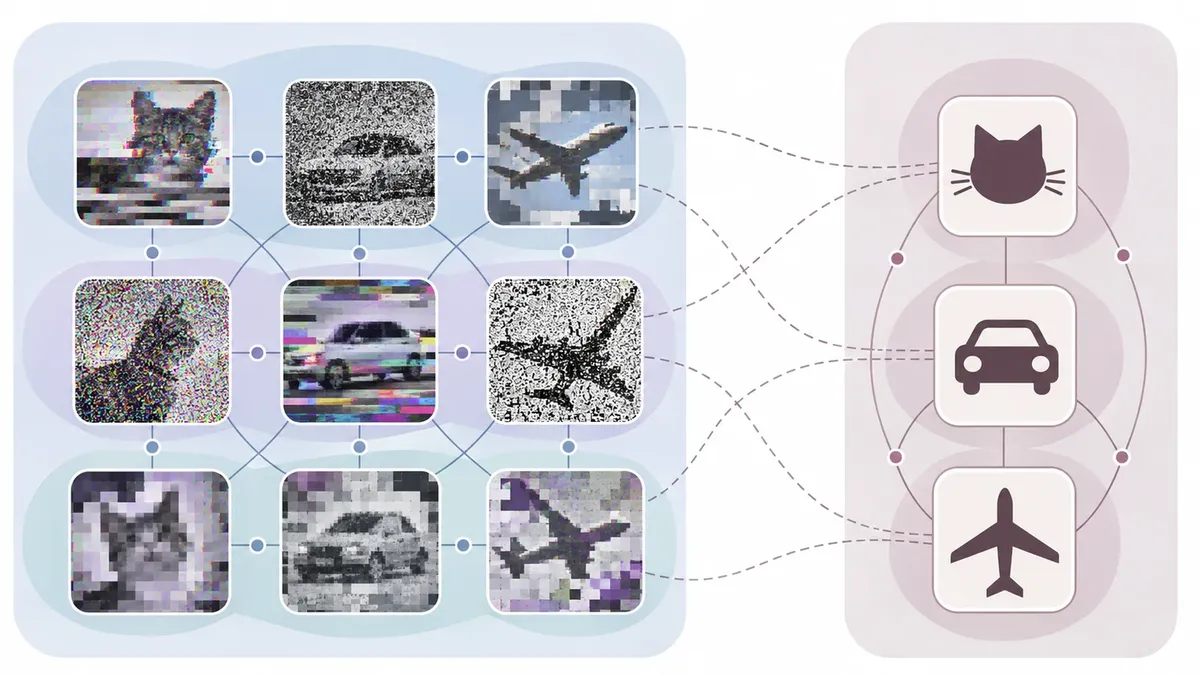
Vision-language models can match images to text labels without task-specific training, but their predictions may falter when images look different from the data they learned from. A new preprint proposes using patterns of similarity within image and text sets—not just image-to-label matches—to guide predictions and on-the-fly model updates.
A vision-language model can classify an image by comparing it with text descriptions of possible categories. For instance, it might score how closely an image matches “a photo of a dog” versus “a photo of a bicycle.” But if images are blurry, noisy or otherwise altered, those comparisons can become less reliable. Updating a model using its own mistaken predictions may then reinforce its errors.
In a preprint, Qi Yu and colleagues propose ORIGIN, a method that looks beyond individual image–text matches. The distances between images, and between text descriptions, form patterns of relationships. The researchers investigate whether those patterns can help when direct image-to-text similarities are disrupted.
Matching patterns, not just pairs
ORIGIN has two connected stages. First, it estimates which images in a batch correspond to which class descriptions. Rather than choosing matches from pairwise similarities alone, it uses Fused Gromov–Wasserstein optimal transport, a mathematical approach combining direct image–text comparisons with relationships within the image set and within the text set. The result is a set of soft assignments—provisional pseudo-labels, rather than fixed ground-truth labels.
Second, ORIGIN uses those assignments to adapt the model. Its multi-level InfoNCE loss, a contrastive-learning objective, encourages both image–text matches and agreement between image-to-image and text-to-text relationships. The experiments update normalization layers in the image encoder. The authors also prove that inference and adaptation can be expressed as optimizing the same underlying objective with respect to different variables. This links the two stages mathematically; it does not establish that the method will work in every deployment setting.
Results on corrupted-image benchmarks
The authors evaluate online test-time adaptation, in which test images are processed in batches and the model adapts using them. They report results with CLIP’s ViT-B-16 and ViT-B-32 visual encoders on CIFAR10-C, CIFAR100-C and ImageNet-C, benchmarks that apply common corruptions such as noise, blur and weather effects to familiar image datasets. The reported benchmark results use the highest corruption severity. Batch sizes are 200 for the two CIFAR benchmarks and 50 for ImageNet-C. The paper reports results for both encoders, but not every comparison or analysis covers every setup.
For ViT-B-16, the paper reports gains of up to 3.1 percentage points in mean accuracy over the best competitor on CIFAR10-C and 1.9 points on CIFAR100-C; it also reports at least a 1.5-point improvement on ImageNet-C. With ViT-B-32, the authors report a 5.4-point ImageNet-C improvement over SAT, a comparison that should not be folded into the ViT-B-16 headline. These are benchmark-specific results, not a uniform gain across corruptions, models or settings.
A component ablation on CIFAR100-C offers evidence about the proposed ingredients. In that comparison, FGW inference scored higher than embedding-based inference or Wasserstein-only transport without adaptation. Combining FGW with the multi-level loss scored higher than the tested alternatives, including FGW with semantic-only adaptation. These results are specific to the reported ablation; they do not establish that every component helps in every setting.
The paper also reports a favorable accuracy–runtime balance against the training-based methods it evaluated. That finding is tied to the authors’ implementations and experimental setup, not a general guarantee about real-world speed.
What remains uncertain
The evidence concerns image classification under benchmarked corruptions. It does not show that ORIGIN works across every kind of distribution shift, other vision tasks or real-world deployments. The evaluation uses CLIP and three corruption benchmarks; further testing would be needed to establish how broadly the results transfer.
The authors note practical limits: ORIGIN is designed for online adaptation and is not directly suited to strictly episodic settings unless it retains explicit memory of past samples. It also requires model gradients, which may make it unsuitable for some closed-source systems.
This is an arXiv preprint, not evidence of peer-reviewed publication. Its findings should be read as the authors’ reported results, pending independent evaluation. The method offers a tested way to incorporate relationships among images and text, but whether its benefits extend beyond these benchmark conditions remains open.
- vision-language models
- test-time adaptation
- optimal transport
- image classification
- distribution shift
- contrastive learning
Related reading
Automatically matched by shared topic keywords. These links do not imply that the sources agree or establish a consensus.
ACTOR uses delayed labels to improve later image classifications
Source published
Shared keywords: image classification, test time adaptation, vision language models
CLIP-FMoE splits image-and-text learning into expert modules
Source published
Shared keywords: contrastive learning, vision language models
CLASP looks beyond a model’s final answer to spot unfamiliar medical images
Source published
Shared keywords: vision language models
FedFiOT matches neurons to merge federated models with fewer exchanges
Source published
Shared keywords: optimal transport
When image and text directions diverge
Source published
Shared keywords: contrastive learning, vision language models