TRANSMISSION // 2608.16762v3
Does gravity change how a local quantum clock evolves?
Source published
A theoretical preprint finds clock-based evolution is generally nonunitary on a fixed curved background, while dynamical gravity may allow unitary evolution if an effective quantum theory preserves diffeomorphism invariance.
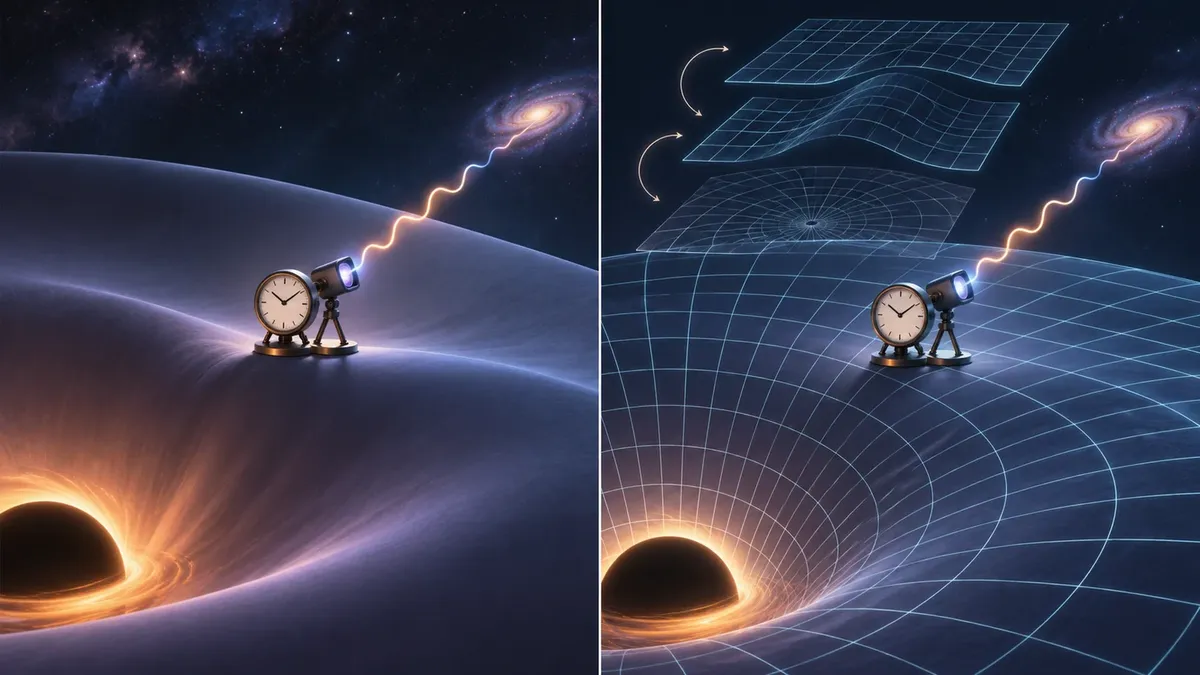
What does quantum evolution look like when time is measured by a clock carried by a local observer? Kengo Shimada’s theoretical preprint compares this question in two settings: a fixed curved spacetime and a theory with dynamical gravity. Its conclusions differ, with an important condition attached to the dynamical-gravity result.
The question: evolution by a local clock
Quantum evolution can be described relative to a clock carried by an observer. But does that relational description preserve unitarity—the consistency of quantum evolution with probability and information—when gravity is included? The paper examines how the answer connects to the Einstein equivalence principle.
Kengo Shimada models the observer as a relativistic particle carrying a clock and a detector for a matter field. The abstract reports a theoretical analysis, not an experiment.
Comparing two descriptions of gravity
The paper first considers the observer on a fixed curved background. It then considers a fully diffeomorphism-invariant theory of dynamical gravity. In the second setting, the author says observer-centered coordinates can be adopted. On a partially reduced phase space, one of the diffeomorphism generators becomes linear in the clock Hamiltonian, the quantity associated with the clock’s evolution.
This structure lets the paper define evolution relative to the observer’s clock while remaining consistent with the other diffeomorphism constraints. The comparison is about how these theoretical descriptions treat clock-based evolution; the abstract does not provide further detail about the models or derivations.
A contrast, with a condition
For the fixed curved background, the paper finds that evolution relative to the internal clock is generally nonunitary. The author says this implies a violation of the Einstein equivalence principle at the quantum level in this setting.
For dynamical gravity, the conclusion is different, but conditional. The paper argues that the observer-centered description and constraint structure imply unitary evolution relative to the internal clock—and thus preserve the equivalence principle in the quantum regime—assuming an effective quantum theory exists that consistently preserves diffeomorphism invariance.
That assumption matters: the result is not an unconditional claim that all theories of quantum gravity preserve clock-based unitarity. Nor does the abstract report an experimental test. It presents a theoretical argument about what follows if the stated effective-theory condition holds.
What the evidence can establish
This account is based on the paper’s abstract, not its full text. The abstract summarizes the model and main conclusions but does not provide enough information to assess the detailed derivations, the scope of the assumptions, or how the proposed effective-theory condition might be realized. Those questions should not be treated as settled by the summary alone.
The source is an arXiv preprint. The supplied information does not establish its peer-review status. The paper’s central proposal is that the treatment of gravity—especially the preservation of diffeomorphism invariance—can shape whether a local observer’s clock yields unitary relational evolution. That is a theoretical conclusion, not an experimental verdict on the equivalence principle.
- quantum gravity
- quantum clocks
- unitarity
- Einstein equivalence principle
- diffeomorphism invariance
Related reading
Automatically matched by shared topic keywords. These links do not imply that the sources agree or establish a consensus.
How selecting quantum outcomes could make a clock appear to run ahead
Source published
Shared keywords: quantum clocks
Encoding a black-hole mass model in qubits
Source published
Shared keywords: quantum gravity
Could a quantum horizon timescale shape cosmic expansion?
Source published
Shared keywords: quantum gravity
A calibrated assist for testing gravity and entanglement
Source published
Shared keywords: quantum gravity
A quantum model links baby universes to hidden observer information
Source published
Shared keywords: quantum gravity