TRANSMISSION // 2608.14164v2
When Political Pressure Reaches the Research Paper
Source published
A preprint reports that economists at universities more reliant on federal funding reduced flagged-word content on certain topics after a government stop list appeared in early 2025.
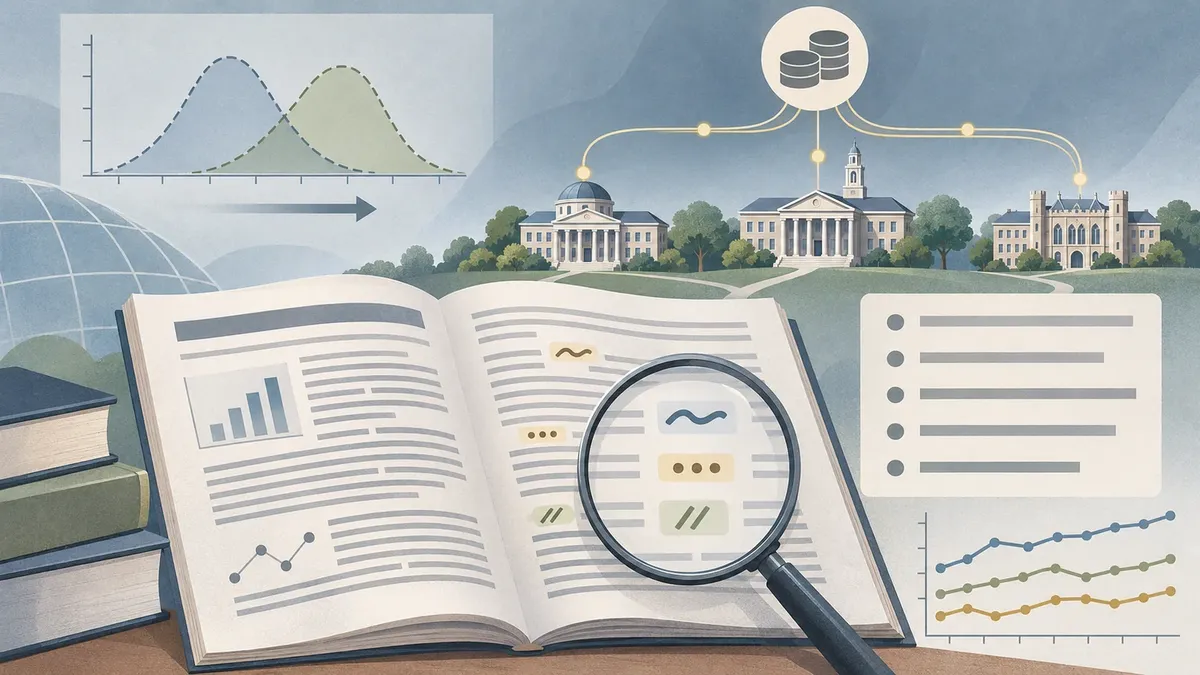
Can perceived political pressure affect what researchers publish? A study of economists examines changes after a government stop list appeared in early 2025. Its abstract reports reduced use of flagged words in content related to gender, race and the environment at universities more reliant on federal funding, while leaving important details open.
A policy signal, and a question about academic freedom
Academic freedom can be affected by formal restrictions, but researchers may also respond to perceived risks. If scholars think certain words or topics could have consequences, they may adjust their work even without a direct instruction to do so. Whether that happens—and how to distinguish it from other explanations—is difficult to measure.
In Science under Threat? A Natural Experiment in Economics, Dominic Rohner, Oliver Vanden Eynde and Philine Widmer examine economists’ published work around the appearance of a government “stop list” in the United States in early 2025. The list flagged words, and the study focuses on content related to gender, race and the environment.
What the study reports
The authors describe their research as a natural experiment. The abstract reports that economists at universities relying more on federal funding reduced gender-, race- and environment-related content containing flagged words relative to other US and UK economists.
That is the central finding available in the abstract. It indicates a relative change in the specified content; it does not, by itself, tell us that research on those topics stopped, or that every researcher changed their writing. A word-based measure can register altered wording even if the underlying subject or argument remains.
The authors also examine possible explanations. They say their analyses suggest self-censorship may explain the reduction better than direct grant cancellation. This comparison suggests one account fits their findings better; it does not establish what individual scholars believed or demonstrate the reason for any particular change.
The abstract further says estimates are similar when papers acknowledging federal funding are excluded, and when the analysis controls for universities’ institutional measures and financial distress. These checks address particular possible explanations, but cannot eliminate every alternative account.
What the abstract cannot tell us
The available source is the abstract, not the full paper. It does not give the sample size, effect sizes, corpus construction, precise measure of funding reliance, or details of the statistical analysis. Nor does it explain the comparison groups and assumptions in enough detail to independently assess the natural-experiment design. The abstract’s relative finding should therefore not be expanded into a more specific description of how the comparisons were constructed.
The result is also limited in scope: it concerns economists, particular topics, and flagged-word content. It does not establish a change across academia generally. And although the authors describe the pattern as consistent with self-censorship, the abstract does not prove that the stop list caused it. Other developments could have contributed to changes observed over the same period.
The source is an arXiv preprint. The supplied information does not establish its peer-review status, so readers should consult the full paper for methods and results before drawing stronger conclusions. The abstract presents evidence of a relationship between university funding reliance and changes in flagged-word content; it leaves open how that pattern arose and how broadly it applies.
- academic freedom
- economics
- research funding
- self-censorship
- political pressure
- natural experiment