TRANSMISSION // 2608.13346v2
A smarter way to track oscillating scalar dark matter
Source published
A new CLASS method detects when scalar dark matter starts oscillating rapidly and switches to an averaged calculation. Tests support the method in QCDM, while the data comparison still favors ΛCDM overall.
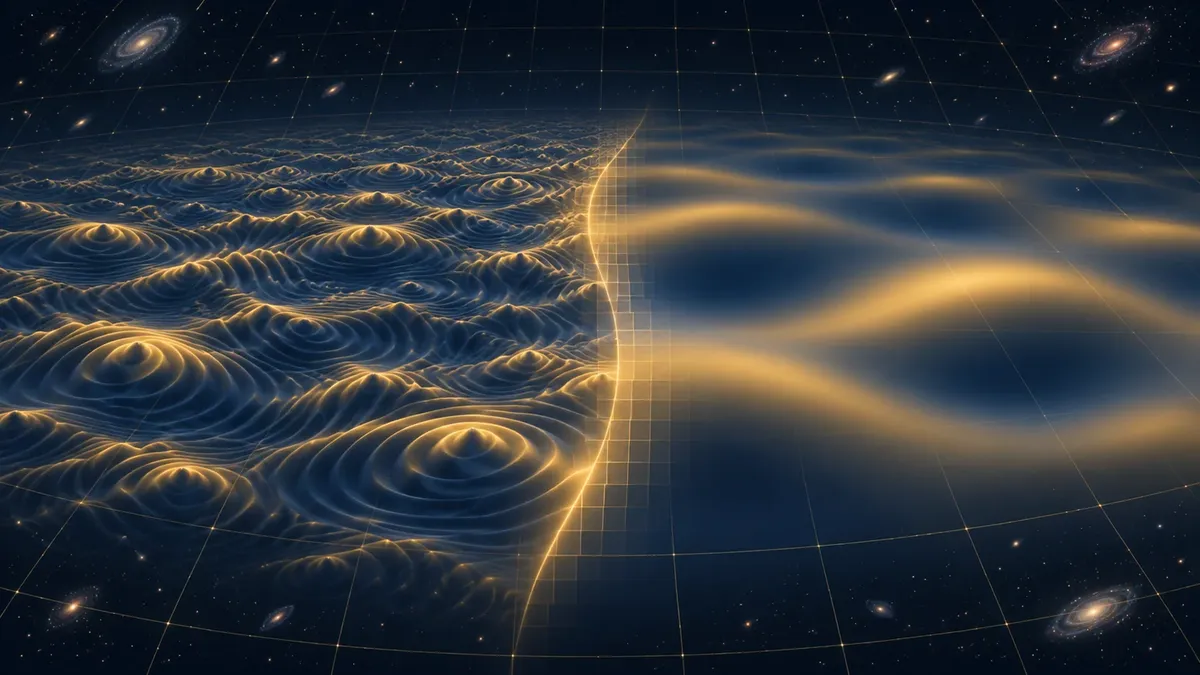
Rapidly oscillating scalar fields can be difficult for cosmology software to calculate, especially when dark matter interacts with dark energy. Amin Aboubrahim and Pran Nath introduce a method that detects the onset of oscillations and changes how the calculation is performed. Their tests support the approach in one interacting model; their data analysis does not show that model is preferred over the standard cosmological picture.
A scalar field can behave like dark matter when it oscillates around the minimum of its potential. For a quadratic potential, the field’s energy and pressure, averaged over its rapid oscillations, give an effective pressureless component. But the field can also affect the growth of cosmic structure in a scale-dependent way. Numerically following every oscillation becomes difficult when the field cycles much faster than the Universe expands: a computer must take very small time steps, making repeated calculations slow.
One workaround is to calculate the field’s motion directly at first, then switch to equations describing its averaged behavior. The challenge is choosing when to switch. A threshold set by hand can trigger too early or too late, and choosing it can become cumbersome when scanning many model parameters or including interactions between dark matter and dark energy.
Detecting when to switch
Aboubrahim and Nath implement an automatic transition method in CLASS, a cosmology calculation code. They test it on QCDM, a model in which scalar dark matter interacts with a quintessence-like dark-energy field.
The detector tracks a ratio of variables describing the dark-matter field. A sufficiently large drop in that ratio identifies a possible onset of oscillations, but does not by itself trigger averaging. The code also checks whether the dark matter’s equation of state—the relationship between its pressure and energy density—has taken both positive and negative values and changed sign repeatedly. The paper’s detector uses configurable thresholds for these checks and for the transition. Once the criteria are met, it begins a gradual computational handoff from the exact field equations to an averaged description. Users can also retain a manual mode for comparison.
Interactions require adjustments to the averaging prescription. The authors show that a straightforward use of a standard averaging rule would misrepresent the dark matter’s average pressure in their interacting model. They modify the background and perturbation equations so the oscillation-averaged dark matter has zero pressure in the rapid-oscillation regime, while accounting consistently for the interaction. Perturbations are small variations in the fields that contribute to the formation of cosmic structure.
How well does it work?
The authors compare the automatic calculation with a direct solution of the Klein–Gordon equation, which governs the scalar field. They use a lighter dark-matter mass for this test than for their cosmological parameter analysis, because direct integration at the analysis mass is impractical. In the comparison, background quantities track closely; density perturbations also follow one another closely. The largest reported deviation for momentum perturbations is 5%, during the transition between calculation methods.
They further test detector sensitivity, including a 50-point scan across combinations of six detector settings. In that scan, the reported median of the maximum differences is 0.36% for the CMB temperature spectrum, 0.093% for its polarization spectrum, and 0.59% for the matter power spectrum. The transition time can shift as settings change, while the resulting observables are generally less sensitive. The authors also check conservation of energy and momentum through the handoff and whether the conditions for the averaging approximation are met.
These are numerical checks for the model and parameter choices studied, not proof that the method will work unchanged for every scalar-field theory. Other models and parameter ranges would need their own validation.
What the observations say
For the data analysis, the researchers connect CLASS to Cobaya, a tool for sampling cosmological parameters. They consider three data combinations: CMB alone; CMB with DESI’s second-release baryon acoustic oscillation measurements and Pantheon+ supernovae; and those data with the SH0ES supernova distance-ladder calibration. Their CMB dataset includes measurements from Planck, ACT and SPT, as well as CMB lensing data. The dark-matter mass is fixed to a chosen value; it is not independently measured by this analysis.
Adding DESI and supernova data tightens constraints on several parameters. For the full combination including Pantheon+SH0ES, the inferred Hubble constant is higher than in the CMB-only analysis. The interaction strength remains weakly constrained. Although one combination gives QCDM a modestly better best-fit chi-squared than ΛCDM, the paper’s Bayesian comparison favors ΛCDM for all three combinations, with a stronger preference for ΛCDM in the full combination. This comparison accounts for the additional model freedom; a better best fit alone does not establish that the more complex model is preferred.
The work’s principal contribution is a computational method and an updated analysis of one interacting dark-sector model—not evidence that scalar-field dark matter has been detected. The findings are reported in an arXiv preprint and may not have undergone peer review. The authors make their modified CLASS code publicly available, allowing others to examine and test the implementation.
- scalar-field dark matter
- cosmology
- CLASS
- QCDM
- dark matter interactions
- numerical methods
- DESI
Related reading
Automatically matched by shared topic keywords. These links do not imply that the sources agree or establish a consensus.
A Julia toolkit for exploring quantum billiards
Source published
Shared keywords: numerical methods
Teaching Monte Carlo estimates to correct themselves
Source published
Shared keywords: numerical methods
A Look Ahead, Not a Higher Order: Rethinking Faster Diffusion Sampling
Source published
Shared keywords: numerical methods
A learned clock helps diffusion models spend sampling steps more wisely
Source published
Shared keywords: numerical methods
A better way to split quantum time evolution
Source published
Shared keywords: numerical methods