TRANSMISSION // 2608.13206v3
A faster way to follow primordial black holes from birth
Source published
A new three-dimensional simulation framework follows a model early-Universe fluctuation from its initial state through black-hole formation and later growth. Its key advance is a time-stepping method that cuts computational steps in a long simulation, while tests recover a collapse threshold and approximate mass scaling for a specific spherical setup. The results are promising groundwork—not yet a study of realistic, nonspherical fluctuations.
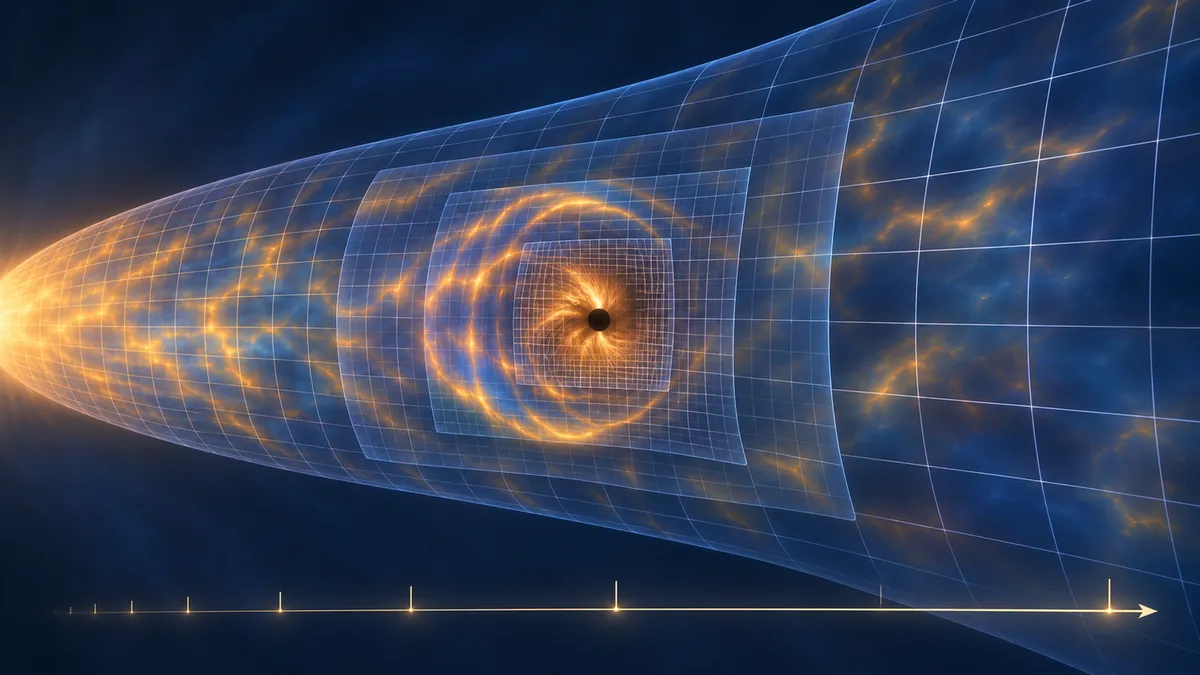
Could a small patch of the early Universe collapse into a black hole—and keep growing as the cosmos expands? Simulating that process is demanding: researchers must track a region larger than the Hubble horizon at the start while resolving tiny scales near collapse, then continue the calculation long afterward. A new numerical-relativity study tackles this challenge in three dimensions.
Primordial black holes, if they exist, would have formed in the early Universe rather than from the deaths of stars. One proposed route is the collapse of an unusually large curvature perturbation: a distortion in the geometry of space that, after it enters the Hubble horizon, can drive radiation and gravity into a black hole. Whether collapse happens depends on the perturbation’s size and shape, as well as the pressure of the surrounding radiation.
The study by Zhuan Ning and colleagues asks two connected questions: can a three-dimensional simulation follow this process efficiently over long periods, and can it reproduce familiar results for a controlled example? The team built a framework in the GRChombo numerical-relativity code, coupling Einstein’s equations to a radiation fluid. They used adaptive mesh refinement, which concentrates computing resolution where the collapse develops, and initialized the calculation with a perturbation larger than the horizon.
The central technical change concerns time steps. As the Universe expands, physical signals travel across the simulation grid more slowly in its chosen coordinates. A standard gauge condition—the mathematical choice that governs how coordinates behave—can nevertheless impose a restrictive time step. The researchers introduced a “cosmologically scaled” Gamma-driver gauge, adjusting its parameters as the scale factor grows. In a representative long run, this preserved the black hole’s apparent-horizon mass history and the behavior of the Einstein-equation constraint diagnostics, while reducing coarse-grid time advances by about a factor of 94 compared with the standard driver. A separate formulation using conformal time produced consistent horizon-mass histories, providing a check on the implementation.
For their first application, the researchers chose a spherical Gaussian curvature profile in a radiation-dominated universe. They found a collapse threshold of about 0.7958 in the profile’s amplitude parameter: below the threshold, the disturbance disperses; above it, an apparent horizon forms. This value agrees closely with a spherically symmetric calculation for the same profile. The threshold is not a universal number for primordial black holes: it depends on the setup, including the profile and the assumed matter content.
Near the threshold, the simulated black-hole mass approximately follows a critical scaling relation: smaller departures above the threshold produce smaller black holes. The fitted scaling exponent, however, is not a precision measurement. It shifts with the simulation’s resolution and with which data points are included in the fit. The authors report this sensitivity explicitly and conclude that their simulations demonstrate approximate scaling, not a definitive continuum value for the exponent.
The team also followed black-hole growth after formation. At late times, the simulated mass evolution could be fitted with the Zel’dovich–Novikov accretion prescription, a model for accretion from a radiation background. This shows that the framework can connect near-threshold collapse with later evolution in the same three-dimensional calculation. The fit is model-dependent, and the paper notes that the inferred accretion efficiency depends on the choice of time slicing.
There are important boundaries to what the results establish. The application presented here is spherical, even though the framework is three-dimensional; it does not yet determine how nonspherical fluctuations alter the threshold, mass scaling, or black-hole spin. Numerical tests support the reported exterior observables, but the authors also describe resolution-dependent shifts and numerical difficulties in some simulations, particularly inside the apparent horizon. The reported speed-up is a comparison of simulation steps for a representative case, not a guarantee of the same gain in every calculation.
The work is an arXiv preprint, so it should be treated as a research report rather than as a result whose peer-review status is established by the supplied source. The available source text describes simulations, not observations of primordial black holes. Its main contribution is methodological: a tested route toward more efficient three-dimensional studies of early-Universe collapse, including future cases that depart from perfect spherical symmetry.
- primordial black holes
- numerical relativity
- early Universe
- radiation domination
- adaptive mesh refinement
- critical collapse
Related reading
Automatically matched by shared topic keywords. These links do not imply that the sources agree or establish a consensus.
Could ancient cosmic walls have left a gravitational-wave background?
Source published
Shared keywords: early universe
How the early Universe’s changing particle soup could reshape gravitational waves
Source published
Shared keywords: early universe
A Python tool traces possible signals from the early universe
Source published
Shared keywords: primordial black holes
What dead stars reveal about matter, gravity and the early Universe
Source published
Shared keywords: primordial black holes
Inflation models face a small-scale test—and a black-hole problem
Source published
Shared keywords: early universe, primordial black holes