TRANSMISSION // 2608.12474v2
A new search finds 50 stellar “heartbeats”
Source published
By pairing APOGEE binary-star data with TESS brightness records, researchers identified 50 heartbeat stars and examined how these systems are distributed across the main sequence.
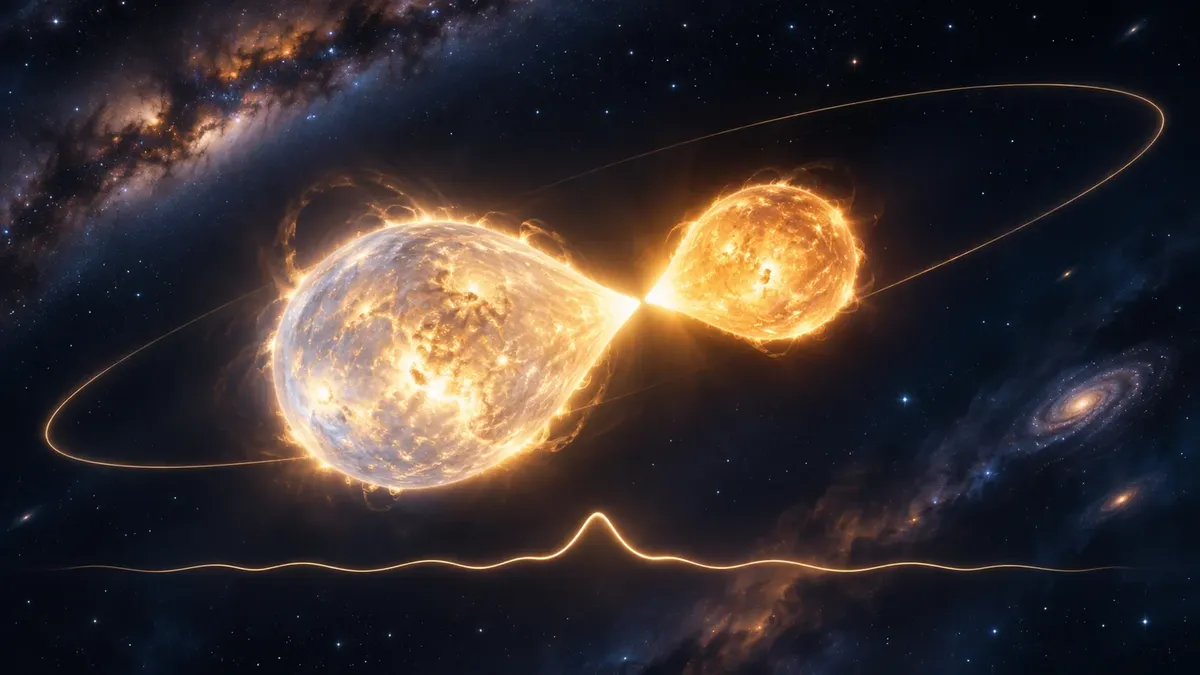
Some pairs of stars brighten and dim in a distinctive pulse as they swing close together. A search combining NASA’s TESS light curves with APOGEE survey data identified 50 such “heartbeat” systems. The researchers infer that many of the systems’ primary stars have begun evolving away from the main sequence based on where they sit on a color–magnitude diagram—not by watching individual stars change over time.
A star’s “heartbeat” is not a regular beat like a pulsar’s. It is a brief change in brightness associated with the stars’ closest approach in an elongated orbit. Their mutual gravity deforms the stars, producing the characteristic pattern in the light curve. These detached, short-period binaries offer a way to study tidal forces and, in some cases, oscillations inside stars.
Jowen Callahan and colleagues searched for heartbeat stars by combining two kinds of observations. APOGEE had identified likely binaries through changes in their measured velocities. TESS, NASA’s space telescope, records changes in stellar brightness. The researchers searched TESS data for the characteristic brightness pattern among APOGEE-identified binaries, then modeled promising light curves to estimate orbital properties.
Searching the light curves
The team selected main-sequence binaries with APOGEE velocity scatter of at least 3 km/s, the criterion they used to identify binaries, and excluded giants using a surface-gravity cut. They focused on stars bright enough for the TESS Quick-Look Pipeline data used in the analysis. This left 31,548 candidate binaries. The researchers examined TESS sectors separately and searched for repeating signals using period-analysis methods.
For candidates, they compared an analytic heartbeat-star model with a simple linear brightness trend. After visually inspecting promising cases, they fit the phase-folded light curves—data lined up by orbital phase—to estimate orbital period, eccentricity, inclination and the orientation of the orbit. Eclipses can distort the heartbeat signal, so the team masked eclipses in affected systems before fitting. They also searched the model residuals for oscillations at integer multiples of the orbital frequency, a possible sign of tidally excited oscillations.
The search identified 50 heartbeat stars. Fourteen show eclipses, and 14 show oscillations consistent with tidal excitation. Their orbital periods range from about 1.48 to 10.92 days, and their eccentricities from about 0.085 to 0.588. Fourteen of the 50 had been identified in earlier searches; the authors report the remaining 36 as new identifications in this search, not necessarily as objects newly discovered in an absolute sense.
APOGEE’s repeated velocity measurements could also help constrain companion masses, but only when enough usable observations covered the orbit. Eight systems met the team’s criteria for fitting velocity orbits and measuring mass functions. A mass function narrows down possible companion masses but does not, by itself, provide a direct mass measurement. Estimates also depend on the assumed mass of the primary star and the orbital inclination inferred from the light curve.
What the sample suggests
The researchers asked whether a new sample would support trends reported in their earlier work. It did: they find that the fraction of main-sequence binaries identified as heartbeat stars rises toward higher effective temperatures and falls toward cooler, redder stars. They also find that the heartbeat systems sit high on a color–magnitude diagram. The authors interpret this position as evidence that many non-giant primary stars have begun evolving away from the main sequence. This is an inference from the stars’ population-level properties, not a direct observation of individual stars evolving.
The authors suggest that stellar evolution and the damping of tidal variations may help explain why heartbeat stars are more common among hotter stars. This search, however, does not establish those processes as the cause of the observed pattern.
The results describe a selected sample, not every binary in the sky. The search focused on relatively bright stars with usable TESS light curves; the paper says that lower photometric precision for fainter targets prevented the detailed modeling used here. The authors also note that reliable mass-function measurements required adequate radial-velocity coverage. In some systems, fitting involves uncertainties: the paper describes cases where masking eclipses changed inferred orbital parameters, including a candidate whose fitted eccentricity fell below the search’s nominal threshold after masking.
This work is an arXiv preprint, so its findings may still be subject to formal review. It adds a set of heartbeat-star identifications and supports trends found in earlier work, while leaving open why those trends occur. The authors point to future survey data and longer TESS observing sectors as opportunities to expand samples and investigate longer-period systems.
- heartbeat stars
- binary stars
- TESS
- APOGEE
- stellar tides
- tidally excited oscillations
Reviewed cross-references
These connections were reviewed by a model, not independently fact-checked by a human. Similarity does not imply agreement; consult the original papers and the evidence below.
TESS finds pulsations common in young B-type stars
Shared method: Both studies analyze TESS photometry in the frequency domain: Callahan et al. search periodograms of heartbeat-model residuals for tidally excited oscillations, while Nardini et al. use frequency analysis to identify pulsation signals. The analyses address different signals and stellar samples, so this is a methodological connection, not evidence that the findings agree.
Model review: · openai-codex/gpt-6-luna
Evidence and provenance
Selected excerpts, not complete papers. PDF extraction can omit figures or damage equations, tables and reading order; sources may be preprints.
2608.12474v2 — Original paper
Excerpt reference:
static/papers/2608.12474v2.md:144-247
Basis: Paper text
Source SHA-256:7ad197e87e25e493ff035f4e373e3c04b0d1c12287bf8dc3f7bdd73c0cbfa3b02611.27680v1 — Original paper
Excerpt reference:
static/papers/2611.27680v1.md:539-605
Basis: Paper text
Source SHA-256:78e733d44a71b779ed39986029995754f1d90f941ea38ef8a045aeeaea9912d5
Related reading
Automatically matched by shared topic keywords. These links do not imply that the sources agree or establish a consensus.
Earth 2.0 could reveal shrinking orbits around three distant stars
Source published
Shared keywords: stellar tides
TESS finds pulsations common in young B-type stars
Source published
Shared keywords: binary stars
Stellar pulses point to two binaries—and spectra confirm the motion
Source published
Shared keywords: binary stars
Stellar pulsations help weigh both stars in HD 70510
Source published
Shared keywords: binary stars
Borrowed stellar material leaves clues in Collinder 261’s blue stragglers
Source published
Shared keywords: binary stars