TRANSMISSION // 2608.12193v2
The quiet work behind LIGO’s gravitational-wave detections
Source published
A preprint reviews detector-characterization work during LIGO’s O4b and O4c, including noise investigations and tools for checking gravitational-wave candidates.
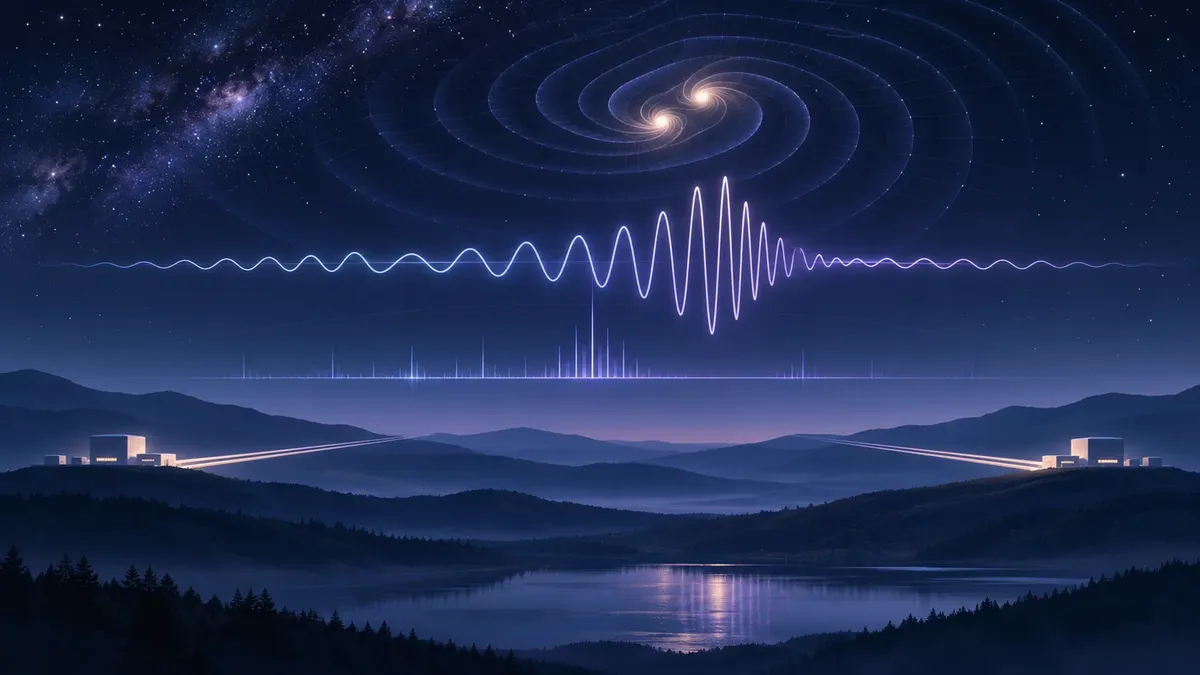
Gravitational-wave searches depend on understanding the instruments that collect the data. A preprint by J. Glanzer and colleagues surveys detector-characterization activities at LIGO’s Hanford and Livingston observatories during the later parts of the fourth observing run.
A gravitational-wave candidate is a pattern in detector data that researchers need to assess. The instruments can also register disturbances, so understanding detector behavior and data quality is an important part of searches. A preprint by J. Glanzer and colleagues reviews this work during O4b and O4c, the second and third parts of LIGO’s fourth observing run.
What the review covers
The authors summarize changes in the configuration and performance of the LIGO observatories at Hanford and Livingston, from the end of O4a through O4c. They include upgrades made during the commissioning break before O4b and repairs performed during O4c.
The paper describes investigations intended to understand and mitigate effects on detector sensitivity from several kinds of noise: transient glitches, narrowband spectral lines and vibration-driven noise, among other data-quality concerns. The abstract outlines these topics but does not give specific measurements or explain the results of individual investigations.
Another focus is how teams validate gravitational-wave candidates and provide data-quality products to searches. The abstract names searches for compact binary coalescences, unmodeled transients, continuous gravitational waves and the stochastic gravitational-wave background. These searches address different kinds of signals; the paper reviews procedures and tools that support them.
Why characterization matters
The authors describe detector characterization as important for maintaining and improving sensitivity and reliability, particularly as observing runs lengthen and more events are detected. They say these efforts enabled confident detections of hundreds of compact binary coalescences during the fourth observing run. The abstract presents this as an enabling role; it does not quantify how much particular repairs or noise-mitigation actions changed sensitivity or detection rates.
This is a review of work to understand detector performance and support searches, rather than an announcement of a new astrophysical discovery. The abstract does not provide event-by-event validation results, detailed measurement methods, or numerical estimates of the impact of individual interventions. It mentions prospects for future observing runs but does not specify them in the abstract.
This account is based on the abstract available for the arXiv preprint, not a full-text assessment. That limits the detail that can be checked here; the supplied material also does not establish whether the preprint has undergone peer review. The broad point is that gravitational-wave observations rely not only on searches for cosmic signals, but also on sustained work to characterize detector data and provide quality information to those searches.
- LIGO
- gravitational waves
- detector characterization
- instrument noise
- data quality
- O4 observing run
Related reading
Automatically matched by shared topic keywords. These links do not imply that the sources agree or establish a consensus.
Could LIGO triggers hint at sub-solar objects?
Source published
Shared keywords: gravitational waves, instrument noise
New Data Products for Gravitational-Wave Alerts
Source published
Shared keywords: gravitational waves
A New Search Strategy for Gravitational Waves from Eccentric Neutron-Star Binaries
Source published
Shared keywords: gravitational waves
Eccentricity remains uncertain in three gravitational-wave events
Source published
Shared keywords: gravitational waves
Wavescan Sharpens the Time-Frequency View of Gravitational Waves
Source published
Shared keywords: gravitational waves