TRANSMISSION // 2608.11659v2
Quieter satellites could protect radio astronomy and Earth-rotation measurements
Source published
A measurement-based modelling study proposes satellite emission limits that tighten as constellations grow. It identifies unwanted harmonics from direct-to-device downlinks as a particular threat to geodetic radio observations, while distinguishing predicted interference from actual telescope outages.
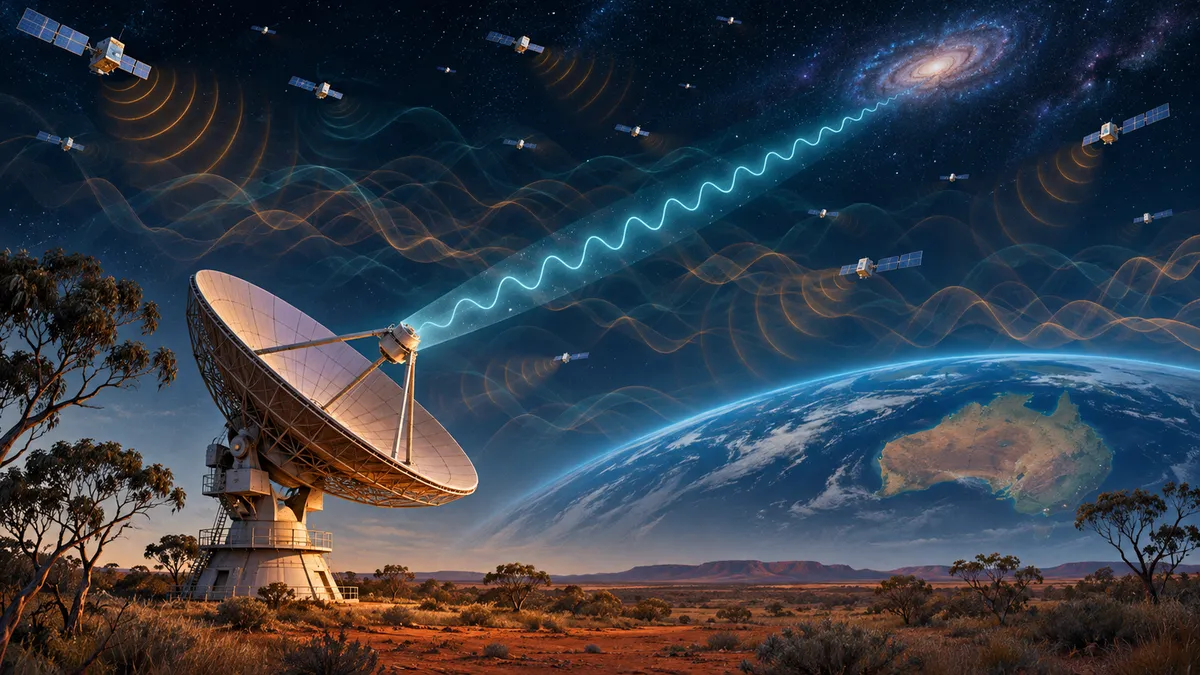
Radio telescopes do more than explore the universe: by timing signals from distant quasars, they help measure Earth’s rotation and maintain the reference frames behind precise navigation. A revised arXiv study asks how those measurements can survive a sky increasingly filled with satellites—and calculates how quiet individual spacecraft would need to become.
Why Earth measurements need a quiet sky
Geodetic very long baseline interferometry, or VLBI, compares when radio waves from distant quasars arrive at widely separated telescopes. Those timing differences reveal the geometry of the observing network and Earth’s orientation in space. The technique uniquely determines UT1–UTC, which relates Earth’s rotation to coordinated clock time.
Its next-generation system, VGOS, combines 32 observing channels, each 32 megahertz wide, spread across approximately 3–14 gigahertz. That broad frequency span supports precise timing measurements, but most of it lies outside primary radio-astronomy allocations. Retreating into a few protected bands would sacrifice measurement precision.
Balthasar Indermuehle and colleagues examine this vulnerability in an arXiv manuscript revised on 6 November 2026. Although the manuscript acknowledges an anonymous referee, the supplied record does not establish final journal publication.
From satellite measurements to simulated interference
The analysis draws on SNIFFLES-I, a survey comprising 4,629 tracked satellite observations across 1–26 gigahertz. Measurements with the Mopra telescope, calibrated using the Australia Telescope Compact Array, supplied estimates of individual satellites’ radio output.
The researchers distinguish three sources: licensed communication signals; unwanted transmitter emissions, including harmonics at multiples of a downlink frequency; and unintended radiation from onboard electronics. These categories have different engineering origins and regulatory implications.
They combine those measurements with a catalogue snapshot containing 11,981 satellites from five systems. Monte Carlo simulations vary observing times and telescope directions, propagate satellite orbits, and sum the interference received through a reference telescope antenna pattern. The resulting equivalent power flux density accounts for the antenna’s response to satellites both near and far from its pointing direction.
The team compares this aggregate with International Telecommunication Union radio-astronomy protection criteria. It also models larger populations, including 100,000 and 300,000 satellites. A separate observing test at 11.3 gigahertz broadly supported the model’s measurable aggregate statistics, although the model overpredicted the most extreme signal tail.
Harmonics dominate the geodetic result
The main analysis identifies a particularly troublesome signal: the second harmonic of a 2,620-megahertz Starlink direct-to-device downlink, appearing at 5,240 megahertz within VGOS sub-band B.
At the Hobart AuScope station, the model estimates that this harmonic exceeds the VLBI protection threshold in about 68% of sampled sky directions and 2,000-second observing windows for the catalogue fleet. It reaches 100% in the 100,000-satellite scenario. Because the strongest calibration measurements were compressed by the measuring system, the authors treat the signal level and present-fleet loss estimate as lower bounds.
Crucially, “data loss” here means simulated threshold exceedance—not a measured percentage of failed geodetic observations, a global network outage, or receiver damage. Interference at the VLBI threshold adds 1% of receiver noise; stronger exceedances produce greater sensitivity penalties.
Integration time also matters. A third harmonic at 7,860 megahertz exceeds the criterion in 7.6% of present-fleet samples using the 2,000-second reference window. At typical 10–30-second VGOS scan lengths, however, that present-fleet case remains below the study’s 2% exceedance benchmark. The second harmonic remains problematic at every tested window.
Different observations need different protection
Single-dish astronomy faces substantially stricter sensitivity criteria than VLBI. At several bright measured features, including radiation at 2,700 megahertz in a primary radio-astronomy band, the simulations predict continuum-threshold exceedance in every present-fleet sample across the accessible sky. The 4,995-megahertz feature, also within a primary radio-astronomy band, produces partial rather than all-sky exceedance: 6.9% of present-fleet pointing-and-window samples at Murriyang and 42.0% at the Hobart 26-m dish, with the other single-dish facilities between those values. The separate 12-m AuScope Hobart antenna reaches 54.8% when assessed against the same continuum criterion, not the looser VLBI criterion. These results do not mean all astronomy across 1–14 gigahertz becomes impossible: they depend on frequency, signal strength, observing mode and facility.
Narrow electronic-radiation features behave differently from broad downlink harmonics. Their small total power, integrated within a 32-megahertz channel, generally keeps them below the modelled VLBI sensitivity threshold, while they can still trouble more sensitive single-dish observations.
A spacecraft-level prescription, with caveats
Working backwards from the aggregate thresholds, the researchers derive proposed per-satellite ceilings. For the broadband harmonics in a 300,000-satellite scenario, VLBI protection requires approximately 65–70 decibels relative to one microvolt per metre, referenced to 10 metres and a one-megahertz bandwidth. Single-dish ceilings across the analysed features are roughly 18–46 in the same field-strength units, with narrower reference bandwidths where appropriate. Geodetic calibration measurements also require stricter protection than the interferometric observable alone.
These are proposed technical targets, not newly enacted regulations. Nor are they compliance limits on an authorised downlink inside its licensed band.
The projections assume future orbital distributions and radiating fleet shares resembling today’s. Simple population scaling can misrepresent the interference distribution; direct enlarged-fleet tests quantify that bias. Reference antenna patterns and uncertain signal levels add limitations. A separate orbital-data-centre scenario is especially conditional because those platforms’ radiation has not been measured.
The practical proposal is to pair population-aware emission control with aggregate limits. Pointing avoidance can reduce near-beam encounters, but cannot remove the widespread sidelobe interference that limits sensitive single-dish astronomy.
- radio astronomy
- satellite constellations
- geodetic VLBI
- VGOS
- radio-frequency interference
- direct-to-device satellites
- Earth rotation
- spacecraft emission limits
Related reading
Automatically matched by shared topic keywords. These links do not imply that the sources agree or establish a consensus.
Measuring the noise that can hide faint cosmic radio signals
Source published
Shared keywords: radio astronomy, radio frequency interference
Which exoplanets could the SKA hear? A radio forecast with important caveats
Source published
Shared keywords: radio astronomy
Simulations explore how three antennas could locate solar radio signals
Source published
Shared keywords: radio astronomy
Ammonia Maps Offer a Closer Look at Gas Near the Milky Way’s Centre
Source published
Shared keywords: radio astronomy
Faint radio signals probe two growing galaxy clusters
Source published
Shared keywords: radio astronomy