TRANSMISSION // 2608.11537v3
A visible color map helps refine road-scene segmentation
Source published
Semantic Prism turns road-scene labels into a color-coded image, then uses generator features to correct the map and estimate where errors may remain.
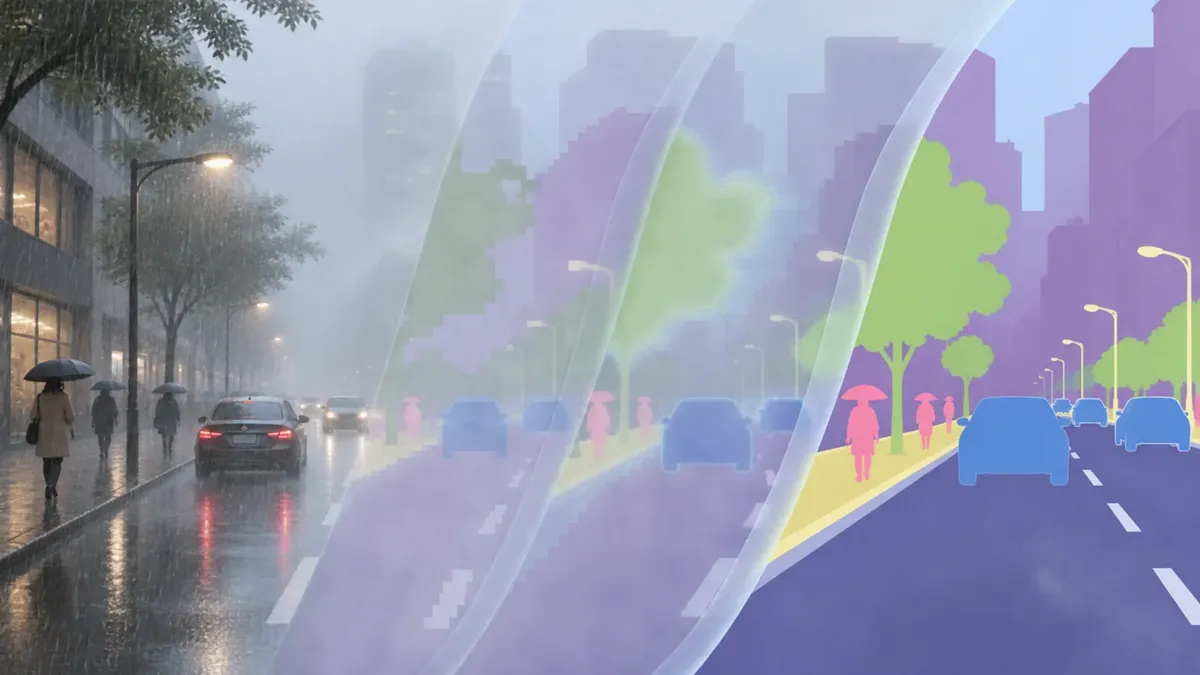
Image generators can paint a scene’s categories as colors, but blurred edges and color shifts can confuse the labels. Semantic Prism pairs that visible color map with a separate refinement step and tests the approach on three driving datasets.
Semantic segmentation gives every pixel in an image a label: road, building, car, person, and so on. One way to produce those labels is to have an image generator paint a color-coded map, with each color representing a class. The map is easy to inspect, but it is not always precise. Colors can drift from their intended values, and a pixel near a boundary between two objects may blend both colors.
Semantic Prism, a study by Weize Cai and colleagues, asks whether that visible map can serve as a useful interface for segmentation if a model also uses its internal features to repair mistakes. The researchers focus on road scenes, where thin objects and sharp boundaries matter. Their paper reports tests on Cityscapes, BDD100K and the Adverse Conditions Dataset with Correspondences (ACDC).
From generated colors to corrected labels
The system first adapts a pretrained generator to produce a semantic RGB image: a picture in which colors stand for scene classes. A fixed palette, or codebook, assigns a representative color to each class. The system compares every generated pixel’s color with those palette colors. Pixels closer to a particular class color receive higher probability of belonging to that class. This gives a full set of class probabilities, not just a single label.
That first decoding is explicit: it can be reconstructed from the generated image and the fixed palette, without inspecting the generator’s internal features. The researchers call it an observable interface. It also offers a baseline against which they can test the effect of refinement.
Their refinement module, Hierarchical Generator Evidence Alignment (HGEA), uses features from three levels of the generator’s variational autoencoder, alongside the input image, generated map and initial class probabilities. It aligns those features to the pixel grid and predicts adjustments to the class scores. In effect, the color map makes an initial proposal; the features help revise it, particularly where the image is difficult to decode directly.
The generator uses one denoising step per crop. For full-resolution evaluation, the model processes three overlapping crops and combines their predictions. A separate component, Contextual Interface Hierarchy Disagreement (C-IHD), estimates which pixels are more likely to be wrong. It combines uncertainty at a pixel, uncertainty in its local neighborhood and the difference between the initial and refined predictions. It ranks possible errors but does not change the segmentation itself.
What the tests found
On the 500-image Cityscapes validation set, the full system achieved 72.07% mean intersection over union (mIoU), a measure that summarizes overlap between predicted and reference labels across classes. Directly decoding the generated color map achieved 60.68% mIoU. The researchers report that refinement also improved scores for thin or rare classes and reduced expected calibration error, a measure of how closely predicted confidence matches observed correctness.
Controlled tests help clarify what contributed to the result. When the researchers matched the number of trainable parameters across alternative refiners, using features from multiple generator levels performed better on average than using a flat design or a single feature level. The comparisons involved three training seeds; they support the value of combining levels in these tests, rather than proving that this design is best in every setting.
The Cityscapes-trained model was also tested on ACDC without adapting it to that dataset. It reached 46.89% mIoU across 406 validation images covering fog, night, rain and snow. This is evidence of performance under a change in conditions, but the score also shows that substantial errors remain. On BDD100K, a separately trained model reached 62.22% mIoU on the full 1,000-image validation set; this is an in-dataset test, not a transfer test.
For error ranking, the researchers compared C-IHD with maximum-softmax-probability uncertainty while holding the segmentation predictions fixed. C-IHD improved the area under the precision-recall curve (AUPR) on all three datasets. On ACDC, the score rose from 0.6580 to 0.7557. This means the method ranked incorrect pixels more effectively under that evaluation; it did not make the underlying segmentation more accurate. The authors report a paired bootstrap analysis for the Cityscapes ranking comparison, but the ACDC figure should be read as a result on this particular validation set, not a guarantee for other weather or driving conditions.
What remains uncertain
The results suggest that a visible, decodable output and internal generator features can work together: the first supplies an inspectable starting point, while the second helps correct it. But Semantic Prism is not simply a lightweight color decoder. Its evaluation uses multiple image crops and a computationally demanding generator; the paper reports lower throughput and higher memory use than some compared methods. Its fixed palette also assumes a closed set of known classes, and the evaluation covers three driving datasets rather than the full range of real-world scenes.
The paper is an arXiv preprint, so its claims should be treated as research findings awaiting independent scrutiny, not as established clinical or road-safety evidence. The authors also disclose that AI tools assisted with language editing, parts of the code implementation and preliminary visualizations, and say they reviewed the material and take responsibility for the work. Further replication and evaluation would help show how reliably the approach works beyond the reported benchmarks.
- semantic segmentation
- computer vision
- image generation
- road scenes
- uncertainty estimation
- Cityscapes
Reviewed cross-references
These connections were reviewed by a model, not independently fact-checked by a human. Similarity does not imply agreement; consult the original papers and the evidence below.
Why an Open AI Vision Model Struggles With Depth and Segmentation
Shared method: Both systems represent semantic segmentation outputs as RGB images and decode colors into classes: Semantic Prism uses distances to a fixed class-color codebook, while Open Vision Banana specifies a semantic palette and nearest-color decoder in its task contract. This is a limited interface-level methodological connection; their generators, training setups, and refinement methods differ.
Model review: · openai-codex/gpt-6-luna
Evidence and provenance
Selected excerpts, not complete papers. PDF extraction can omit figures or damage equations, tables and reading order; sources may be preprints.
2608.11537v3 — Original paper
Excerpt reference:
static/papers/2608.11537v3.md:63-121
Basis: Paper text
Source SHA-256:202643fe284206d65fad1378d2c085c88d4e2fe8015ac3999aae3440d0e25dce2611.28489v1 — Original paper
Excerpt reference:
static/papers/2611.28489v1.md:334-505
Basis: Paper text
Source SHA-256:92e6d42b781317ea18909bf8ba7062d2bba454145f1d48ddde86df5a5fae6f03
Related reading
Automatically matched by shared topic keywords. These links do not imply that the sources agree or establish a consensus.
Why an Open AI Vision Model Struggles With Depth and Segmentation
Source published
Shared keywords: computer vision, image generation, semantic segmentation
A Small Decoder Takes Another Pass at Image Segmentation
Source published
Shared keywords: computer vision, semantic segmentation
Beyond spotting windows: A LiDAR benchmark asks what building features do
Source published
Shared keywords: computer vision, semantic segmentation
How an event camera can help track a spacecraft
Source published
Shared keywords: computer vision, uncertainty estimation
Teaching vision transformers where finer image patches matter
Source published
Shared keywords: computer vision