TRANSMISSION // 2608.11095v2
Why AI Coding Prompts Keep Growing—and How Comments May Help
Source published
A study of coding-agent instructions links prompt growth to lost reasoning about why rules were added. It tests whether maintainer-only comments can help keep prompts smaller.
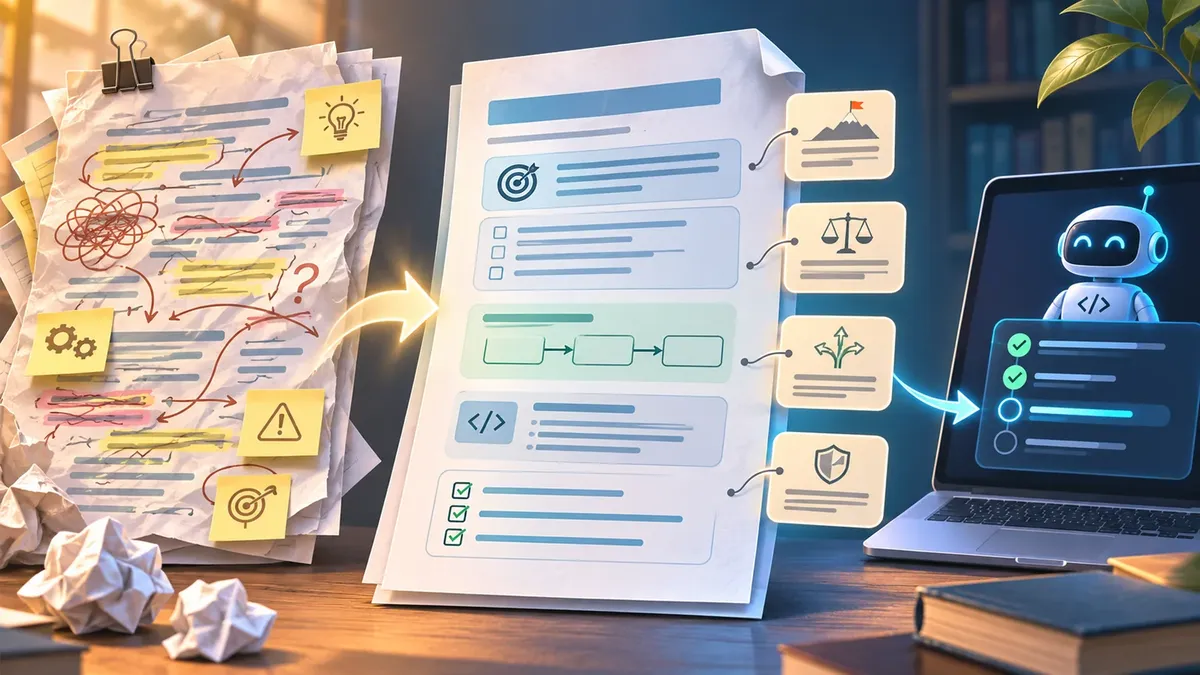
Files that guide AI coding agents often accumulate instructions but rarely lose them one at a time. A new study examines why this happens and tests whether recording the reason behind each instruction can make prompts easier to maintain.
A coding agent may consult a repository file such as CLAUDE.md or AGENTS.md before working. These files can guide how it behaves, but each added rule is another constraint for the agent to follow. Why do the files tend to grow, and could comments explaining why a rule exists make them easier to maintain?
Kushal Chakrabarti’s arXiv preprint calls its proposed explanation “catastrophic remembering.” The instruction remains in the file, the paper argues, while the reason for adding it becomes harder to recover. Adding a rule is easy; deleting one safely can be difficult if its purpose is no longer clear. In the paper’s theoretical model, an exhaustive audit of which instructions can be removed without harming performance may require testing every subset of a prompt. For a prompt with |D| instructions, that means O(2^|D|) probes under the model’s assumptions. This is a theoretical audit cost, not a measurement of the time developers actually spend.
To study prompt growth, the author tracked instruction changes in public GitHub repositories. The dataset covered 247,694 instruction lifetimes across 1,867 repositories. Across files, the mean instruction-count change reached +226% at the peak of their observed lifetimes; the paper also reports a net gain of 4.7 instructions per commit outside large rewrites. This is an aggregate pattern, not a claim that every file grew in the same way. The study classified 67.2% of tracked instruction deaths as occurring in wholesale rewrites—commits that removed at least three-quarters of a file’s instructions. Files often grew again after a rewrite.
The author also estimated each instruction’s “deletion hazard”: the chance it would be deleted at a given age. That chance declined geometrically with age. The pattern is consistent with imperfect recall, the paper argues, and fit better than the other tested explanations, including rules becoming outdated. But commit histories record changes, not what maintainers remembered or intended. This part of the study is observational, and the tested alternatives do not exhaust all possible explanations.
The proposed remedy is to keep comments for maintainers that record why each instruction was added, while hiding those comments from the coding agent. In a controlled experiment based on a modified version of the IFEval instruction-following benchmark, comments recorded evidence, the failure that prompted a rule, and what might disprove the maintainer’s explanation. After 51 rounds, prompts maintained with comments had 1.4% excess size relative to the benchmark’s reference prompt, compared with 211.3% without comments. Both groups satisfied 44.0% of hidden constraints at the end. In this setup, comments were associated with much smaller prompts without a measured drop in constraint satisfaction.
The paper also compared comment-based maintenance with existing context-maintenance approaches and tested pruning on selected repository material. That live-repository experiment covered 680 task–instruction pairs from 37 tasks and 11 prompts. In a single maintenance step and one seed, comment-assisted pruning scored 6.7 percentage points higher in constraint satisfaction than the post-rewrite files. Compared with agentic pruning without comments, it removed more instructions and scored 6.6 points higher. These are narrow results, not a broad comparison of human and agent maintainers: only six of the 11 selected rewrites had no identifiable coding-agent signature.
The boundaries are important. The controlled tests used small, largely stationary tasks and feedback that did not reveal every hidden requirement. Some evaluations relied on language-model judges rather than automatic verifiers, and several reported experiments used one seed. The paper does not establish how well the approach works with changing requirements or rarely triggered rules; it also does not study non-English instructions, system prompts, or agent skill files. Comments can be wrong or misleading, and automated pruning could remove important rules. The author recommends keeping a person involved, particularly for safety-relevant instructions.
This work is an arXiv preprint. Its findings support a promising idea—preserve the reasoning behind instructions so later maintainers can judge them—but do not guarantee that comments will prevent prompt growth across projects or uses.
- AI coding agents
- prompt maintenance
- CLAUDE.md
- software engineering
- instruction following
- large language models
Reviewed cross-references
These connections were reviewed by a model, not independently fact-checked by a human. Similarity does not imply agreement; consult the original papers and the evidence below.
A Rename Is More Than a Find-and-Replace
Supporting evidence: Both papers report results consistent with a bounded proposition: explicitly preserving information relevant to an agent’s decisions can improve outcomes in the tested coding task. Chakrabarti reports that comments encoding latent reasoning reduced excess prompt size while maintaining constraint satisfaction in controlled worlds; Bellur et al. report that their Declared Scope workflow achieved higher F1 than tested baselines on coordinated-renaming benchmarks. The mechanisms and tasks differ, so these results are complementary rather than direct replications; the supplied excerpts are selective and both papers are preprints.
Model review: · openai-codex/gpt-6-luna
Evidence and provenance
Selected excerpts, not complete papers. PDF extraction can omit figures or damage equations, tables and reading order; sources may be preprints.
2608.11095v2 — Original paper
Excerpt reference:
static/papers/2608.11095v2.md:140-204
Basis: Paper text
Source SHA-256:74e1ebc7b502b77130ce59d2ad598b8d58761f4de50fa8f3e6c3624307cf112a2601.00482v2 — Original paper
Excerpt reference:
static/papers/2601.00482v2.md:919-994
Basis: Paper text
Source SHA-256:eece618a88a0dcfdb49064a7270bc5502478b89102436624b2ccd79258e15303
Related reading
Automatically matched by shared topic keywords. These links do not imply that the sources agree or establish a consensus.
For Code-Finding Agents, Exploration Beat Extra Structure
Source published
Shared keywords: ai coding agents, large language models, software engineering
CodeTeam gives AI repository coding a team structure
Source published
Shared keywords: ai coding agents, large language models, software engineering
Teaching Coding Agents the Hidden Structure of On-Device AI
Source published
Shared keywords: software engineering
A tougher coding benchmark finds leading AI agents still struggle to finish the job
Source published
Shared keywords: ai coding agents, software engineering
What Do AI Coding Tokens Actually Measure?
Source published
Shared keywords: ai coding agents, software engineering