TRANSMISSION // 2608.10302v2
Tracking atmospheric winds helps reveal a star’s debris disk
Source published
The windsoCC pipeline uses adaptive-optics sensor recordings to reconstruct and remove wind-driven starlight contamination. Tests on MagAO-X observations recovered clearer visible-light images of the debris disk around HR 4796A, although the paper does not quantify the improvement in detection sensitivity or disk-brightness accuracy.
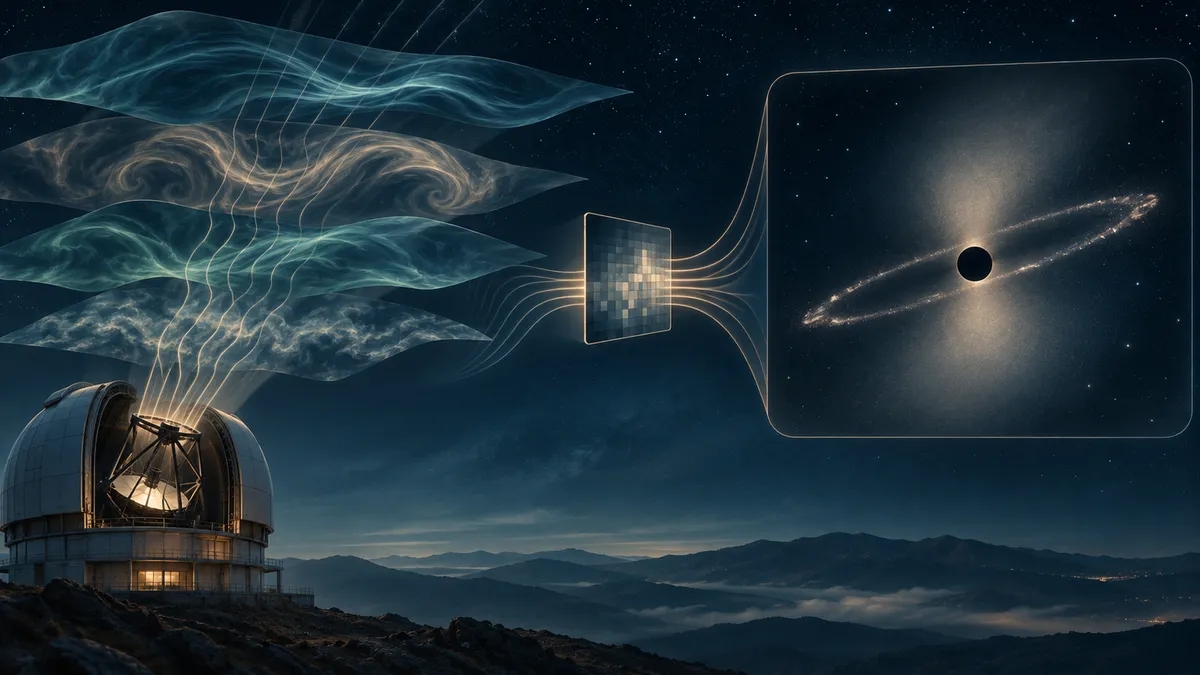
A telescope’s efforts to correct atmospheric distortion can leave a shifting halo of unwanted starlight. Researchers have shown how recordings from the correction system itself can help disentangle that interference from the faint disk surrounding a star.
When atmospheric correction leaves a halo
Adaptive optics helps ground-based telescopes counter the atmosphere’s distortion of incoming light. But the correction cannot be instantaneous. While the instrument measures and responds, wind carries turbulent air onward, leaving a mismatch known as servo-lag error. One consequence is the wind-driven halo: a broad pattern of leaked starlight that can obscure faint structures near a star.
Removing that halo is especially difficult when the target is an extended disk. Filtering away broad image features can also erase the disk’s smooth, diffuse light. Other starlight-subtraction techniques must contend with a halo whose brightness and orientation change during an observation, potentially requiring aggressive processing that compromises the astronomical signal.
Jay K. Kueny and colleagues address this problem with windsoCC, a pipeline that extracts atmospheric wind information from recordings already made by an adaptive-optics instrument. They combine those measurements with image modeling to remove the halo more selectively.
Reading the winds from sensor recordings
The team used archival observations from MagAO-X, the extreme adaptive-optics instrument on the 6.5-meter Magellan-Clay telescope at Las Campanas Observatory in Chile. Their demonstration targeted the debris disk around HR 4796A, using observations logged for March 10 and March 13, 2023.
MagAO-X’s pyramid wavefront sensor measures distortions remaining while the correction system operates. It can record telemetry at up to 3,600 measurements per second. These data provide a record of atmospheric behavior alongside the science images.
The method relies on the “frozen-flow” approximation: over the relevant interval, a turbulent layer is treated as a pattern moving across the telescope pupil without substantially changing shape. WindsoCC compares sensor images separated by different time delays using cross-correlation, a mathematical way of finding matching patterns and their displacement. Moving peaks in the resulting maps reveal wind speed and direction.
The pipeline divides the recordings into 12-second blocks, normalizes the images, and processes the sensor’s four pupil images separately. It averages correlations from overlapping two-second segments to strengthen the wind signatures, then combines the four sets of results. Additional filtering makes the peaks easier to track. Candidate tracks must move straight outward at constant speed; detections that fail these tests are rejected.
A clustering algorithm groups the recovered wind vectors into distinct populations. Many vectors agreed with historical atmospheric profiles from the ERA5 weather reanalysis, providing a consistency check on the measurements.
From wind measurements to cleaner images
Measuring the wind is only the first step. The researchers also need to estimate how its associated halo appears in the science images—and how subsequent processing changes that appearance.
They initially processed the observations conservatively with KLIP, a statistical starlight-subtraction technique. They then constructed adjustable, two-dimensional halo models that could reproduce different orientations, opening angles, radial shapes and asymmetries between their two lobes. The telemetry informed the expected orientations and number of components: four for the March 10 dataset and five for March 13.
Using the DiskFM modeling tool, the team passed candidate halos through the KLIP processing to predict the residual patterns. A Markov chain Monte Carlo procedure explored model parameters and identified best-fitting combinations.
Finally, the fitted halo components were combined with an estimate of the star’s image pattern. A non-negative least-squares fit adjusted their contributions in each individual science frame. The halo components were then subtracted before the final starlight-removal step.
What the demonstration establishes
The resulting images show clearer recovery of HR 4796A’s disk in two visible-light bands, centered at 615 and 762 nanometers. The illustrated final reductions used just one KLIP mode, demonstrating disk recovery without highly aggressive statistical subtraction. The authors describe the improvement as dramatic.
The evidence nevertheless has limits. The paper presents one target observed on two nights, not a broad validation across instruments and atmospheric conditions. It does not report a numerical gain in detection sensitivity or a quantitative test of recovered disk-brightness accuracy. The wind extraction depends on the frozen-flow approximation, and halo subtraction relies on an adjustable analytical model. Some figure descriptions also refer to March 12, inconsistent with the observation log and final comparison figures.
Publication status and significance
The supplied arXiv version was first submitted on August 10, 2026, and revised on November 6. Its landing page identifies the nine-page paper as published in the Proceedings of SPIE Astronomical Telescopes + Instrumentation 2026. The manuscript separately states that portions covering detailed halo modeling and pipeline architecture have been submitted to the Journal of Astronomical Telescopes, Instruments, and Systems for peer review; it does not establish acceptance there.
The practical message is that saved instrument telemetry can support scientific image reconstruction, not just monitor telescope performance. Here, it helped separate a changing atmospheric artifact from the extended disk astronomers wanted to see.
- adaptive optics
- wind-driven halo
- windsoCC
- MagAO-X
- wavefront sensor telemetry
- HR 4796A
- debris disks
- high-contrast imaging
Related reading
Automatically matched by shared topic keywords. These links do not imply that the sources agree or establish a consensus.