TRANSMISSION // 2608.10264v2
New method sorts newborn neutron stars’ vibrations by their physics
Source published
An analysis of 28 supernova simulations identifies four families of oscillations and links the dominant high-frequency gravitational-wave feature to a newborn neutron star’s fundamental mode. The method could help interpret future observations, but remains limited by its modeling assumptions.
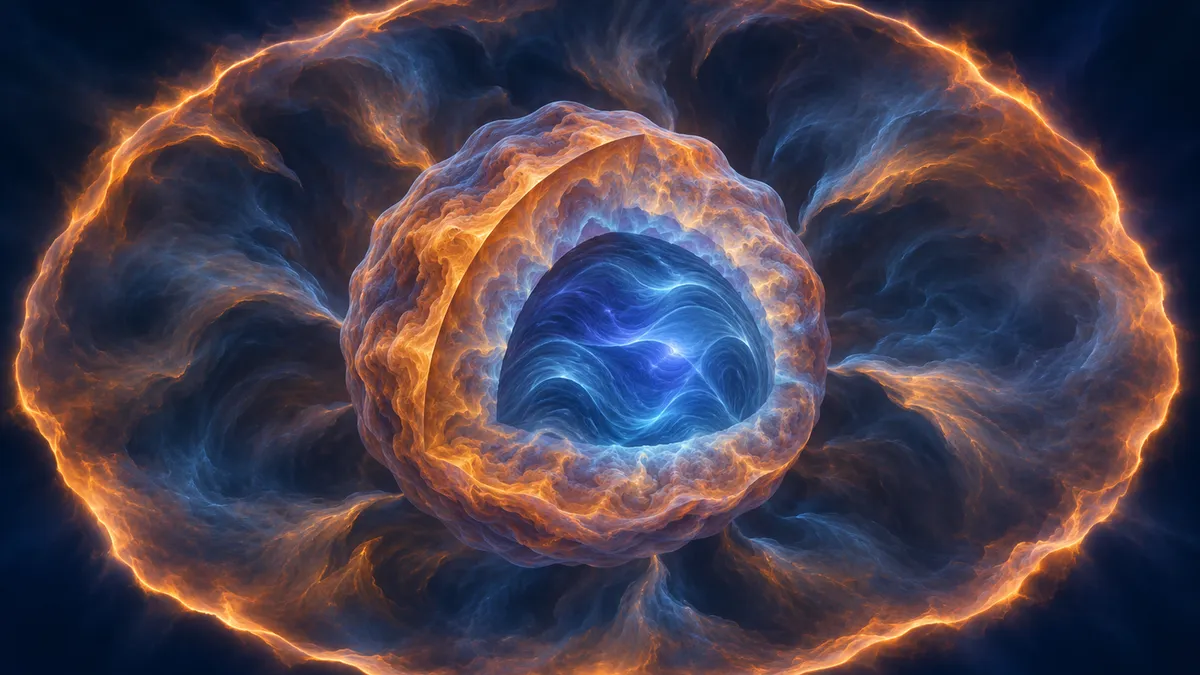
A newborn neutron star can vibrate in several overlapping ways, making its predicted gravitational-wave signal difficult to interpret. Researchers have developed an automated method that distinguishes these vibrations by what restores the moving matter toward equilibrium—and where that motion occurs.
A new study offers a physically grounded way to classify the vibrations of newborn neutron stars, potentially making future gravitational-wave observations more useful for probing their interiors. Applied to 28 computer simulations of stellar collapse, the method separates four families of oscillations and identifies the main high-frequency emission feature as the young star’s fundamental mode.
Dimitra Tseneklidou and colleagues at the Universitat de València report the work in an arXiv preprint revised on November 6, 2026. Its accompanying submission information states that the paper has been accepted for publication in Physical Review D. The findings concern simulations and theoretical calculations, not a newly detected astronomical signal.
Why the vibrations are difficult to name
When a massive star’s core collapses, its inner material rebounds, forming a hot, compact proto-neutron star and launching an outward shock. That shock can stall while matter continues falling through it toward the newborn remnant. Turbulent flows and internal convection can excite nonspherical vibrations that generate gravitational waves.
The long-term goal is gravitational-wave asteroseismology: using these vibrations to infer the remnant’s structure. But researchers have disagreed over which physical oscillations produce particular features in simulated signals.
Pressure modes, or p-modes, are supported by resistance to compression. Gravity modes, or g-modes, are supported by buoyancy in stable layers. Fundamental modes, or f-modes, involve large-scale deformation associated with a surface or interface.
Traditional classification often counts locations where a vibration’s radial displacement changes sign. In a young, rapidly evolving star, however, modes can interact and mix when their frequencies approach one another. These encounters, called avoided crossings, make such labels difficult to interpret physically.
Classifying by energy and location
The team instead calculated how different restoring forces contribute to each mode’s energy. These are the forces that pull displaced matter back, rather than the turbulent processes that initially excite its motion. The analysis separates contributions associated with compression, buoyancy, a surface and changes in the gravitational field.
The researchers used simulations produced with two codes, Aenus-ALCAR and CoCoNuT. The dataset included nonrotating models in one, two and three dimensions, different progenitor stars, and six equations of state—the descriptions of how dense matter behaves.
For multidimensional simulations, they averaged the stellar properties over angles to construct spherical backgrounds. Using the GREAT oscillation code, they then calculated small vibrations around successive snapshots of those backgrounds.
The automated procedure first distinguishes buoyancy-dominated modes from those with predominantly fundamental or pressure-mode character. It then examines where the relevant energy is concentrated. To test those assignments, the team varied the calculation’s outer boundary, compared spatial energy distributions, and checked the results against wave-propagation conditions and simplified analytical models.
Four families, with different origins
The results distinguish two buoyancy-supported families: one associated with a stable region in the proto-neutron star’s core, and another with a stable layer near its surface. Two further families contain fundamental and pressure modes: one associated with the proto-neutron star itself, the other with the surrounding region between its surface and the stalled shock.
Under this energy-based classification, the dominant high-frequency feature follows the proto-neutron star’s f-mode. Its energy extends throughout the remnant, and its existence is associated with the steep density change near the surface. Because material surrounds the star, the researchers also describe it as an interface mode.
This does not mean every earlier analysis tracked a different vibration. Different classification rules can attach different labels to a feature as modes interact. The new scheme emphasizes restoring-force character rather than displacement-node patterns.
The outer boundary also matters. Stopping the calculation at the stellar surface can cut through the surface buoyancy layer and produce misleading classifications. Extending it to the stalled shock captures more of the coupled system.
What remains uncertain
The analysis assumes a stationary, spherical background and small, adiabatic oscillations. It neglects the background accretion flow and uses approximations to relativistic gravity. It is not reliable when the shock moves rapidly, and only one model in the dataset explodes.
Mode mixing still causes occasional misclassifications, requiring outlier filtering. Rotation is outside the tested sample.
The method therefore provides groundwork for inference, not a finished tool for measuring a real star. Its promise is a more consistent way to connect simulated oscillation frequencies with stellar properties before future gravitational-wave observations put those connections to the test.
- proto-neutron stars
- gravitational waves
- asteroseismology
- core-collapse supernovae
- stellar oscillations
- computer simulations
Related reading
Automatically matched by shared topic keywords. These links do not imply that the sources agree or establish a consensus.
A single stellar vibration captures much of neutron stars’ tidal response
Source published
Shared keywords: gravitational waves, stellar oscillations
Even powerful birth kicks struggle to reverse black hole binary orbits
Source published
Shared keywords: gravitational waves
Cosmic phase-transition simulations reveal a two-scale gravitational-wave signal
Source published
Shared keywords: gravitational waves
Blazar jets could create a background that complicates high-frequency gravitational-wave searches
Source published
Shared keywords: gravitational waves
Quantum sensing proposal aims to stop gravitational-wave signals cancelling out
Source published
Shared keywords: gravitational waves