TRANSMISSION // 2608.10065v2
A narrow black-hole jet could explain a seven-hour gamma-ray burst
Source published
Simulations of a star torn apart by a stellar-mass black hole reveal polar escape channels that could help explain GRB 250702B. Combined with analytic models, the results favor a powerful, tightly beamed jet—but its formation, widening and earliest emission remain incompletely tested.
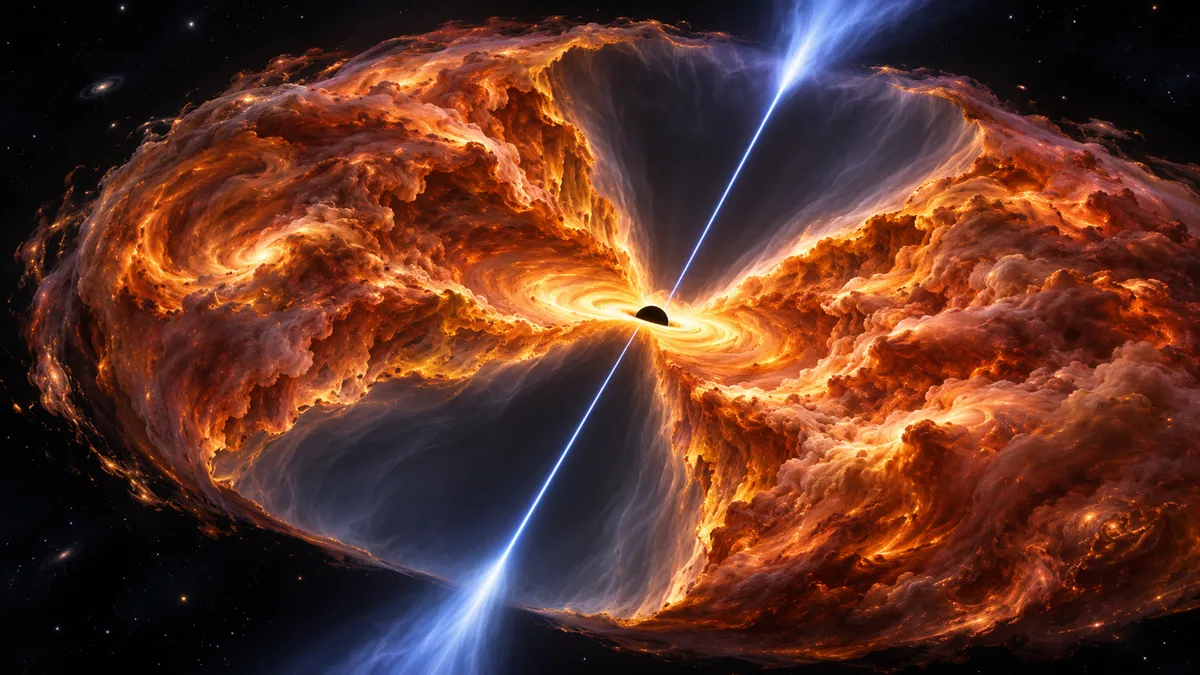
GRB 250702B combined roughly seven hours of gamma-ray activity with an earlier X-ray precursor and a fading X-ray signal lasting weeks. A revised preprint explores whether a black hole shredding a Sun-like star could power this unusual sequence, provided its jet is narrow and powerful enough to escape the surrounding debris.
A star-shredding explanation
GRB 250702B is described in the study as the longest gamma-ray burst yet detected, with activity extending beyond 25,000 seconds. Its prolonged emission, early X-ray signal and lack of a detected supernova have prompted explanations beyond the collapse of a massive stellar core.
Fulya Kıroğlu and colleagues investigate a micro-tidal disruption event: a star torn apart by the gravity of a stellar-mass black hole. Their work combines three-dimensional gas simulations with separate models of accretion and jet stability. It supports this explanation without establishing that it uniquely accounts for the burst.
The article is an arXiv preprint, revised on November 6, 2026. Its landing record lists it as submitted to The Astrophysical Journal Letters, rather than documenting a published journal article.
Simulating the debris, not the jet
Using the moving-mesh code AREPO, the researchers simulated a one-solar-mass star encountering a ten-solar-mass black hole. They examined two initially bound orbits, both with eccentricity 0.5: a grazing disruption and a deeper plunge.
Both produced rotating debris structures with relatively low-density channels above and below the disk. These polar funnels had half-opening angles of approximately 15 degrees. Along them, gas density fell approximately as the inverse square of distance—a profile central to the subsequent jet analysis.
The deeper encounter produced a more compact, thicker disk, whereas the grazing encounter formed a larger, thinner one. In the authors’ later accretion calculations, the deeper encounter better matched the burst’s late X-ray decline.
Crucially, these simulations did not launch a jet or directly follow gas accreting into the black hole. The black hole was represented as a gravitating point particle without accretion or radiative feedback. Longer-term disk evolution and jet behavior were calculated separately.
Powerful enough to escape
A magnetically dominated jet can suffer a current-driven kink instability, a distortion capable of disrupting it before it escapes. Applying an analytic stability framework to the simulated funnel densities, the team calculated which jets could survive.
For a jet with a bulk Lorentz factor around 100, their deep-encounter model required a total jet power of roughly three times 10^47 ergs per second or more. The Lorentz factor describes how relativistic the motion is; this value corresponds to travel extremely close to light speed.
Their minimum-power example used a radiation beaming half-angle of about 0.7 degrees. This is not the same as the much smaller physical opening angle of the confined jet. Relativistic motion limits how tightly its radiation can be concentrated, even when the jet itself is narrower.
Such beaming lets a comparatively modest engine appear enormously bright to an aligned observer. The burst’s isotropic-equivalent luminosity—the luminosity inferred if it radiated equally in all directions—was around 10^51 ergs per second, reaching several times that value at peak.
Why the X-rays fade in two stages
The researchers modeled returning debris feeding a disk that spreads outward and loses much of its material in winds. For their adopted wind prescription, the late accretion rate and jet power decline approximately as time to the minus second power.
That alone cannot explain the steeper early X-ray decline. They therefore proposed that, after escape, the radiation beam widens approximately linearly with time. Combining falling power with radiation spread across a growing angle produces an apparent decline close to time to the minus fourth power, comparable to the observed early slope of about minus 3.8.
Their illustrative fit widens the beaming half-angle from 0.7 to eight degrees. Once widening stops, the apparent luminosity again follows the engine’s slower decline, approximately matching the weeks-long X-ray tail.
What remains uncertain
The widening prescription is a proposed explanation, not an outcome demonstrated by the hydrodynamic simulations. Magnetic jet launching and propagation require future general-relativistic magnetohydrodynamic calculations.
The energy budget is also demanding. The fiducial model assumes a rapidly spinning black hole, strong accumulated magnetic flux and effectively 100 percent conversion of jet power into prompt gamma-rays. Weaker disk winds permit lower radiative efficiencies and lower spins, illustrating how the inference depends on uncertain accretion physics.
Timing remains another complication. The illustrated fast-accretion model places the prompt peak roughly four hours after complete disruption in the source frame, shorter than the approximately 17-hour precursor lead time. The authors discuss slower accretion or an earlier partial stripping encounter as possible resolutions. The quasi-regular gamma-ray episodes likewise lack a quantitative explanation.
A prediction beyond one burst
Because the preferred jet sits near its stability threshold, the authors predict fainter events in which weaker jets fail to escape and instead energize surrounding gas. That population remains hypothetical. Early observations across several wavelengths could test both this prediction and the narrow-jet interpretation of future ultra-long bursts.
- GRB 250702B
- gamma-ray bursts
- micro-tidal disruption events
- stellar-mass black holes
- relativistic jets
- hydrodynamic simulations
- jet stability
- X-ray emission
Related reading
Automatically matched by shared topic keywords. These links do not imply that the sources agree or establish a consensus.
Falling merger debris could fuel—and frustrate—a second cosmic jet
Source published
Shared keywords: relativistic jets
Fading X-rays connect merger-driven gamma-ray bursts to their opening flash
Source published
Shared keywords: gamma ray bursts
What millimeter waves reveal about gamma-ray blazars
Source published
Shared keywords: relativistic jets
Radio and optical rhythms hint at changes in a blazar’s jet
Source published
Shared keywords: relativistic jets
Even powerful birth kicks struggle to reverse black hole binary orbits
Source published
Shared keywords: hydrodynamic simulations