TRANSMISSION // 2608.09014v2
A Cross-Signal Search for the Universe’s Missing Baryons
Source published
Fast radio bursts and a Planck map of hot-gas pressure show a positive statistical link after known galaxy clusters are masked. The inferred baryon fraction depends on the adopted gas model.
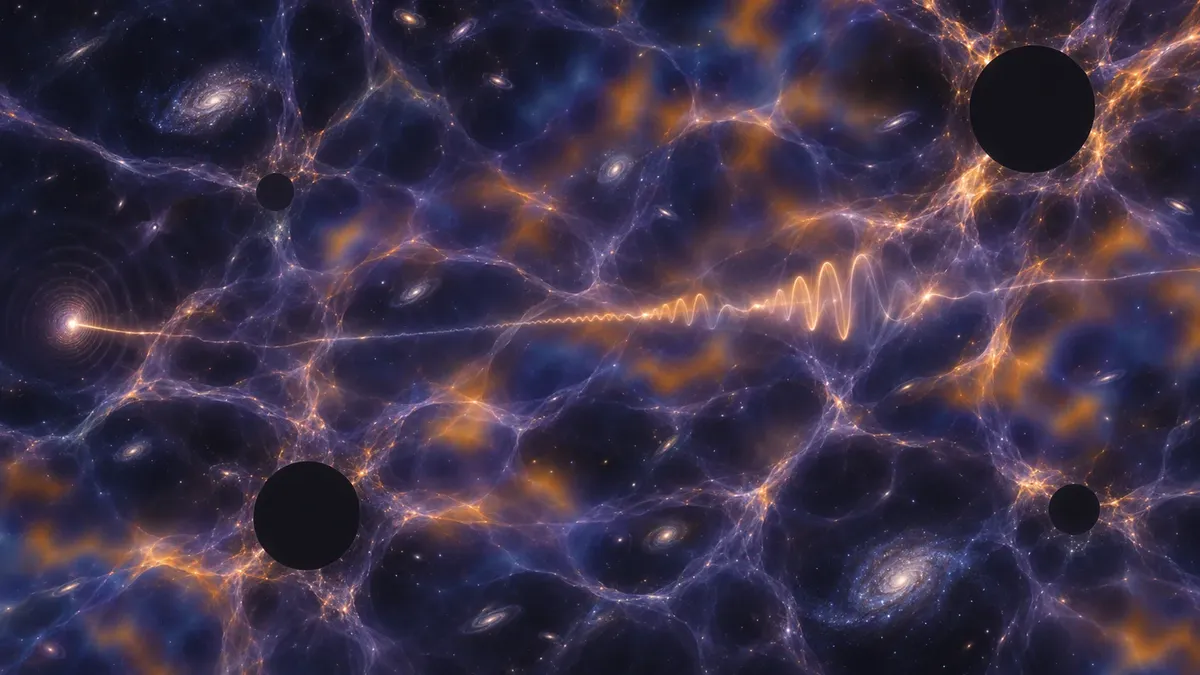
Ordinary matter is not all in stars and galaxies. Some may reside in diffuse, hot gas across the cosmic web—material that is difficult to observe directly. A preprint combines signals from fast radio bursts and the cosmic microwave background to search statistically for this gas. It reports a positive correlation, but interpreting its size requires assumptions about gas properties.
A faint signal from between galaxies
The universe’s baryon budget counts ordinary matter: the material that makes stars, planets and gas. At late cosmic times, inventories of familiar objects account for only part of the amount inferred from cosmological measurements. One proposed hiding place is the warm-hot intergalactic medium (WHIM), diffuse ionized gas threaded through the cosmic web. Its low density makes it difficult to detect, especially in the hotter range where its X-ray glow is faint.
Dao-Hong Zhai and colleagues ask whether two different signals can reveal this gas statistically. Fast radio bursts (FRBs) are brief radio pulses whose arrival times vary with frequency as they pass through ionized material. The resulting dispersion measure, or DM, traces the total column of free electrons along the path. It does not, by itself, reveal how hot that gas is.
The thermal Sunyaev–Zel’dovich effect (tSZ) offers complementary information. It arises when energetic electrons transfer energy to cosmic microwave background photons. A map of the tSZ Compton-y parameter therefore traces electron pressure, which depends on both the amount and temperature of gas. If FRB electron columns and tSZ pressure tend to be higher in the same directions, their cross-correlation can reveal a shared signal, though it does not identify individual gas structures.
Comparing two maps of the sky
The team used FRB dispersion measures from the second CHIME/FRB catalog and a Planck satellite tSZ map. After data-quality cuts, they began with 2,656 extragalactic bursts. They removed bursts near cataloged galaxy clusters and masked corresponding regions in the tSZ map, aiming to reduce the strong signal from hot gas inside clusters. Their main analysis retained 2,035 FRBs; a more extensive cluster mask retained 1,919.
Rather than compare individual bursts with individual gas structures, the researchers measured an angular cross-power spectrum: a statistical measure of how strongly the two sky patterns line up across different angular scales. They estimated uncertainties by repeatedly omitting regions of the sky (a jackknife method), then compared the result with a model of gas clustering. The model also accounted for effects including map resolution and FRB position uncertainty.
In the main, less extensive cluster-mask analysis, the cross-correlation was positive. A test against a zero-correlation model gave a null probability of 0.0169, which the authors describe as greater than 98% confidence. This is evidence for a statistical association, not a direct image of a specific filament or proof that all correlated electrons belong to the WHIM.
The fraction depends on a gas model
To translate the measured signal into a baryon fraction, the team adopted a reference electron temperature of 2.4 million kelvin and a pressure-response model. Under those assumptions, they infer that the hotter WHIM component contains 37.5% of cosmic baryons, with a 68% credible interval of about 21% to 54% (reported as 0.375 with −0.161 and +0.165 uncertainty).
That estimate is not an independently measured temperature. The paper says the signal amplitude depends on the product of the inferred gas fraction, temperature and pressure normalization; the data do not determine those ingredients separately. The authors also describe “hotter WHIM” as gas preferentially weighted by the tSZ signal, not as a component with a sharply measured temperature boundary.
The larger cluster mask gives a lower central fraction, about 30%, and weaker evidence against zero correlation (null probability 0.0631). The estimates overlap within their stated uncertainties, but this change illustrates sensitivity to the mask choice. Tests varying selected gas-profile parameters and Galactic-DM cuts yielded broadly similar amplitudes. A comparison with a different tSZ map gave a higher central estimate, though with overlapping intervals; that map also treats foregrounds differently, so the shift cannot be assigned to one foreground effect alone.
What “closing the budget” means here
The authors say the result statistically closes the local-universe baryon budget when combined with earlier estimates of other components. This conclusion is conditional: the inferred fraction relies on the adopted density and pressure model, and the hot-gas tracer may overlap with cooler gas measured through ultraviolet absorption. The paper cautions that those estimates cannot simply be added as independent components. The analysis also cannot separate contributions from diffuse filaments, undetected halos, cluster outskirts and other environments.
The source is an arXiv preprint. The supplied material does not establish its peer-review status, so the result is best read as a model-dependent cross-correlation measurement rather than a settled census. Independent checks will be important for assessing how robustly the signal constrains the amount and location of diffuse baryons.
- missing baryons
- warm-hot intergalactic medium
- fast radio bursts
- Sunyaev-Zel'dovich effect
- cosmic web
Reviewed cross-references
These connections were reviewed by a model, not independently fact-checked by a human. Similarity does not imply agreement; consult the original papers and the evidence below.
Radio bursts offer tentative clues to gas around nearby galaxies
Shared method: Both studies correlate FRB dispersion measures with an external sky tracer: Zhai et al. cross-correlate CHIME/FRB DMs with Planck’s thermal SZ map, while Khadir et al. stack DMs against foreground galaxy halos and derive an FRB–galaxy cross-correlation. The tracers and analyses differ, so this is a methodological connection, not evidence that either study confirms the other’s result.
Model review: · openai-codex/gpt-6-luna
Evidence and provenance
Selected excerpts, not complete papers. PDF extraction can omit figures or damage equations, tables and reading order; sources may be preprints.
2608.09014v2 — Original paper
Excerpt reference:
static/papers/2608.09014v2.md:115-164
Basis: Paper text
Source SHA-256:96ec8a68d4328dbb766e909e76c2e16671a1e00f3e92109bd865615013aa2d6c2611.12860v1 — Original paper
Excerpt reference:
static/papers/2611.12860v1.md:46-91
Basis: Paper text
Source SHA-256:bc9f8ec925a3fbafa2d527692cf84fb77a759cf31d71cdd99234ca312799b73f
Related reading
Automatically matched by shared topic keywords. These links do not imply that the sources agree or establish a consensus.
Radio bursts offer tentative clues to gas around nearby galaxies
Source published
Shared keywords: fast radio bursts
Why repeating fast radio bursts may change their dispersion over time
Source published
Shared keywords: fast radio bursts
ALMA Survey Finds Diverse Gas Conditions in FRB Hosts
Source published
Shared keywords: fast radio bursts
A radio burst’s crowded path reveals the challenge of tracing cosmic gas
Source published
Shared keywords: fast radio bursts
Reading the early universe through the cosmic web
Source published
Shared keywords: cosmic web