TRANSMISSION // 2608.08448v2
How Neutral Gas Reshapes Magnetic Reconnection
Source published
Two-dimensional simulations suggest that neutral atoms change how magnetic reconnection breaks into plasmoids, while ions pile up inside them. The results are limited to an idealized model.
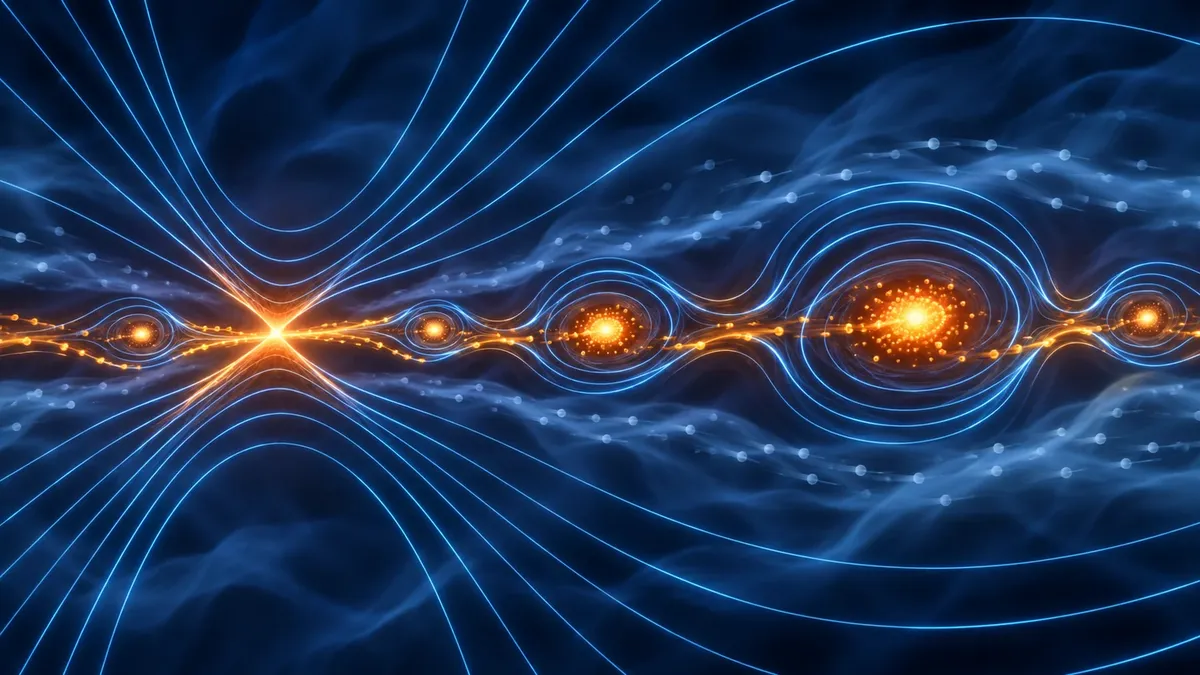
Magnetic reconnection releases energy as magnetic fields rearrange. In many cosmic environments, however, some of the gas is neutral and does not respond directly to magnetic forces. New simulations explore how that difference affects the small magnetic structures called plasmoids—and show why ions and neutrals may behave very differently within the same reconnection layer.
Magnetic fields can store energy, then release it when their lines of force rearrange in a process called magnetic reconnection. In a thin current sheet, that process can produce small magnetic islands known as plasmoids. But much of the plasma in places such as the solar chromosphere and interstellar medium is only partly ionized: charged particles respond to magnetic fields, while neutral atoms do not. How does this mixture affect the formation and growth of plasmoids?
A team led by Yue Hu investigated the question with high-resolution, two-dimensional computer simulations. Their work is described in an arXiv preprint, a research manuscript that has not necessarily been peer reviewed. The simulations modeled a sheet of reversing magnetic field as two interacting fluids—ions and neutrals—with momentum exchanged through collisions. The researchers compared a fully ionized case with two partly ionized cases, whose starting ionization fractions were 10% and 1%.
The model used an isothermal approximation and a high Lundquist number, a measure of how strongly magnetic fields are carried with the flow compared with how quickly they diffuse. Each simulation began with the same type of magnetic configuration, and the calculations followed the sheet as it thinned, broke into plasmoids and evolved. The model included Ohmic resistivity and ion–neutral drag, but no ionization or recombination: particles did not change between neutral and ionized states through chemical reactions.
Different mixtures, different plasmoid patterns
In the fully ionized simulation, smaller plasmoids merged over time and a large, dominant “monster” plasmoid formed. In the 1%-ionized case, the layer remained a chain of smaller plasmoids during the period studied; it did not develop a similarly dominant structure. The 10%-ionized case fell between these patterns: plasmoids merged, and a large one appeared to be emerging at one point, but the evolution was intermittent.
The authors suggest that ion–neutral friction can damp the motions that drive plasmoid merging. That could help explain the persistent fragmentation in the weakest-ionization simulation, but the simulations do not establish a universal rule for all partly ionized plasmas. The difference is tied to the specific conditions and limited time span modeled.
The simulations also revealed a striking contrast between the two fluids. Below a characteristic scale at which neutrals stop following ion motions, magnetic forces concentrated ions into plasmoid cores while the neutral gas remained comparatively smooth. In the 1%-ionized run, peak ion density reached about 3,000 to 5,000 times its initial upstream value; in the 10%-ionized run, it reached roughly ten times that value. These are peak densities in the simulations, not predictions that all astrophysical plasmoids reach such extremes.
As ions accumulated, the local ionization fraction rose and the fluids became more strongly coupled again inside the plasmoid cores. In other words, the simulation produced a patchwork: ions and neutrals could move differently around the outskirts, yet become more closely linked in dense cores. Because the model omits chemical reactions, its extreme ion pile-ups should be treated as possible upper limits if recombination would otherwise remove ions quickly.
Inflow is not the same as reconnection
The researchers measured reconnection using the electric field at active reconnection sites, rather than treating the inflow speed alone as a measure of how quickly magnetic flux reconnects. In the 1%-ionized case, the reported rate settled near 0.01; in the 10%-ionized case, it rose to about 0.02 and reached about 0.035 during an apparent coalescence event. The 1%-ionized run also showed much faster ion inflow than neutral inflow—about 0.5 versus 0.1 times the upstream Alfvén speed, a characteristic speed set by the magnetic field and density. Yet that rapid ion inflow did not mean magnetic flux was reconnecting at the same pace.
These results come from a deliberately simplified setup: two dimensions, an isothermal gas, only three starting ionization fractions, and no ionization or recombination chemistry. The model also excludes Hall physics and kinetic scales, which can matter in other regimes. The authors note that three-dimensional geometry, broader parameter studies and chemical processes are needed before applying the detailed results to real cosmic environments.
The study therefore offers a focused result, not a complete account of reconnection in nature: in these simulations, partial ionization changes both plasmoid merging and the distribution of matter inside plasmoids. Whether the same patterns persist when chemistry and three-dimensional dynamics are included remains an open question. The manuscript is available as the arXiv preprint 2608.08448v2.
- magnetic reconnection
- partially ionized plasma
- plasmoids
- ion-neutral coupling
- ambipolar drift
- astrophysical simulations
Related reading
Automatically matched by shared topic keywords. These links do not imply that the sources agree or establish a consensus.
A hidden magnetic field may steady pulsar current sheets
Source published
Shared keywords: magnetic reconnection
Why Simulated Black-Hole Disks Need Fine Resolution
Source published
Shared keywords: astrophysical simulations
A star cluster’s motion can tell more than one kind of age
Source published
Shared keywords: astrophysical simulations
Small white dwarf explosions could resemble the faintest Type Iax supernovae
Source published
Shared keywords: astrophysical simulations
How Magnetic Reconnection May Heat Ions Behind Shock Waves
Source published
Shared keywords: magnetic reconnection