TRANSMISSION // 2608.08346v3
When quantum states change but the spectrum does not
Source published
An exactly solvable two-qubit model shows that non-unitary deformation can change eigenstate entanglement while preserving the spectrum.
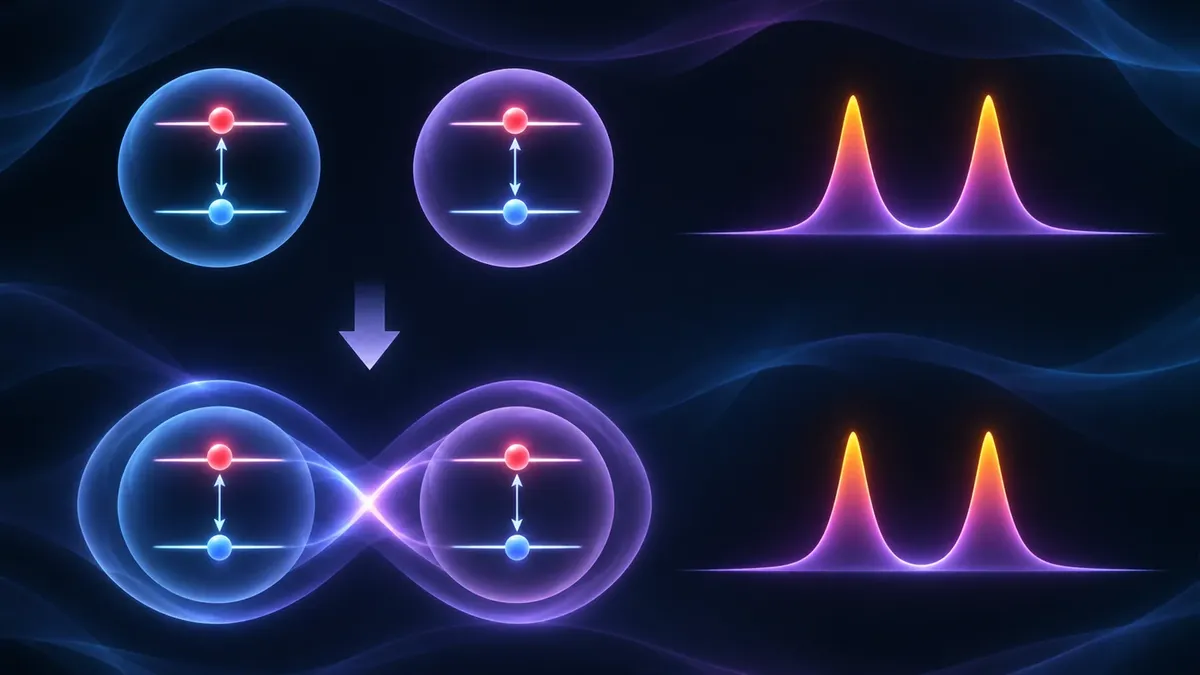
A system’s spectrum lists its eigenvalues, but those values do not necessarily determine how entangled its eigenstates are. Chen-Huan Wu’s theoretical preprint explores this distinction with a model whose spectrum stays fixed while two-qubit states change.
A quantum system can be described by its eigenvalues and by the states associated with them. These are related, but they are not the same. In a theoretical study, Chen-Huan Wu examines how eigenstates—and the entanglement between parts of a system—can change while the spectrum remains unchanged.
The model starts with a Hermitian operator that has a degenerate eigenspace: several independent states share an eigenvalue. The author applies an invertible, non-unitary similarity transformation to it. The resulting operator is non-Hermitian, while the transformation preserves its eigenvalues. The abstract describes a non-defective degeneracy at every finite value of the non-Hermiticity parameter.
That distinction matters because degeneracy and an exceptional point are not identical. A degeneracy means that states share an eigenvalue; an exceptional point involves a defective structure in which eigenstates coalesce. The model is designed to separate these spectral features from properties of the eigenvectors.
A two-qubit example
The study gives an exactly solvable realization using two qubits, each a quantum two-level system. As the parameter changes, the right eigenstates—the states obtained directly from the non-Hermitian operator—evolve continuously from product states to maximally entangled states. Product states have no entanglement between the qubits; maximally entangled states represent the strongest entanglement possible for this two-qubit setting. Throughout this evolution, the spectrum stays unchanged.
This is a mathematical result for the specified model, not a report of an experiment. It illustrates why eigenvalues alone do not determine the entanglement of eigenstates.
Different ways to describe states
The abstract distinguishes two ways of constructing a reduced density matrix, the mathematical object used to describe one part of a composite system. A reduction made from a right eigenstate is positive. A biorthogonal reduction, which uses both right and left eigenstates, is generally not positive; an entropy calculated from it may therefore be complex. These constructions need to be kept distinct when interpreting entanglement measures in a non-Hermitian system.
For the two-qubit solution, the author reports a closed expression for partial-transpose negativity, an entanglement diagnostic. The abstract does not specify which of the two reduced-state constructions is used for that negativity, so it would be premature to assign it to one here.
The paper also evaluates a quantity called non-local magic, which characterizes non-stabilizer correlations. The abstract reports that entanglement increases monotonically with the non-Hermiticity parameter. Non-local magic follows a different pattern: it vanishes in both the product-state and maximally entangled limits and is largest at an intermediate coupling. “Magic” here is a technical term for a quantum-information resource, not a claim about supernatural effects.
For larger bipartite spaces, the study uses Page entropy and Haar-averaged purity as reference values for considering eigenstate typicality. The abstract supplies no specific numerical comparisons, so it does not establish how closely the model’s states match those references.
Scope and uncertainty
The work’s main point is that several questions should not be conflated: whether a degeneracy is defective, how a spectrum responds to perturbations, how much entanglement a state has, and whether its correlations have non-stabilizer character. In this model, eigenstate entanglement changes even though the spectrum does not.
The available evidence for this article is the paper’s abstract, not its full text. The derivations, detailed assumptions behind the diagnostics, and the larger-space analysis therefore cannot be independently assessed here. The result is theoretical and model-specific; the abstract does not report an experiment or establish that the same behavior occurs in all non-Hermitian systems. The source is an arXiv preprint, and the supplied information does not establish whether it has undergone peer review.
- non-Hermitian systems
- quantum entanglement
- two-qubit model
- non-local magic
- exceptional points
Related reading
Automatically matched by shared topic keywords. These links do not imply that the sources agree or establish a consensus.
How one quantum boundary can create nonunitary critical behavior
Source published
Shared keywords: quantum entanglement
A quantum exceptional point depends on what you measure
Source published
Shared keywords: exceptional points
What a system’s relaxation modes can—and cannot—reveal about equilibrium
Source published
Shared keywords: exceptional points
Quantum entanglement could build patterns that outlast it
Source published
Shared keywords: quantum entanglement
When quantum chaos helps atomic gases synchronize
Source published
Shared keywords: quantum entanglement