TRANSMISSION // 2608.07270v2
When cosmic expansion and magnetic fields compete
Source published
A theoretical study finds that magnetic fields can promote chiral symmetry breaking in de Sitter space, while expansion suppresses it—but the model limits what this says about the early universe.
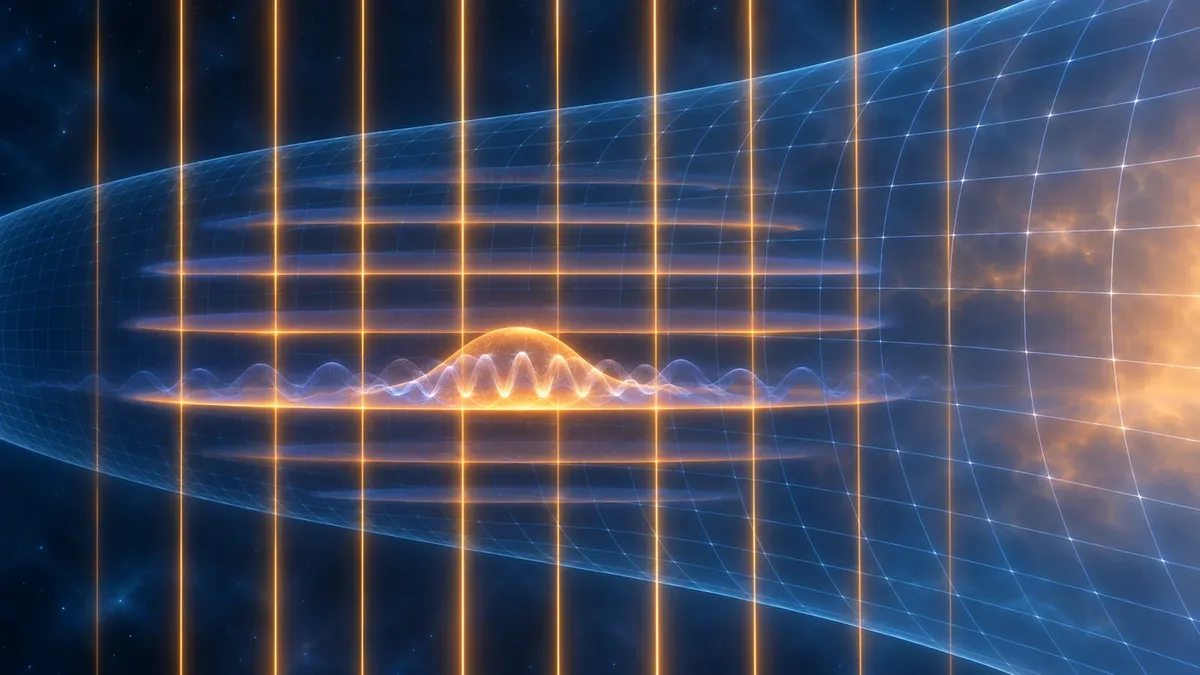
Can a magnetic field help a fermion acquire mass in an expanding universe? A calculation using a simplified interaction model says yes: stronger fields favor a chiral condensate, while stronger cosmic expansion works against it. The result is a theoretical map, not a prediction that such masses formed during inflation.
A contest between two effects
In particle physics, a fermion’s mass can arise not only as a fixed input but also through interactions that produce a chiral condensate. Chiral symmetry is a mathematical symmetry relating left- and right-handed fermion states; when it is spontaneously broken, the condensate can act like a dynamically generated mass.
A magnetic field can encourage this symmetry breaking. In a uniform field, charged particles occupy discrete energy levels called Landau levels. At very large field strength, the lowest level dominates, and the motion becomes effectively restricted to the direction along the field. This concentration of low-energy states can make an attractive interaction more effective—a phenomenon known as magnetic catalysis.
The question in this study is what happens when that mechanism operates in de Sitter space, a model of an expanding universe with a constant Hubble rate. De Sitter space also has a thermal interpretation, which suggests that curvature could oppose chiral symmetry breaking. The authors, Kohei Fujikura, Toshifumi Noumi and Shintetsu Yamazaki, calculate how these competing influences affect a charged fermion.
How the calculation works
The researchers use the Nambu–Jona-Lasinio (NJL) model, which represents the attractive interaction with a simplified contact interaction between fermions. They first derive the charged fermion’s mode functions in de Sitter space with a uniform background magnetic field, choosing the Bunch–Davies vacuum as the initial quantum state. They use those modes to calculate the chiral condensate, handling ultraviolet divergences with a proper-time cutoff.
They then apply a mean-field approximation: instead of tracking all the interacting fields in full detail, the calculation treats the condensate as a uniform average. A gap equation determines whether the model has a solution with a nonzero dynamically generated mass. The authors derive analytic results in limiting cases, including very large magnetic fields, and numerically solve the equation for a broader range of model parameters to chart the phase structure.
What they find
In this setup, increasing the magnetic field strengthens the condensate and can produce a nonzero gap even when the model’s four-fermion attraction is weak. In the large-field limit, the authors identify the lowest Landau level as central to this behavior. They report that magnetic catalysis therefore operates in their de Sitter calculation, provided the magnetic field is sufficiently strong relative to the expansion scale.
Increasing the Hubble parameter has the opposite effect: the condensate decreases and eventually vanishes, restoring chiral symmetry. The numerical phase diagrams show continuous transitions between the condensed and symmetry-restored phases in the parameter regions they investigated. The calculation did not find a first-order transition or multiple gap-equation solutions in that scan; this is a statement about the examined setup and range, not every possible theory or parameter choice.
The broad picture is a competition: magnetic fields favor condensation, while de Sitter curvature suppresses it. But this does not establish that a particular magnetic field generated a fermion mass in the real early universe. The phase diagrams are fixed-time results, treating the physical field and expansion rate as parameters. The authors note that a realistic inflationary field and condensate can evolve over time, and that the effect of this evolution remains to be quantified.
Why the result is qualitative
The authors emphasize that the NJL model is the main limitation. Its contact interaction is a simplified stand-in for interactions such as photon or gluon exchange, and its assumed constant interaction strength is not reliable when the magnetic field exceeds the model’s cutoff scale. The paper says a more sophisticated treatment could yield a much smaller gap, especially in the weak-coupling regime. Its results therefore offer a qualitative account of the phase structure, not a dependable numerical estimate of a cosmological fermion mass.
There is another important caveat: the paper uses large-curvature and large-field limits as diagnostic tools, even though the NJL model is a controlled local effective theory only when those physical scales are below its cutoff. Quantitative predictions in those extremes would require specifying additional physics or an ultraviolet completion. The calculation also neglects the magnetic field’s effect on the spacetime background, which requires the magnetic energy density to remain sufficiently small.
This work is a theoretical preprint prepared for submission to JHEP, not evidence from an observation or experiment. Its numerical results depend on the model, approximation, regulator and investigated parameter range. The authors themselves caution that further work is needed before drawing cosmological implications. The study clarifies how two effects can compete in a tractable model; whether the same balance produces a significant mass in a realistic inflationary universe remains open.
- magnetic catalysis
- de Sitter space
- chiral symmetry breaking
- fermion mass
- Nambu–Jona-Lasinio model
- inflationary cosmology
Related reading
Automatically matched by shared topic keywords. These links do not imply that the sources agree or establish a consensus.
A New Route to Inflation-Era Particle Signatures
Source published
Shared keywords: de sitter space
Quantum memory may reshape a field in an expanding universe
Source published
Shared keywords: de sitter space
Can gravity seed cosmic structure without an inflaton?
Source published
Shared keywords: de sitter space