TRANSMISSION // 2608.07172v2
Simple patterns emerge in models of magnetic neutron stars
Source published
Calculations identify relationships between neutron stars’ normalized magnetic properties and deformation that depend only weakly on uncertain interior physics. The results could help future gravitational-wave modeling, but rely on an idealized magnetic geometry and a perturbative treatment.
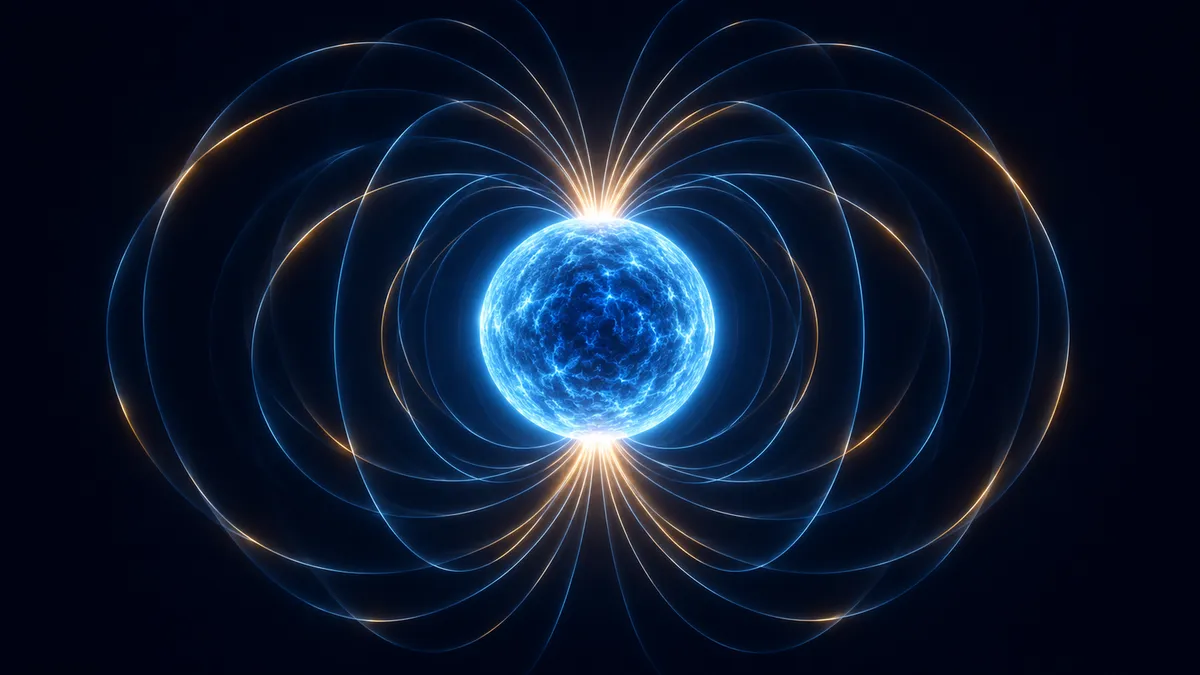
A neutron star’s internal matter determines how it responds to gravity and magnetic forces, yet that matter remains imperfectly understood. A theoretical study finds that some magnetic properties follow nearly the same relationships across different models of the interior—provided the quantities are scaled appropriately.
Looking beyond uncertain interiors
Neutron stars bring together dense nuclear matter, strong gravity and, in some cases, exceptionally powerful magnetic fields. Predicting their properties requires an equation of state: a description of how pressure relates to energy density inside the star. Different equations of state can produce substantially different relationships between stellar mass and radius.
Some combinations of stellar properties, however, are less sensitive to those differences. These are called universal relations, although most are only approximately universal. Byon N. Jayawiguna and colleagues investigate whether similar patterns connect a neutron star’s magnetic field and the deformation it produces.
Their study is theoretical, not a measurement of individual stars. The arXiv preprint was first submitted on August 7, 2026, and revised on November 6. The revised landing page reports acceptance for publication in Physical Review D.
Building a slightly deformed star
The researchers begin with static, spherical stars in general relativity. They calculate their structure using ten tabulated equations of state for hadronic matter, alongside a simplified mathematical model known as an n = 1 polytrope.
They then add a purely poloidal dipole magnetic field. In this idealized geometry, field lines run through planes containing the magnetic axis, rather than wrapping around that axis as a toroidal component would.
The team solves the magnetic-field equations on the spherical background, then calculates how the field changes the star and its surrounding spacetime. These changes are retained through second order in magnetic-field strength. This perturbative approach treats magnetic effects as corrections to the original configuration, rather than solving for arbitrarily large magnetic distortions.
The calculations track compactness, which measures mass relative to radius; magnetic dipole moment, which characterizes the external dipolar field; the magnetically induced quadrupole moment, which describes the quadrupolar gravitational deformation; and ellipticity, which measures the difference between equatorial and polar radii relative to the mean radius.
Crucially, the researchers scale the magnetic quantities using combinations of stellar mass and the magnetic-field strength at the surface pole. The reported relations concern these normalized quantities, not an unrestricted correspondence between raw magnetic strength and stellar shape.
An exact relation—and several approximate ones
The cleanest result connects normalized magnetic dipole moment with compactness. It follows analytically from the exterior dipole-field solution and the definition of the polar surface field, without requiring knowledge of the interior equation of state.
Here, “exact” has an important qualification: the relation is exact at the leading order used for the normalized quantity. It is not an all-orders statement about strongly distorted magnetic stars. Extending it requires higher-order magnetic calculations beyond this study.
The other relationships are approximate. Numerical results connect normalized dipole moment, quadrupole moment and ellipticity along closely grouped curves despite differences in interior physics.
For the tabulated equations of state, deviations from the fitted relations are generally no more than about 5% across a broad compactness range. In some regimes they rise to around 10% or more. The simplified n = 1 model shows larger departures than the more realistic models. Thus, a single percentage does not describe the accuracy everywhere.
The authors also derive analytic results in the Newtonian, weak-gravity limit for constant-density stars and n = 1 polytropes. Their numerical n = 1 results approach the corresponding analytic predictions. Comparing the two simplified models gives differences of approximately 17%, 11% and 23% for the three relationships, supporting approximate rather than exact universality.
Potential use, with substantial caveats
The dipole–quadrupole relationship could help model gravitational waves from binaries containing magnetic neutron stars. Magnetic dipole interactions and magnetic quadrupolar deformation affect the waveform phase at the same leading post-Newtonian order. Relating them could reduce the number of independent properties that must be inferred.
The paper does not demonstrate that benefit with an observational parameter-estimation study. Quantifying measurement precision and systematic errors remains future work.
Magnetic geometry is another major limitation. Purely poloidal fields are dynamically unstable, and more realistic models may mix poloidal and toroidal components. The researchers also leave superconducting interiors for future investigation. The relations therefore offer useful structure within a controlled model, not a demonstrated description of every magnetic neutron star.
- neutron stars
- magnetic fields
- universal relations
- equation of state
- gravitational waves
- stellar deformation
Related reading
Automatically matched by shared topic keywords. These links do not imply that the sources agree or establish a consensus.
Neutron Star Tides Could Complicate Tests of Einstein’s Gravity
Source published
Shared keywords: equation of state, gravitational waves, neutron stars
Simulated detector network sharpens the search for neutron stars’ faint internal vibrations
Source published
Shared keywords: gravitational waves, neutron stars
A single stellar vibration captures much of neutron stars’ tidal response
Source published
Shared keywords: gravitational waves, neutron stars
Magnetar Crust-Shock Simulations Find Little Heavy-Element Production
Source published
Shared keywords: neutron stars
AI trained on physics equations speeds up models of spinning neutron stars
Source published
Shared keywords: equation of state, neutron stars