TRANSMISSION // 2608.05283v2
How Scattering May Shape Little Red Dot Emission Lines
Source published
A theoretical study explores how Balmer-line shapes could differ when light forms inside scattering gas rather than passing through it. Its thermal model does not explain the lines’ observed brightness.
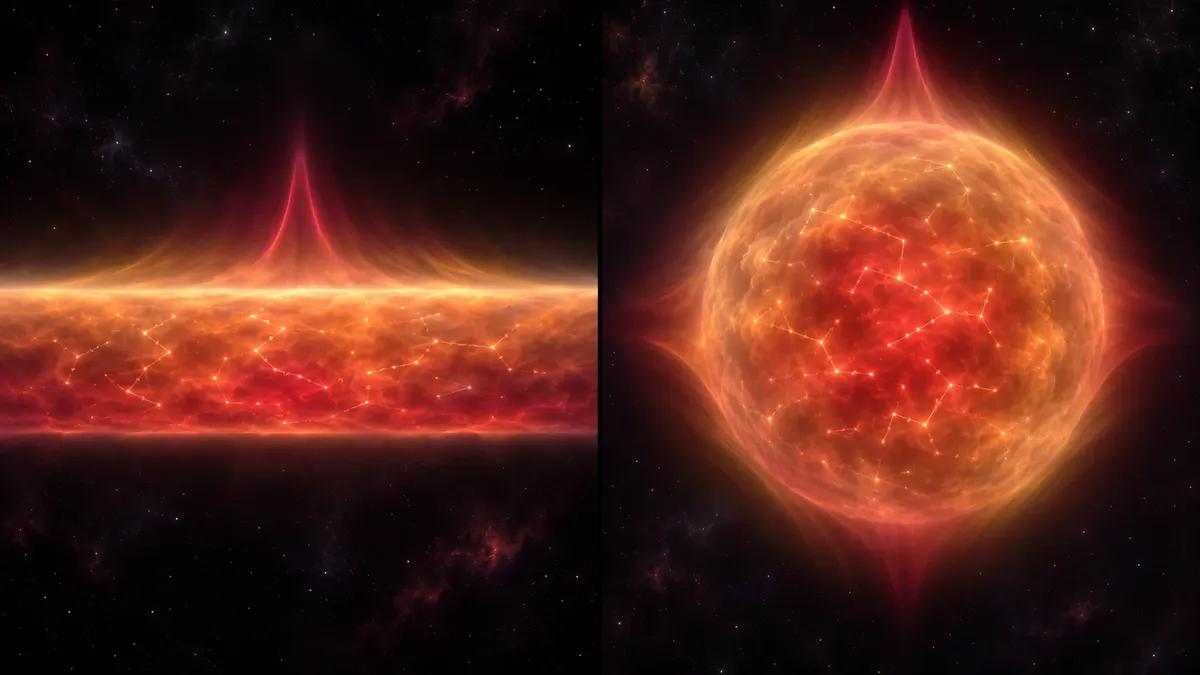
Little Red Dots, compact red objects observed by JWST, show broad hydrogen emission lines whose origin is debated. A new theoretical study asks what happens if those lines form and broaden within the same scattering gas—and whether their shapes could distinguish that scenario from other explanations.
A line’s shape can tell a story
When astronomers spread an object’s light into a spectrum, bright emission lines appear at particular wavelengths. A line’s shape, including its extended wings on either side of the center, can hold clues about how its photons travelled before reaching a telescope.
Little Red Dots (LRDs), a population of compact, distant objects seen by the James Webb Space Telescope, have prominent broad Balmer lines, including Hα. One explanation is that a line forms in one region and then passes through separate scattering gas, which broadens it. Another is that the line forms within the scattering material itself. The distinction matters because the profile could offer clues to the gas around these objects.
In an arXiv preprint, Elisha Modelevsky and colleagues develop a theoretical model for this second, “intrinsic” scenario. They do not establish that it explains LRDs; they calculate what line shapes this process could produce under specific assumptions.
Following photons through gas
The researchers use random-walk and diffusion approximations to describe photons scattering from electrons in dense, optically thick gas. A photon takes many small, unpredictable steps through the material. Each scattering can shift its frequency slightly, spreading light away from the line’s central wavelength and producing broad wings.
The model assumes static gas and atoms with thermal populations, an approximation called local thermodynamic equilibrium (LTE). It examines alternative photosphere geometries: a thin, planar surface and a radially extended atmosphere. The authors also consider an external-scattering picture, in which the line forms elsewhere before scattering.
The calculations predict different profiles. A thin planar photosphere produces a shallow line with a roughly logarithmic plateau and wings that decline approximately as the inverse of velocity offset. A radially extended photosphere instead produces a broken power law: the profile declines with one slope, then steepens farther into the wings. The predicted change is from a dependence proportional to velocity offset raised to −α to one proportional to velocity offset raised to −(α+1), where α lies between zero and one.
In the authors’ treatment, external or “backlit” scattering produces an exponential profile. That contrast suggests a possible test: sufficiently high-quality spectra might let astronomers compare the detailed shapes of the line wings and assess which scenario fits better.
A fit, and a mismatch
The team compares its radially extended model with Hα profiles in two LRDs, JADES-GN-68797 and JADES-GN-73488. The paper reports that the broken-power-law model can fit these profiles. This does not identify the physical process: the same profiles can also be fit with exponential forms, and the paper notes that the available data do not clearly settle the distinction. The fits presented are manual, by-eye fits, not a statistical demonstration that one model is preferred.
There is also a key shortcoming. The LTE model does not produce enough Hα emission relative to the continuum. For the example conditions discussed, the authors say the observed line-to-continuum contrast is about 50, while their model gives at most about 10. The model may therefore reproduce a line’s shape without explaining its prominence.
The authors suggest that non-LTE physics could matter. If excited hydrogen atoms are more abundant than thermal equilibrium predicts, they might produce more line emission and increase the contrast. This is a possibility for future investigation, not a result established by the current calculations. The authors also identify temperature gradients and outflows as important extensions. Because the model assumes static gas, it does not capture broadening or other features caused by bulk motion, such as P-Cygni-like absorption.
What the study can tell us
The work connects possible photosphere geometries to predicted emission-line shapes. Its analytic calculations and Monte Carlo simulations examine photon behavior within the model, while the comparisons with JWST spectra provide an initial observational test. The fits make intrinsic scattering a scenario worth investigating, but they do not show that it is the true explanation for LRDs or rule out alternatives.
This article is based on an arXiv preprint. The source does not establish the paper’s peer-review status. As with any theoretical model, its conclusions depend on its assumptions; in particular, its LTE treatment fails to explain the observed line-to-continuum contrast. Better spectra and models that include non-LTE populations, gas motion, and temperature structure will be needed to test whether line profiles can distinguish how LRD Balmer emission forms.
- Little Red Dots
- JWST
- Hα emission
- scattering
- radiative transfer
- emission line profiles
- astrophysics
Related reading
Automatically matched by shared topic keywords. These links do not imply that the sources agree or establish a consensus.
How the wings of little red dots change their measured widths
Source published
Shared keywords: hα emission, little red dots
Little Red Dots at Cosmic Noon: What Spectra Reveal
Source published
Shared keywords: hα emission, little red dots
What powers the Little Red Dots? A model finds smaller black holes in faint galaxies
Source published
Shared keywords: little red dots
How JWST Could Trace the Seeds of the First Massive Black Holes
Source published
Shared keywords: little red dots
Little Red Dots may have unusually red UV light
Source published
Shared keywords: little red dots