TRANSMISSION // 2608.03470v3
Can a different cosmic expansion ease the JWST–CMB reionization tension?
Source published
A study finds that an expansion history inspired by self-interaction gravity lowers its predicted reionization optical depth, but important assumptions and model limitations remain.
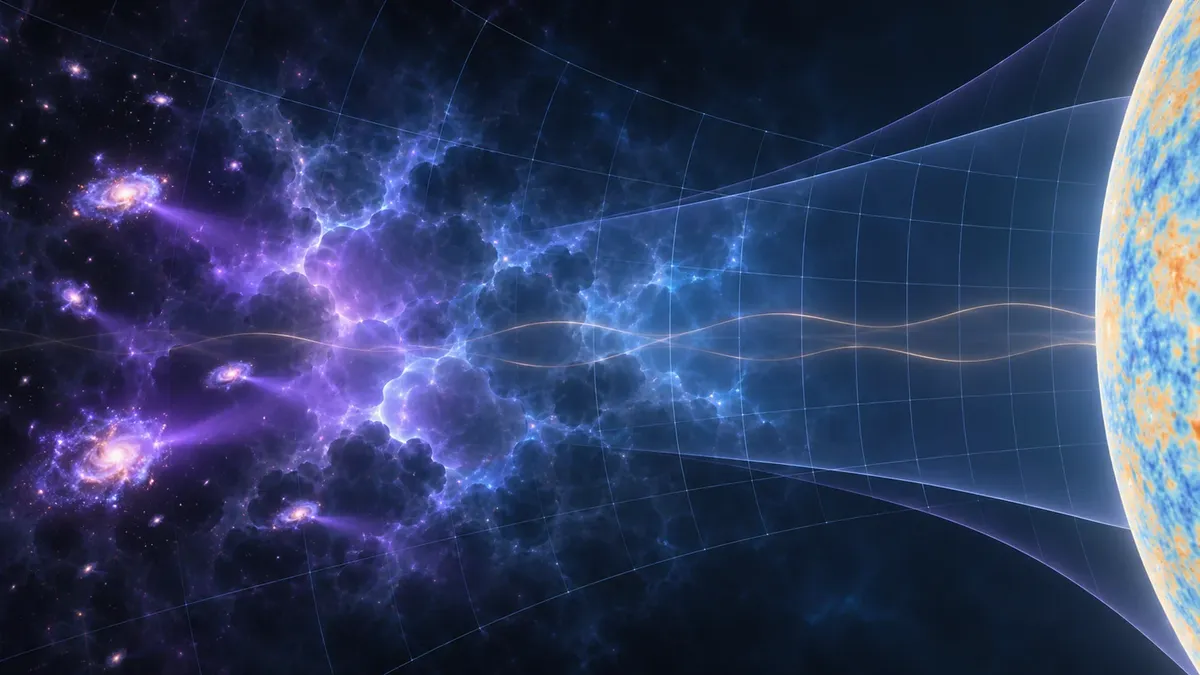
JWST-informed models of early galaxies can imply more early ionization than the cosmic microwave background measurements favor. Researchers test whether changing the assumed history of cosmic expansion can narrow that gap—without changing their reionization recipe.
The first stars and galaxies released ultraviolet light that gradually ionized hydrogen gas between galaxies, a process known as cosmic reionization. Its timing matters for the cosmic microwave background (CMB): free electrons scatter this ancient light, and the cumulative scattering is described by the Thomson optical depth, usually written as τ. A larger early population of ionizing galaxies can imply a higher optical depth than the value inferred from CMB observations. This raises a question: could the apparent mismatch partly reflect the assumed history of cosmic expansion, rather than the galaxies’ properties alone?
Subhadeep Mukherjee, Shashank Shekhar Pandey and A. S. Majumdar explore that possibility using an expansion history motivated by self-interaction (SI) gravity. In this framework, a phenomenological “depletion function” changes how matter contributes to cosmic expansion as structures form. The authors do not derive this function from a complete, first-principles theory of SI gravity; instead, they use a parameterized version to calculate a possible expansion history.
A changed background, with the same galaxy recipe
The researchers first constrain the model’s parameters with three kinds of observations: Type Ia supernova distances from the Union3 compilation, baryon acoustic oscillation (BAO) measurements from DESI’s second data release, and the CMB’s angular acoustic scale. They use Bayesian Markov chain Monte Carlo sampling to estimate which parameter combinations fit these data.
They then calculate how hydrogen becomes ionized over time and integrate the resulting free-electron density along the line of sight to obtain τ. The galaxy-based inputs—including ultraviolet luminosity functions, ionizing-photon production efficiency and photon escape fraction—are held to the same prescriptions in the SI-motivated and standard ΛCDM calculations. Because luminosity functions are inferred assuming a particular cosmology, the authors also remap them approximately for the modified expansion history, accounting for changes in distance and survey volume.
With those assumptions, the predicted optical depth falls from 0.0745 ± 0.0001 in ΛCDM to 0.0643 ± 0.001 in the SI-motivated background. The authors report that this changes the comparison with Planck PR3 from about 3σ to about 1.4σ: the model prediction is closer to the CMB result. The modified model produces only a slightly delayed reionization history, and its predicted neutral-hydrogen evolution is described as consistent with current JWST constraints over the observed redshift range. However, the paper also says that this history remains in tension with some independent measurements based on quasar damping wings, Lyman-alpha emitters and gamma-ray bursts.
Improvement is not the same as a verdict
The SI-motivated model achieves a better best fit to the combined supernova, BAO and acoustic-scale data. But it has more adjustable parameters. After accounting for model complexity using the Deviance Information Criterion, the difference between it and ΛCDM is nearly zero. The authors therefore find no significant statistical preference for the more complex model.
The optical-depth result is also conditional on modeling choices. The expansion history is prescribed phenomenologically, and the published galaxy luminosity functions are remapped approximately rather than recalculated from the original galaxy catalogues and survey-selection procedures. The acoustic-scale comparison assumes that early-universe physics and the sound horizon remain close to their standard values. The authors note that a more complete CMB analysis would require a self-consistent treatment of the model’s early-universe physics and perturbations.
In addition, the study does not directly fit the high-redshift reionization observations used for comparison. Its predicted optical depth follows from the expansion history constrained by supernovae, BAO and the CMB acoustic scale, together with the adopted galaxy prescriptions. A lower predicted τ therefore shows what this particular setup can yield, not that SI gravity has been established as the explanation for the discrepancy. Other changes to cosmic expansion could affect the same calculation.
The paper is a preprint prepared for submission to the Journal of Cosmology and Astroparticle Physics; the available source does not establish that it has been peer reviewed. Its findings are best read as a model-dependent investigation, not a resolution of the JWST–CMB question. The authors call for further tests, including a fuller treatment of cosmological perturbations and independent observations of reionization.
- cosmic reionization
- James Webb Space Telescope
- cosmic microwave background
- Thomson optical depth
- self-interaction gravity
- cosmology
Related reading
Automatically matched by shared topic keywords. These links do not imply that the sources agree or establish a consensus.
Could ancient magnetic fields have brought forward cosmic reionization?
Source published
Shared keywords: cosmic reionization
A late finish to cosmic reionization
Source published
Shared keywords: cosmic microwave background, cosmic reionization
Early Galaxies Narrow a Search for Neutrino Interactions
Source published
Shared keywords: cosmic microwave background, james webb space telescope
Can 21-cm maps trace reionization’s changing pattern?
Source published
Shared keywords: cosmic reionization
Can strong Lyα emitters stand in for the first galaxies?
Source published
Shared keywords: cosmic reionization