TRANSMISSION // 2608.03307v2
A hybrid cavity could let light read a molecule’s vibrations
Source published
A theoretical study proposes using a hybrid metal–dielectric cavity to strengthen Raman interactions with a single molecule. Its calculations predict split Raman lines and photon correlations that could reveal nonlinear features of molecular vibrations at relatively low incident powers. This is a model-based proposal, not an experimental demonstration.
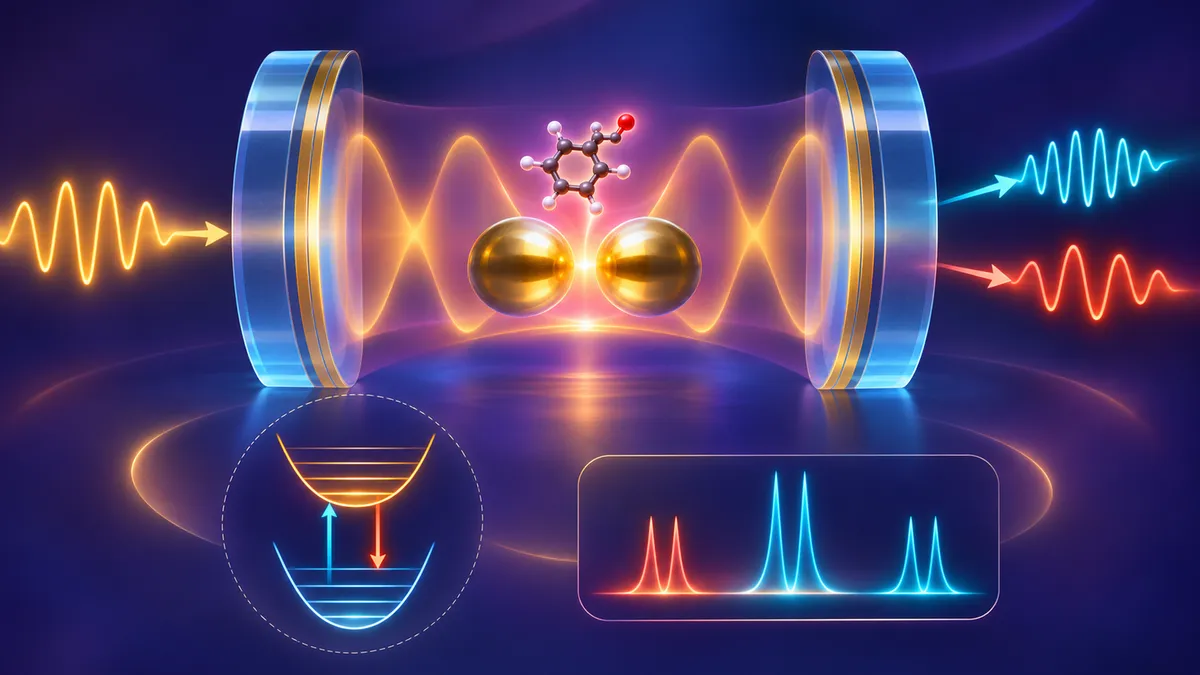
Raman spectroscopy reads molecular vibrations from the colors of scattered light. Yet an individual molecule interacts only weakly with light, and stronger illumination can risk sample damage. Could a carefully designed optical cavity boost that interaction enough to reveal more about a molecule’s vibrations?
The study by Miguel Á. Martínez-García, Johannes Feist and Diego Martín-Cano explores that question in surface-enhanced Raman scattering, or SERS. In SERS, a molecule near a metal nanostructure can scatter light more strongly than it would on its own. The authors propose a hybrid cavity combining a metallic dimer with a dielectric resonator. They investigate how this design could strengthen interactions among light, a molecular electronic transition and a vibration.
In a Raman process, scattered light can have less energy than the incoming light if it creates a vibration; this is called Stokes scattering. It can also have more energy if it takes energy from a vibration, producing anti-Stokes scattering. The spectral features carry information about molecular vibrations. If light and matter interact strongly enough, the features can split or shift instead of simply reflecting the vibration’s usual frequency.
Modeling a stronger interaction
The authors construct a quantum-optical model of a molecule with an electronic transition and a vibrational mode, coupled to a driven cavity and their respective sources of loss. They consider a laser-detuned electronic transition driven near saturation. Using a master-equation approach, they calculate emission spectra and frequency-resolved photon correlations. Their comparisons include a narrowband hybrid cavity, a broader plasmonic resonance, and models with additional off-resonant electronic levels.
The calculations predict resolved splittings in both the Stokes and anti-Stokes features for the narrow hybrid mode. As the drive increases, the split features also shift and broaden. The authors interpret these changes as signatures of coupled electronic and vibrational states, which they call laser-induced polarons—not merely an unchanged vibrational line.
The model also predicts correlations between Stokes and anti-Stokes photons: certain frequency pairs occur together more strongly than classical light would permit. The calculated correlations can violate the Cauchy–Schwarz inequality, a test the authors use to identify nonclassical photon statistics.
To explore whether the method could reveal a vibration’s nonlinear character, the researchers model an anharmonic vibration, whose energy levels are not evenly spaced like those of an ideal spring. In this scenario, the calculated correlations between pairs of Stokes photons vary with the modeled anharmonicity. At selected frequencies, the model predicts antibunching—a reduced likelihood of detecting photons in pairs. The authors suggest this could provide an optical signature of vibrational anharmonicity, using photon statistics as a probe alongside the Raman spectrum.
What the results do—and do not—show
These are theoretical calculations, not measurements from a fabricated cavity or a single molecule. The predicted splittings, correlations and vibrational signatures depend on the models and parameters used; they do not establish that the effects have been observed experimentally. The authors estimate that the proposed configurations could produce relevant signals at incident powers in the microwatt range, which they describe as far below damage thresholds cited for SERS experiments. That estimate does not guarantee that a real sample would avoid damage: outcomes depend on the molecule, materials, geometry and experimental conditions.
The paper also does not demonstrate that the predicted correlations can be measured reliably in a practical setup. Real devices and molecules may not match the modeled parameters, and losses and measurement constraints could affect the signals. The work offers a route to test, rather than a validated spectroscopy method: cavity design and photon-correlation measurements might reveal vibrational behavior if the needed coupling and coherence can be achieved.
This account is based on the supplied paper text. The work is presented as an arXiv preprint, which may not yet have undergone peer review, and the supplied evidence does not establish independent confirmation. The proposal is therefore best understood as a theoretical roadmap: engineered nanocavities may make scattered light sensitive not only to a molecule’s vibration, but also to its anharmonic behavior.
- SERS
- molecular vibrations
- hybrid plasmonic cavities
- quantum optics
- photon correlations
Related reading
Automatically matched by shared topic keywords. These links do not imply that the sources agree or establish a consensus.
How an electron’s quantum connection passes from an ion to light
Source published
Shared keywords: quantum optics
How photon-pair graphs make NOON states
Source published
Shared keywords: quantum optics
A staircase formula for a hidden quantum symmetry
Source published
Shared keywords: quantum optics
A Magnetic-Drive Proposal for Paired Quantum Emission
Source published
Shared keywords: quantum optics